









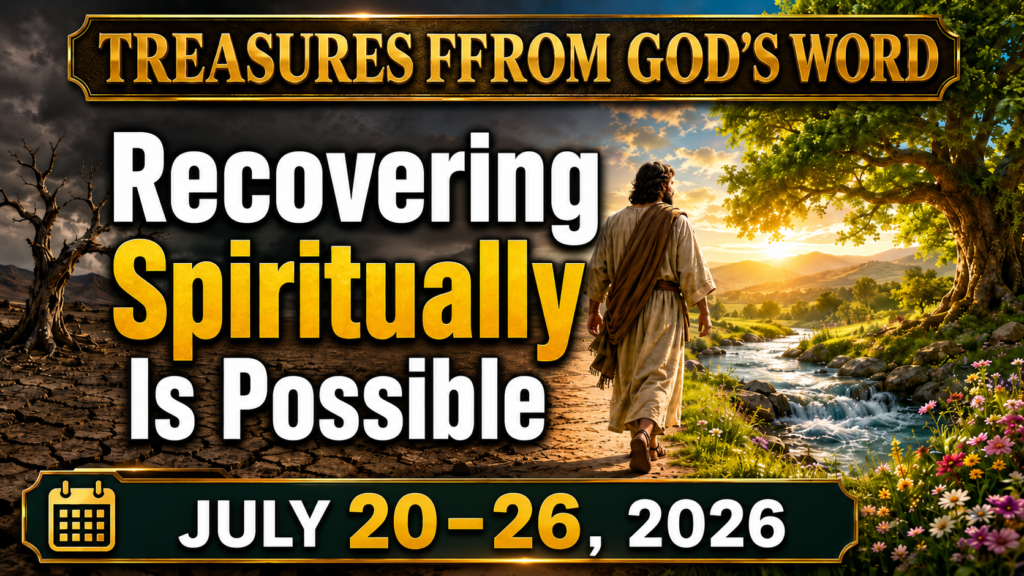
Theme: Spiritual Recovery Is Possible
Can a person change when he’s been doing something bad for a long time? Maybe someone thinks, I’ve fallen too many times, this defect is too ingrained in me, or I have no choice anymore. I might even believe that fighting to change is useless.
The inhabitants of Judah came to think that way. For many years they had been contaminated by false worship and by practices that Jehovah hated. His misconduct was deeply rooted. Even so, Jehovah did not immediately give up the people. He begged them to leave their wrong way and correct their behaviour.
This teaches us a very encouraging truth: even if someone has moved away spiritually or has been fighting a bad inclination for time, he can recover. Jehovah doesn’t expect us to think everything is lost. He wants us to accept his help and make the necessary changes.
The first point is this: although the inhabitants of Judah had deep-rooted evil practices, Jehovah begged them to correct their conduct.
Read Jeremiah 18:11 :
Now please tell the men of Judah and the inhabitants of Jerusalem, This is what Jehovah says: Am I preparing a calamity against you and thinking how to punish you. Please return from your wrong path and correct your behavior and your actions.
Jehovah announced that he was preparing a calamity against them. But let’s look at the tone of the warning. The Jehovah said, Please return from your evil way. I wasn’t looking forward to punishing them. I was giving them a chance to change.
To what extent was the misbehavior of Judah? The information explains that Baalism managed to entrench itself in that nation. Some faithful kings made efforts to eliminate false worship, but it reappeared.
King Asa tried to put an end to everything related to that form of worship. But years later, the influence of the Ahab family and Jezebel introduced tyrannical baiting into the royal family of Judah. Reforms were also made during the reign of Jehoah and, later, during Hezekiah. But none of them permanently eliminated the worship of Baal.
After Hezekiah’s death, his son Manasseh rebuilt the high places his father had destroyed. Although many kings of Judah were defiled with false worship, Manasseh went much further than the others in the practice of that degraded cult.
Manasseh later repented and made some reforms. Later, his grandson Josiah carried out an extensive cleansing of false worship. But as a nation, the people did not permanently regain true worship. Spiritual pollution had penetrated deep into them. Finally, the nation was punished with exile and the earth was desolate.
It might seem that such a serious situation no longer had a solution. But Jehovah continued to say unto them, “Come back from your evil way and correct your conduct and your actions.” That shows that, even if sin was deeply rooted, Jehovah was still willing to forgive them if they sincerely repented.
What a comforting this is for us. Jehovah doesn’t just see how long we’ve been struggling with a flaw. He also sees our sincere desire to change. Perhaps someone has been trying for years to control bad temper, avoid certain thoughts, abandon a harmful custom or correct a moral weakness. He may have moved forward, but then he tripped again.
In these circumstances, Jehovah does not say unto him, It is too late. He says, so to speak, “Go back from your evil way and correct your conduct.” Jehovah wants to help us change. But we have to accept its correction and act.
It’s not enough to recognize that something is wrong. The inhabitants of Judah were to correct their conduct and their actions. Similarly, real repentance produces concrete changes. We may have to cut off a damaging friendship, change the entertainment we consume, limit internet use, ask for help from the elderly or avoid situations that feed a bad inclination.
Jehovah can forgive us, but he hopes we will demonstrate with our actions that we really want to change.
However, how did the inhabitants of Judah react to the supplication of Jehovah? That brings us to the second point: they said it’s useless, but they were wrong.
Read Jeremiah 18:12 :
But they said, It is useless. For we will follow our own plans and we will all let ourselves be carried away by the stubbornness of our evil heart.
What a sad answer. Jehovah was offering them a way out. He told them they could come back and correct their behaviour. But they said, “It is useless.”
Maybe they thought they’d gone too far to change. Or maybe they just didn’t want to make the effort. Instead of fighting his bad inclination, they decided to follow their own plans and get carried away by the stubbornness of their heart.
Saying it’s useless can become a very dangerous excuse. A person might think, “I have always been so,” I cannot control this desire, I have tried to change and I have fallen again, or Jehovah will never forgive me. But that reasoning does not come from Jehovah.
Jehovah was telling them to change precisely because change was possible. He never asks for anything that is out of our odds with his help. The inhabitants of Judah were not condemned to remain evil. They could abandon their behavior, but they preferred to get carried away by their heart.
We must be careful not to hear a similar voice within us. Impfection can make us think: “You will not be able to overcome this bad desire. You don’t have enough strength. It’s not worth fighting anymore.
But we must not accept that idea. A stumble doesn’t mean the fight is lost. Even several relapses don’t mean it’s impossible to recover. The important thing is not to give up or voluntarily decide to follow the plans themselves.
Imagine someone who’s climbing a mountain. If he stumbles and falls, he might go back a few meters. But that doesn’t mean I have to go back to the starting point or abandon the rise. You can get up, learn from the fall and keep moving forward.
Similarly, if we make a mistake, we must analyze what led us to fall. We may need to strengthen our defences, ask for help or avoid certain circumstances. What we shouldn’t do is say: It’s useless, and stop fighting.
The third point confirms that change is possible: we can win the battle against sin; it is not a useless struggle.
Read Jeremiah 18:7, 8:
Whenever I talk about plucking, demolishing and destroying a nation or a kingdom and then that nation abandons the evil I spoke against, I will change my mind about the calamity I had thought of commanding Him.
These words show that Jehovah takes into account people’s reaction. If a nation against which he had spoken abandoned evil, Jehovah was willing to change his mind about the calamity he intended to send him.
This shows that Jehovah’s warnings are not intended to take away all hope. On the contrary, they seek to bring about change. Jehovah wants people to listen, to give up evil, and to be saved.
This idea also applies to our personal struggle against sin. The Bible says we should not let sin continue to tir – over us. The expression “rein” gives the idea of a ruler who completely controls his subjects. Even if we are imperfect, we do not have to allow sin to rule our life.
We may have bad desires, but we are not obliged to carry them out. There is a difference between feeling an incorrect inclination and deciding to act on it. With the help of Jehovah, we can reject it.
We may not be able to stop a bad thought from appearing, but we can avoid feeding it. We may feel a strong temptation, but we can move away from the situation, pray immediately, occupy the mind with something else or ask for help.
Jehovah knows we’re able to resist. Otherwise, I wouldn’t ask us to do it. He knows our limitations perfectly and never demands anything impossible for us. Besides, he doesn’t expect us to fight alone. It gives us his holy spirit, his Word, the prayer, the meetings and the support of mature brothers.
Let’s think of a fire. When it’s just started, maybe it can be off quickly. But if you let it grow, it can become a difficult fire to control. Something similar happens with bad wishes. If we reject them from the beginning, it will be easier to beat them. If we feed them with fantasies, inadequate entertainment or dangerous situations, they will get stronger.
That’s why we don’t wait until we fall to react. Let’s take action in advance. Let us identify what situations weaken us and make concrete plans to avoid them.
It is also important to strengthen love for Jehovah. The struggle against sin is not just about telling us constantly: I must not do this. It is more effective to remember: I love Jehovah and I do not want to do anything that harms my friendship with him. When the love for Jehovah grows, our desire to obey Him also grows.
Perhaps someone thinks that, after committing a serious sin, he will never be able to be spiritually well again. But Jeremiah’s message proves otherwise. The Jehovah offered the inhabitants of Judah the possibility to return, despite how entrenched his misconduct was.
Of course, recovering requires sincere repentance, humility and concrete changes. In some cases it will be necessary to talk to the elderly and accept their help. The process may take time. But it’s not useless.
Jehovah does not define a person solely because of his past mistakes. He also takes into account what he decides to do now. If he forsakes wickedness and returns to him, Jehovah is ready to show mercy.
So, if we’re fighting a weakness, let’s not hear the voice that says, “You can’t change.” Let us hear Jehovah, who says to us, Return from your evil way and correct your conduct.”
The inhabitants of Judah said, It is useless. But they were wrong. Change was possible. What was missing was the willingness to do so.
We don’t want to repeat your mistake. Although a bad habit is deeply rooted, even if we have stumbled more than once or even if progress is slow, we can continue to struggle. With the help of Jehovah, we can control evil desires, correct our conduct and restore our spiritual health.
Jehovah does not forsake him who repents with heart and strives to return to him. That’s why we never think we’re too far away, that we’ve failed too many times or that the fight is useless. Recovering ourselves in a spiritual sense is possible.
Discover more from Comentarios para la Reunión TJ
Subscribe to get the latest posts sent to your email.
Receive new posts by email
Create a free account or choose the ad-free plan. During registration, you can choose to receive new posts by email.
Register


