










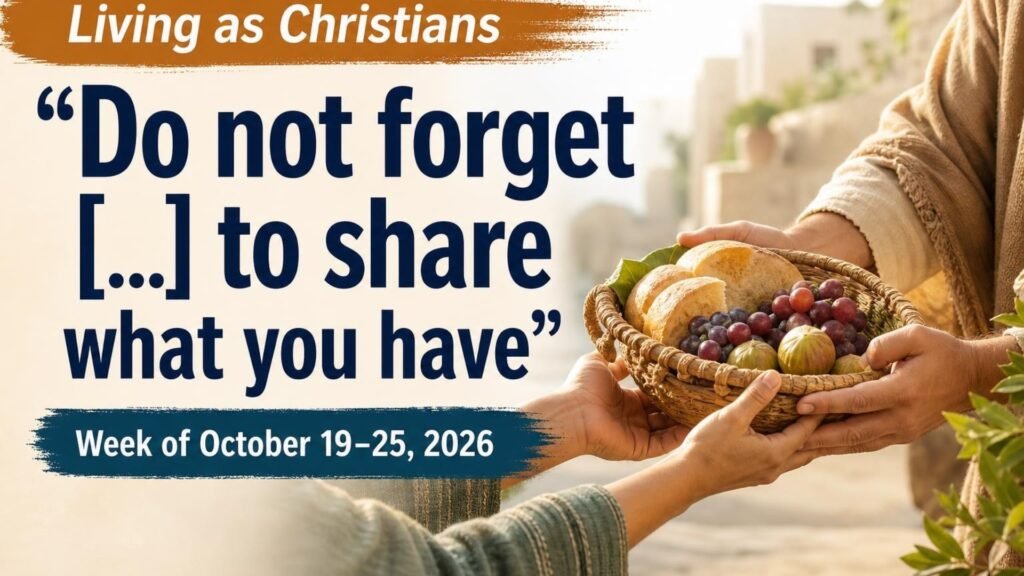
“Do not forget […] to share what you have”
How would Paul’s counsel benefit Christians who put it into practice?
Hebrews 13:16 — Moreover, do not forget to do good and to share what you have with others, for God is well-pleased with such sacrifices.
Comment 1: Putting this counsel into practice helped Christians view generosity as part of their worship. They were not simply helping out of obligation; they were making sacrifices that greatly pleased Jehovah.
Comment 2: When Christians shared what they had, no one had to face an urgent need alone. Thus, the congregation became a united family in which everyone felt the love and support of others.
Ephesians 4:28 — Let the one who steals steal no more; rather, let him do hard work, doing good work with his hands, so that he may have something to share with someone in need.
Comment 3: Paul’s counsel also gave dignity to those who were able to work. They not only obtained what they needed for themselves but also had the joy of having something to give to anyone in need.
Comment 4: Being generous protected Christians from focusing too much on their own things. Sharing helped them remember that material possessions are tools for doing good, not the most important thing in life.
Comment 5: In difficult times, the habit of sharing could make a big difference. Someone who had already learned to think of others would be more willing to help quickly and in practical ways.
1 Timothy 6:17-18 — Instruct those who are rich in the present system of things not to be arrogant, and to place their hope, not on uncertain riches, but on God, who richly provides us with all the things we enjoy. Tell them to work at good, to be rich in fine works, to be generous, ready to share,
Comment 6: This counsel especially benefited those who had more resources. It reminded them not to put their trust in riches but to use what they had to do good and strengthen others.
Comment 7: Generosity also produces joy. A person who shares may not have much, but he experiences the satisfaction of knowing that he eased a burden and showed Christian love in a concrete way.
Comment 8: The brothers who received help obtained more than what they needed. They also saw that Jehovah was caring for them through the congregation, and this could greatly strengthen their faith.
Comment 9: Sharing helped prevent divisions between brothers with different economic circumstances. Instead of emphasizing differences, everyone could focus on the love that united them.
Comment 10: Paul’s counsel taught Christians to be prepared. If we learn to live generously when things are going well, it will be more natural to respond lovingly when an unexpected need arises.
Comment 11: The picture of families sharing supplies during an emergency reminds us that sometimes something simple can be very valuable: food, water, transportation, or simply a safe place.
Comment 12: It also benefited young ones. When they see adults gladly sharing, they learn that happiness does not depend on keeping everything for oneself but on thinking of others.
Comment 13: In summary, obeying this counsel strengthened both the giver and the receiver. Material help met a need, but the love that accompanied it strengthened the entire congregation.
In view of what will happen in the future, why is it important that we learn now to share what we have?
Comment 1: Future difficulties may require us to depend more on one another. Learning now to share prepares our heart to act calmly, lovingly, and generously when real needs arise.
Hebrews 13:16 — Moreover, do not forget to do good and to share what you have with others, for God is well-pleased with such sacrifices.
Comment 2: Paul says that we should not forget to share. This indicates that generosity must be cultivated. If we practice it now, doing good will not seem strange when circumstances become more difficult.
Comment 3: We do not know exactly what needs may arise, but we can develop a willing spirit. For example, we can get used to using our resources while also thinking about the well-being of the brothers.
Comment 4: In an emergency, we may not be able to give much. But if we have already learned to share, we will not think first of accumulating things for ourselves; we will look for ways to ease the burden of others.
Comment 5: The scene of two families sharing what they carry in their emergency backpacks helps us visualize this. Preparing does not mean isolating ourselves but being ready to care for our brothers too.
Comment 6: Learning now to share also helps us simplify our life. If we are not overly attached to things, it will be easier to adapt and put people’s needs above possessions.
1 Timothy 6:17-18 — Instruct those who are rich in the present system of things not to be arrogant, and to place their hope, not on uncertain riches, but on God, who richly provides us with all the things we enjoy. Tell them to work at good, to be rich in fine works, to be generous, ready to share,
Comment 7: This text encourages us not to put our hope in uncertain riches. Cultivating generosity now shows that our security is in Jehovah, not in the amount of things we manage to store up.
Comment 8: When a trial comes, our habits speak for us. If we are normally considerate, hospitable, and generous, we will be more likely to react immediately and not let fear dominate our decisions.
Comment 9: Sharing now strengthens bonds of trust in the congregation. Thus, if we ever need help, we will all know that we belong to a brotherhood that lovingly cares for one another.
Comment 10: This includes teaching children to share. The video shows that a simple lesson can help them understand that not everything has to be “mine”; they can learn to enjoy giving priority to someone else.
Comment 11: Preparing for the future involves more than having supplies. It also means preparing our mind and heart to cooperate, be flexible, and gratefully accept the help others may offer us.
Comment 12: If we begin with small acts of generosity today, we will develop a quality that will be very necessary in any circumstance. Jehovah can use those acts to give others encouragement and peace of mind.
Comment 13: Generosity learned now helps us look to the future with faith, not selfishness. We trust that Jehovah will care for his people, and we want to be willing to be part of that care.
What do we learn from the good example of the congregations of Macedonia?
2 Corinthians 8:2-4 — During a great test under affliction, their abundance of joy and their deep poverty made the riches of their generosity abound. For it was according to their means, yes, I testify, it was even beyond their means, while they on their own initiative kept earnestly begging us for the privilege of kindly giving, to have a share in the relief ministry for the holy ones.
Comment 1: The Macedonians showed that generosity does not depend on having abundance. Although they were undergoing a severe trial and were poor, they joyfully gave to help their brothers.
Comment 2: I am impressed that they did not wait for their circumstances to be perfect. They looked for ways to contribute within their means, showing very strong faith and sincere love.
Comment 3: They gave voluntarily. They apparently did not need pressure or insistence; they understood that taking part in the relief work was an honor. That spirit makes generosity especially beautiful.
2 Corinthians 8:2 — During a great test under affliction, their abundance of joy and their deep poverty made the riches of their generosity abound.
Comment 4: Their poverty did not extinguish their joy. This teaches us that a person may have little materially and yet be rich in love, faith, and willingness to support others.
Comment 5: The congregations of Macedonia did not compare what they could give with what others might contribute. They simply did what was within their reach. That is a very balanced model for us.
Comment 6: Their example encourages us not to think that a small gift has little value. Jehovah sees the spirit with which we give and can make even a modest contribution accomplish much good.
Comment 7: We also learn that trials can bring good qualities to the surface. Instead of withdrawing into their own problems, the Macedonians remained attentive to the needs of other Christians.
Comment 8: They gave even more than was expected of them. This does not mean acting without balance, but having a heart willing to make reasonable sacrifices out of love for Jehovah and the brothers.
Comment 9: Macedonian generosity was connected with joy. When we give willingly, we do not feel that we are losing something; we feel that we are taking part in an act of love that honors Jehovah.
Comment 10: Their example can help us avoid using our limitations as an excuse. Although we cannot do everything, we can almost always do something: offer time, encouragement, hospitality, or practical help.
Comment 11: The Macedonians viewed the relief work as a privilege. We too can consider it an honor to support the needs of our brothers rather than view it as a burden.
Comment 12: This account shows that Jehovah values a generous heart more than the amount given. What matters is that our love moves us to contribute gladly and within our means.
Comment 13: Their good example invites us to ask, “What can I do?” That humble question may lead us to discover opportunities to share that we had not previously considered.
Besides material things, what else can we share?
Comment 1: We can share our time. Visiting someone, accompanying him to an appointment, or sitting and listening to him can be very valuable help, especially for someone who feels lonely.
Comment 2: We also share encouragement. A timely message, a phone call, or Bible-based words can lift the spirits of a brother facing a difficult situation.
Comment 3: We can share our experience. Someone may need to learn a practical skill or receive help with organizing himself. Patiently teaching him can greatly lighten his load.
1 Timothy 6:17-18 — Instruct those who are rich in the present system of things not to be arrogant, and to place their hope, not on uncertain riches, but on God, who richly provides us with all the things we enjoy. Tell them to work at good, to be rich in fine works, to be generous, ready to share,
Comment 4: Being rich in fine works includes many ways of giving that cost no money. We can use our strength, abilities, and energy to do good to those around us.
Comment 5: Hospitality is another way to share. Sometimes all that is needed is to offer a simple, pleasant setting where someone feels loved, included, and supported by the congregation.
Comment 6: We can share attention. Listening without rushing to give advice shows genuine interest. For a worried person, feeling heard can be a very comforting gift.
Comment 7: Parents can share time and teaching with their children. In the video, the mother uses an everyday situation to teach Caleb and Sophia a simple lesson about sharing.
Comment 8: We can also share responsibilities. Helping an older brother, a family with difficulties, or someone who is ill with a practical task shows love in a very real way.
Comment 9: We share hope when we speak with conviction about Jehovah’s promises. A timely Bible comment can help a brother regain the strength to keep enduring.
Comment 10: We can share our good example. When we willingly yield, give thanks, or think of others first, we teach without many words and encourage others to imitate that attitude.
Comment 11: Prayer is also a way to show concern. Although we cannot solve all of a brother’s problems, we can remember his needs before Jehovah and let him know that we care.
Comment 12: Sometimes we share something as simple as useful information or transportation. Such help may seem small, but at the right moment it reflects great love and Christian consideration.
Comment 13: Not all of us have the same resources, but all of us can give something. If we are attentive, we will find ways to share our kindness, time, and strength with others.
Jehovah shares his things. What does this teach us?
Comment 1: The video teaches that Jehovah did not keep all the animals for himself. He allowed Adam to care for them. This shows that Jehovah is generous and enjoys giving good things.
Comment 2: Jehovah does not share reluctantly. His generosity springs from love. That is why we want to imitate him and learn to give gladly, not because someone forces us.
1 Timothy 6:17-18 — Instruct those who are rich in the present system of things not to be arrogant, and to place their hope, not on uncertain riches, but on God, who richly provides us with all the things we enjoy. Tell them to work at good, to be rich in fine works, to be generous, ready to share,
Comment 3: Jehovah richly supplies us with the things we enjoy. Recognizing this helps us see that what we have is a gift from him and moves us to use it generously to do good.
Comment 4: The question asked in the video helps the children reason. If Jehovah shares, we too do not want to cling to everything as though it belonged only to us; we want to reflect his personality.
Comment 5: Imitating Jehovah means considering the needs of others. Before thinking, “This is mine,” we can ask ourselves, “Is there someone with whom I could share it or whom I could help?”
Comment 6: Jehovah also teaches us to trust. When we share in a balanced way, we show that we believe he can continue caring for us and providing what we need.
Comment 7: Jehovah’s generosity is personal: He wants us to enjoy his gifts. Similarly, when we share, we sincerely want the other person to benefit and be happy.
Comment 8: In the video, the children go from arguing over their gifts to taking turns. This lesson shows that sharing not only prevents conflicts but also makes it possible for everyone to enjoy more.
Comment 9: Jehovah shares and at the same time entrusts responsibilities. Allowing Adam to care for the animals teaches us that we can be generous by giving others opportunities and showing trust in them.
Comment 10: His example moves us to be especially generous in the family. If children see adults sharing joyfully, they will better understand that giving produces happiness.
Comment 11: Imitating Jehovah does not require spectacular actions. Often it is shown by simple details: lending something, giving up a seat, offering help, or giving priority to someone else.
Hebrews 13:16 — Moreover, do not forget to do good and to share what you have with others, for God is well-pleased with such sacrifices.
Comment 12: Sharing is a way to imitate Jehovah and offer him a sacrifice that pleases him. Thus, our generosity becomes a practical expression of our love for him.
Comment 13: Jehovah’s example teaches us that giving does not impoverish us. On the contrary, it makes us more like our heavenly Father and helps those around us feel cared for and loved.
Discover more from Comentarios para la Reunión TJ
Subscribe to get the latest posts sent to your email.
Receive new posts by email
Create a free account or choose the ad-free plan. During registration, you can choose to receive new posts by email.
Register


