










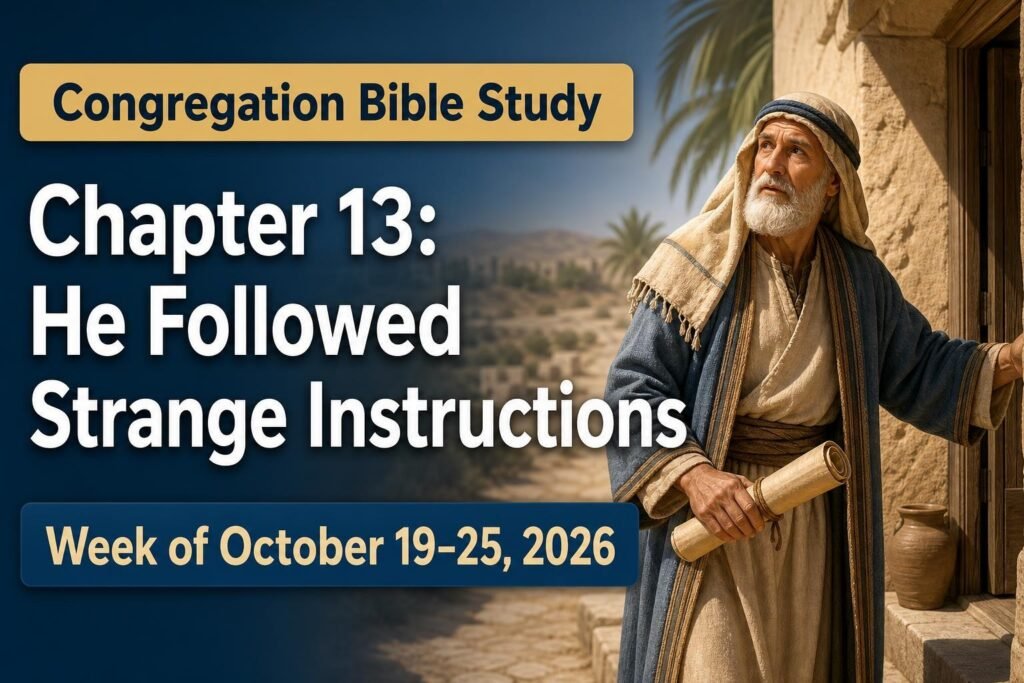
Chapter 13: He Followed Strange Instructions
In what ways did Joshua show courage?
Comment 1: Joshua showed courage by accepting the assignment to lead Israel against Jericho, an important and well-protected city. He did not allow the huge walls or the possibility that other cities would be emboldened to paralyze him. He trusted that Jehovah would fulfill what He had said.
Comment 2: He was also courageous because he obeyed a strategy that did not seem logical from a military standpoint. He ordered the people to march around the city just as Jehovah had instructed, even though he had experience in warfare and could have thought of another method.
Comment 3: Joshua had to give clear instructions and keep doing so day after day. Leading all the people silently around Jericho required faith, patience, and courage. His example shows that being courageous does not always mean acting in a spectacular way; often it means obeying consistently.
1. What inspired writings did Joshua likely have available? (w09 12/1 17 par. 4, footnote)
Comment 1: Joshua likely had available the inspired books that had already been written by that time. Among them was the Law that Jehovah had given through Moses. Therefore, he could know Jehovah’s instructions and find in them the strength he needed.
Comment 2: It was not enough for Joshua simply to have those writings. Jehovah had instructed him to obey carefully all the Law that Moses had commanded him. So he had to read it, meditate on it, and allow it to guide his decisions.
Comment 3: The inspired writings could remind Joshua of how Jehovah had dealt with His servants in the past and how He had fulfilled His promises. That gave him a solid basis for trusting Jehovah when he faced new situations.
Comment 4: We too gain strength from God’s Word, but only if we use it. Personal study and family worship help us to keep Bible principles in mind before trials or difficult decisions arise.
2. What did Jehovah ask Joshua to do before the Israelites marched around Jericho? And why did those instructions seem illogical? (Josh. 5:2-8; w18.10 23 pars. 5-7)
Joshua 5:2-8 — At that time Jehovah said to Joshua: “Make for yourself flint knives and circumcise the men of Israel again, a second time.” So Joshua made flint knives and circumcised the men of Israel at Gibeath-haaraloth. This is why Joshua circumcised them: All the males of the people who left Egypt, all the men of war, had died in the wilderness on the journey after they left Egypt. All the people who left Egypt were circumcised, but all the people born in the wilderness on the journey after they left Egypt were not circumcised. The Israelites had walked for 40 years in the wilderness until the entire nation had died off, that is, the men of war who left Egypt who did not obey the voice of Jehovah. Jehovah swore to them that he would never let them see the land that Jehovah had sworn to their forefathers to give to us, a land flowing with milk and honey. So he raised up their sons instead of them. These Joshua circumcised; they were uncircumcised because they had not circumcised them during the journey. When they finished circumcising the entire nation, they remained where they were in the camp until they recovered.
Comment 1: Jehovah asked Joshua to circumcise the men of Israel. From a human standpoint, it seemed like an inopportune time, because the soldiers would need several days to recover and would not be in a condition to fight.
Comment 2: The Israelites may have worried about the safety of their families while the men recovered. But obeying this instruction showed that their protection did not depend on being militarily prepared, but on Jehovah.
Joshua 5:13-15 — When Joshua was near Jericho, he looked up and saw a man standing in front of him with a drawn sword in his hand. Joshua walked up to him and asked: “Are you on our side or on the side of our adversaries?” To this he said: “No, but I have come as prince of Jehovah’s army.” With that Joshua fell with his face to the ground and prostrated himself and said to him: “What does my lord have to say to his servant?” The prince of Jehovah’s army replied to Joshua: “Remove your sandals from your feet, because the place where you are standing is holy.” At once Joshua did so.
Comment 3: Joshua’s meeting with the prince of Jehovah’s army confirmed that Jehovah was supporting His people. Joshua reacted with deep respect and was willing to receive instructions. This prepared him to obey even though he did not understand every detail.
Comment 4: Soon afterward, Jehovah commanded them to march around Jericho instead of attacking it immediately. It was not the strategy one would expect from an army, but it made clear that the victory would come from Jehovah, not from human ability.
Comment 5: It is significant that the men of Jericho did not attack. The city remained closed, and this surely strengthened Israel’s confidence. When we follow Jehovah’s guidance, we sometimes see over time why it was wise to obey.
Comment 6: This account teaches us not to measure the wisdom of an instruction solely by our experience or by what seems most practical. Jehovah sees the complete picture, and His directions always lead to the best outcome.
Comment 7: Joshua’s obedience was calm and complete. He did not argue about the instructions or try to modify them. That humble attitude helps us to trust Bible-based guidance even when we do not know all the reasons.
3. What evidence is there that the Israelites besieged Jericho for only a short time before conquering it? (w15 11/15 13)
Joshua 6:10-15,20 — Now Joshua had commanded the people: “Do not shout nor let your voices be heard. Not a word should come out of your mouths until the day I say to you, ‘Shout!’ Then shout.” He had the Ark of Jehovah go around the city, going around it once, after which they returned to the camp and spent the night there. The next morning Joshua got up early, and the priests took up the Ark of Jehovah, and seven priests carrying seven ram’s horns walked before the Ark of Jehovah, continuously blowing the horns. The armed troops were walking ahead of them while the rear guard was following the Ark of Jehovah as the horns were blown continuously. They marched around the city on the second day once, after which they returned to the camp. That was what they did for six days. On the seventh day they got up early, as soon as the dawn broke, and they marched around the city in the same manner seven times. It was only on that day that they marched around the city seven times. Then the people shouted when the horns were blown. As soon as the people heard the sound of the horn and shouted a great war cry, the wall fell down fl at. After that the people went up into the city, each one straight ahead, and they captured the city.
Comment 1: The account clearly indicates that the Israelites marched once a day for six days and seven times on the seventh day. After that, the wall fell and they conquered the city. Therefore, the siege did not last for months.
Comment 2: Excavations at Jericho uncovered large quantities of grain among the ruins. This is important because during a long siege, the inhabitants would have consumed their food supplies before the city fell.
Comment 3: The discovery of so much grain fits the Bible’s information that the attack took place shortly after the harvest, when food was abundant. Thus, the archaeological evidence harmonizes with a brief siege.
Comment 4: Normally, conquerors took whatever food remained in a conquered city. However, Jehovah had commanded the Israelites not to take what was devoted to destruction. That explains why grain remained.
Comment 5: This detail strengthens our confidence in the accuracy of the Bible account. The Bible does not present an imprecise version of events; rather, its details agree with what was found in the ruins.
Comment 6: The rapid conquest also highlighted that Jehovah was the one who gave Jericho to Israel. It was not the result of prolonged military attrition, but of the people’s obedience and Jehovah’s power.
Comment 7: We can appreciate that Jehovah preserved in His Word details that allow the truthfulness of the account to be verified. This encourages us to study carefully and base our faith on solid evidence.
4. How was the prophecy at Joshua 6:26 about Jericho fulfilled? (w98 9/15 21 par. 8)
Joshua 6:26 — At that time Joshua pronounced this oath: “Cursed be the man before Jehovah who undertakes to rebuild this city of Jericho. At the cost of his firstborn he will lay its foundation, and at the cost of his youngest he will put up its doors.”
Comment 1: Joshua pronounced an oath concerning the rebuilding of Jericho. He specified that whoever rebuilt it would suffer the loss of his firstborn son when laying its foundation and of his youngest son when putting up its doors.
1 Kings 16:34 — In his days, Hiel the Bethelite rebuilt Jericho. At the cost of Abiram his firstborn he laid its foundation, and at the cost of Segub his youngest he put up its doors, according to the word of Jehovah spoken through Joshua the son of Nun.
Comment 2: About 500 years later, Hiel the Bethelite rebuilt Jericho. The account shows that he lost Abiram, his firstborn, when laying its foundation, and Segub, his youngest, when putting up its doors. Thus, Jehovah’s word was fulfilled exactly.
Comment 3: The fulfillment confirms that Jehovah’s words are not mere human predictions. He can make what He has said come true, even long after a prophecy was pronounced.
Comment 4: This case strengthens our confidence in all of Jehovah’s promises. If He fulfilled a statement made centuries earlier, we can be certain that He will also fulfill everything He has promised for the future.
Comment 5: It also reminds us of the importance of taking Jehovah’s word seriously. His warnings and promises are always reliable, so it is wise to adjust our life to His guidance.
Why did Joshua trust in Jehovah’s promises? (Josh. 23:14) How can we have trust like his?
Joshua 23:14 — “Now look! I am about to die, and you well know with all your heart and with all your soul that not one word out of all the good promises that Jehovah your God has spoken to you has failed. They have all come true for you. Not one word of them has failed.
Comment 1: Joshua trusted in Jehovah because he had personally seen His promises fulfilled. At the end of his life, he could say that not one of Jehovah’s good promises had failed.
Comment 2: He had seen Jehovah protect Israel, allow them to cross the Jordan, and give them Jericho. Remembering those experiences helped him trust Jehovah when the instructions seemed strange or circumstances were difficult.
Comment 3: We can develop similar trust by reviewing how Jehovah has fulfilled His promises recorded in the Bible and by remembering how He has supported us. Meditating on that evidence strengthens our faith to face the future.
How does Joshua’s example help us to follow instructions received from Jehovah’s organization?
Comment 1: Joshua did not evaluate Jehovah’s instructions solely from a human point of view. Although marching around Jericho seemed strange, he obeyed. His example helps us to trust in guidance that is in harmony with God’s Word.
Comment 2: Joshua’s obedience was complete: He did what he was told and helped the people to do it unitedly. We too contribute to unity when we willingly cooperate with the instructions we receive.
Comment 3: At times, we may not immediately understand the reason for a practical direction. Joshua teaches us to be patient, humble, and trusting rather than allowing personal preferences to prevent us from cooperating.
In what ways can you imitate Joshua’s courageous example?
Comment 1: We can imitate Joshua when we do what is right even though we feel afraid. He had to face a fortified city, but he did not allow the danger to become more important than his trust in Jehovah.
Comment 2: We also show courage by obeying Bible principles in situations where others may not understand them. Joshua obeyed unusual instructions because he knew they came from Jehovah.
Comment 3: Another way to imitate him is to remember the help Jehovah has already given us. When we review the evidence of His care, we gain encouragement to press on and courageously do what He expects of us.
What does this account teach me about Jehovah?
Comment 1: The account teaches that Jehovah fulfills His promises. He had said that He would give that land to Israel, and at Jericho He showed that He had the power to make it happen, even though the city seemed impossible to conquer.
Comment 2: Jehovah is patient and just. He had waited until the error of the Amorites reached its limit. His judgment against Canaan was not impulsive; it was related to the detestable practices they carried out.
Comment 3: We also see that Jehovah strengthens those who obey Him. He gave Joshua reasons to trust Him and directed Israel in a way that made clear that the victory came from His power.
How does this account relate to Jehovah’s purpose and the main theme of the Bible?
Comment 1: The entry into the Promised Land was part of the fulfillment of what Jehovah had promised Abraham. Jericho shows that Jehovah moves steadily toward the fulfillment of His purpose.
Comment 2: The clearing of Canaan protected the people of Israel from detestable practices that could turn them away from Jehovah. In this way, the people through whom the promises concerning Abraham’s offspring would be fulfilled were preserved.
Comment 3: The account also highlights the theme of Jehovah’s sovereignty. He demonstrated that He has the right and the power to direct His people, and that those who trust in Him can be certain that He will fulfill His purpose.
What would I like to ask Joshua when he is resurrected?
Comment 1: We might ask him what he felt when he received Jehovah’s instructions about Jericho and what helped him obey so decisively. His answer would surely strengthen our confidence in Jehovah’s guidance.
Comment 2: It would also be interesting to ask him how he encouraged the people during those seven days. Joshua had to help many Israelites maintain unity and obedience while they waited for Jehovah to act.
Comment 3: Perhaps we would want to know what experiences he remembered when he needed courage. Joshua saw much evidence of Jehovah’s power, and it would be very encouraging to hear how those experiences strengthened his faith.
Discover more from Comentarios para la Reunión TJ
Subscribe to get the latest posts sent to your email.
Receive new posts by email
Create a free account or choose the ad-free plan. During registration, you can choose to receive new posts by email.
Register


