










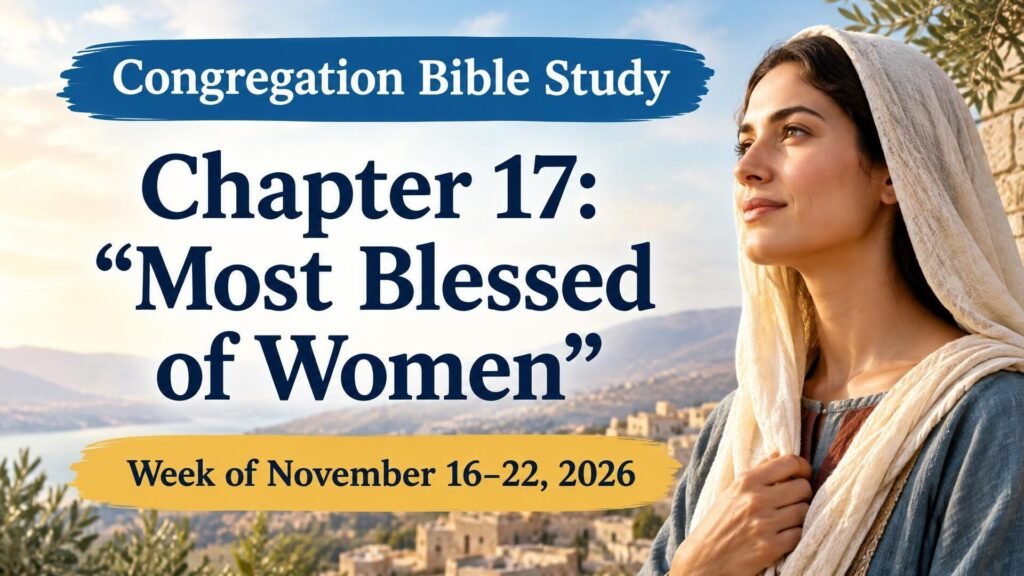
Chapter 17: “Most Blessed of Women”
How did Jael show courage?
Comment 1: Jael showed courage by taking Jehovah’s side, even though her husband maintained peaceful relations with Jabin. Sisera assumed that he would find refuge in that camp, but Jael did not let Heber’s alliance decide for her. She knew that Sisera was an enemy of Jehovah and acted accordingly. Her courage consisted not only in confronting a dangerous man but also in taking a clear stand for Jehovah when she had the opportunity.
Comment 2: She was also courageous because she recognized the danger before her. Sisera was an experienced warrior, and Jael could not confront him as if she were another soldier. So she acted carefully and used what she had at hand. The chapter indicates that one mistake could have cost her life. This helps us see that what she did was neither easy nor risk-free: She did what she knew Jehovah expected of her in a very difficult situation.
Comment 3: What impresses me is that Jael turned her decision into action. She did not merely recognize that Sisera was wicked or let the opportunity to support Jehovah pass by. When the moment came, she acted decisively. We do not imitate her military action, because our fight is spiritual. But we can imitate her willingness to do what is right. Knowing whose side we are on is important; showing it by our decisions, especially when doing so is difficult, also requires real courage.
1. What connection is there between Sisera’s battle and the war of Armageddon? (w19.09 8, 9 pars. 3-6)
Comment 1: The connection has to do with the victories that Jehovah gave his people in the region of Megiddo. There he helped Barak defeat Sisera’s army, even though the Canaanites seemed to have an enormous military advantage. The name Armageddon reminds us of those interventions by Jehovah. So we are not talking simply about a geographical coincidence but about a reason to trust: The God who defeated those enemies will also achieve a complete victory in his final war.
Comment 2: It is important to distinguish between Megiddo, which was a city, and Armageddon, which is not a literal battlefield. The reference explains that Armageddon is the situation in which the kings of the earth are gathered against Jehovah. There is no mountain of Megiddo where all those armies could assemble. Moreover, the attack on God’s servants will be worldwide. The connection with Sisera’s battle helps us understand the outcome, not identify a physical location.
Comment 3: There is an important similarity in the outcome. The song of Barak and Deborah expressed the desire that Jehovah’s enemies disappear and that those who loved him enjoy his favor. At Armageddon, too, Jehovah’s enemies will be eliminated and those who love him will be saved. Therefore, remembering this battle does not have to fill us with fear. It enables us to focus on Jehovah’s ability to end wickedness and protect his servants.
Comment 4: An essential difference is that the Israelites did fight against Sisera’s army, whereas at Armageddon Jehovah’s servants will not fight or carry weapons. The reference emphasizes that our strength will depend on remaining calm and trusting in Jehovah and his heavenly armies. So the courage we need to cultivate now is not military courage. It is the confidence that enables us to obey Jehovah without being dominated by fear, even when the situation seems threatening.
Job 38:22-23 — Have you entered the storehouses of the snow, Or have you seen the storehouses of the hail, Which I have reserved for the time of distress, For the day of battle and war?
Comment 5: This passage from Job shows that Jehovah has at his disposal forces of nature that he can use in a time of war. This fits the account of Sisera, whose army was swept away by the torrent of the Kishon. The reference mentions that Jehovah could use hail or other means at Armageddon, but it does not claim that we know all the details. What we do know is that no human weapon can prevent Jehovah from carrying out his purpose.
Comment 6: We do not need to know exactly how Jehovah will defeat his enemies. The reference mentions several possibilities, such as forces of nature, confusion among the adversaries, or angelic intervention. But what is certain is not a specific method but Jehovah’s victory. Sisera’s defeat helps us trust in that outcome without speculating.
2. Heber, Jael’s husband, had allied himself with the Canaanites—who were enemies of Israel—even though there was a connection between him and the Israelites. What was that connection? (it “Heber” No. 2)
Comment 1: The connection was familial and went back to the days of Moses. Heber was a Kenite and a descendant of Hobab, Moses’ father-in-law. Thus, he did not belong to a people with no connection to Israel. The Kenites had an ancient connection with the Israelites and were generally their allies. Knowing about this relationship helps us appreciate the contrast highlighted by the chapter: Heber maintained peaceful relations with Jabin the Canaanite king, even though his people had good ties with Israel.
Judges 4:11,17,21 — Incidentally, Heber the Kenite had separated from the Kenites, the descendants of Hobab, Moses’ father-in-law, and his tent was pitched near the big tree in Zaanannim, which is at Kedesh. But Sisera fled on foot to the tent of Jael the wife of Heber the Kenite, for there was peace between Jabin the king of Hazor and the house of Heber the Kenite. But Jael the wife of Heber took a tent pin and a hammer in her hand. Then while he was fast asleep and exhausted, she stealthily approached him and drove the pin through his temples and beat it into the ground, and he died.
Comment 2: These verses connect Heber’s family relationship with what happened afterward. First, they explain that he had separated from the other Kenites, descendants of Moses’ father-in-law. Then they point out that his household was at peace with Jabin. That relationship explains why Sisera sought refuge there. But the end of the passage shows that Jael did not support Jehovah’s enemy. This helps us better understand both Sisera’s confidence when he arrived and the importance of the decision she made.
Comment 3: The chapter distinguishes between the Kenites in general and Heber in particular. The Kenites were allies of Israel and lived among the Israelites, but Heber had chosen to maintain peace with Jabin. Therefore, it would not be accurate to attribute his position to all his people. This detail clarifies the setting in which Jael had to decide.
3. Israel’s victory over Sisera and Jabin strengthened God’s people many years later. How? (w08 10/15 14, 15 pars. 12-15)
Comment 1: Many years later, the psalmist remembered that victory when asking Jehovah for help against other enemy nations. In Psalm 83 he asked Jehovah to act against them as he had acted against Sisera and Jabin. Thus, the account did not remain merely a memory of the past. It became a basis for praying with confidence. If Jehovah had already frustrated the plans of powerful enemies, the psalmist had good reason to trust that He could again protect his people.
Comment 2: The enormous disparity between the two armies made that victory especially strengthening. Sisera had 900 war chariots, whereas the Israelites were poorly equipped. Nevertheless, Jehovah threw the Canaanite army into confusion. Remembering these facts helped them not to measure their chances of survival solely by the number of soldiers or weapons. For God’s people, the decisive factor was not their own strength but having Jehovah’s help.
Comment 3: The reference also recalls Gideon’s victory with only 300 men. Although it was a different battle, it reinforced the same lesson as Sisera’s defeat: Jehovah can save his people even when their enemies are far more numerous. The psalmist therefore had several historical examples that fed his confidence and gave strength to his request.
Comment 4: This teaches me one way to strengthen my prayers. The psalmist did not focus only on the threat before him; he also remembered what Jehovah had done. We can follow that approach when a difficulty overwhelms us. Meditating on accounts like this helps us speak to Jehovah with his power in mind, not just our weakness. It does not mean expecting him to repeat exactly the same miracle, but remembering that no situation is beyond his ability to act.
Comment 5: This victory also strengthens us when we think about the future. The reference explains that the name Armageddon recalls the decisive battles fought near Megiddo. Jehovah won then, and those victories assure us that he will also win his final war. Thus, an event that encouraged the psalmist continues to help us today. We do not base our confidence on world problems being solved by human means, but on Jehovah’s ability to accomplish his purpose.
4. What can we highlight about the way Deborah honored Jael, and what do we learn from it? (w15 8/1 15 par. 2)
Comment 1: Deborah honored Jael without envying the recognition she received. Although Deborah was a prophetess and had played an important role in those events, she did not try to take credit away from what Jael had done. For Deborah, the main thing was that Jehovah’s word be fulfilled. This teaches us to rejoice when another brother receives recognition for his service. If what matters most to us is that Jehovah’s will be done, we do not need to feel that another person’s honor diminishes our own worth.
Judges 4:22 — Barak went there in pursuit of Sisera, and Jael now came out to meet him and said: “Come and I will show you the man you are looking for.” He went in with her and saw Sisera lying dead, with the tent pin through his temples.
Comment 2: When Barak entered the tent, he saw that Sisera had died at the hand of a woman. What Jehovah had announced through Deborah had come true. That is the context of the recognition Jael received: It was not a competition between individuals to gain the credit. Jehovah had fulfilled his word, and Barak and Deborah celebrated it. We too can focus on what Jehovah is accomplishing and rejoice in each brother’s contribution.
Comment 3: The honor Deborah gave Jael was in harmony with Jehovah’s view of her. The song was composed under divine guidance and highlighted that woman’s courage. Some commentators have criticized her, but Deborah did not present her as deserving censure. This reminds us to form our judgment on the basis of what Jehovah reveals. In this case, it is also important to remember the context: Jael acted in a war of Jehovah, not as a personal initiative of violence.
Comment 4: We can learn to express our appreciation, not merely feel it. Deborah and Barak included recognition of Jael in their victory song. In the congregation, we can specifically thank others for what they do, even when their work differs from ours. For example, we can acknowledge a quiet act of help or encouraging words. In this way we show that we value the faithful service of our brothers and are not comparing ourselves with them to see who stands out more.
Just as Jael needed courage, in what situations might a sister with an unbelieving husband need courage?
Comment 1: A sister might need courage to respectfully explain that she wants to continue attending meetings and sharing in the ministry, especially if her unbelieving husband does not understand those activities. Jael reminds us that our relationship with Jehovah requires a personal decision. The application would not be to treat the husband as an enemy, but to remain faithful without adopting a defiant attitude. Calmly explaining what is important to her and standing by her convictions may require much courage.
Comment 2: She might also need courage if she is asked to participate in something that violates her Bible-trained conscience. Perhaps she fears causing tension at home or disappointing her husband. Jael’s example can help her remember that pleasing Jehovah should guide her decisions. At the same time, our fight is spiritual, not a fight against family members. So she can clearly express what she cannot do while making sure that her words and treatment remain respectful.
Comment 3: Sometimes courage is not shown in one difficult conversation but by remaining faithful when support at home is limited. A sister may need it to maintain her Bible reading or continue looking for opportunities to serve Jehovah without becoming discouraged. Jael’s situation was not the same as that of a Christian today, but it does show that a person can choose to support Jehovah even when her husband has taken a different position. Such personal loyalty is very valuable.
Jael was neither a prophetess like Deborah nor a soldier like Barak. Yet she did what she could. What does her example teach us about how we view our limitations?
Comment 1: Jael did not need to have the same role as Deborah or Barak in order to make an important contribution. Her opportunity to support Jehovah was different, and she took advantage of it. This teaches me not to measure my usefulness by comparing myself with other brothers. I may not have their health, abilities, or responsibilities, but I can still do something valuable. The question is not whether I can do exactly what someone else does, but what is within my reach in my circumstances.
Comment 2: The illustration of the sister in a wheelchair helps put this idea into practice. She prepares a card and a financial gift, and the couple receiving the card smile as they read it. Her limitations do not prevent her from showing love or encouraging others. Similarly, we may be able to write, call, or show interest in someone even if we cannot move around easily. We do not have to do something remarkable to give support that is very valuable to another person.
Comment 3: Jael was realistic about what she could do. She did not try to confront Sisera like a trained soldier but used the resources available to her. We too do not have to deny our limitations or demand the impossible of ourselves. We can acknowledge them and at the same time look for ways to remain active in Jehovah’s service. Her example encourages us to avoid both extremes: thinking that we can do everything or concluding that, since we cannot do certain things, we have nothing to contribute.
In what other ways can you imitate Jael’s example of courage?
Comment 1: I can imitate her courage when I need to make my position as a servant of Jehovah clear. For example, if I am pressured at work or at school to do something wrong, I might be tempted to hide my convictions to avoid a negative reaction. Jael decided whose side she was on and demonstrated it. I can do the same peacefully, explaining my decision respectfully and maintaining it even if not everyone understands or agrees.
Comment 2: Another way is to act when I see an opportunity to do what is right instead of continually postponing it out of fear. Jael did not keep thinking indefinitely about how difficult her situation was. In my case, it might involve starting a conversation about the Bible or supporting a brother when doing so is difficult for me. This does not mean acting without thinking, but not allowing fear to prevent me from putting into practice a decision I know is right.
Comment 3: I can also imitate her by making good use of what I already have at hand. Sometimes a person waits to feel completely prepared before taking a step in Jehovah’s service. Jael acted with the resources she had, without occupying a prominent position. This encourages me not to make having greater abilities than I do now a condition. I can prepare as well as possible and take advantage of the opportunities that arise, remembering that what I imitate in her is her courage and loyalty, not her military action.
What does this account teach me about Jehovah?
Judges 4:9 — To this she said: “I will certainly go with you. However, the campaign you are going on will not bring you glory, for it will be into the hand of a woman that Jehovah will give Sisera.” Then Deborah got up and went with Barak to Kedesh.
Comment 1: This announcement and its fulfillment teach me that Jehovah always keeps his word. Before Sisera arrived at the tent, Jehovah had already communicated through Deborah that he would give him into the hand of a woman. Events unfolded according to what he had said. This strengthens my confidence in his promises. Even if I do not know how they will be fulfilled or cannot foresee every step, I have no reason to doubt that Jehovah can make what he announces come true.
Comment 2: It teaches me that Jehovah does not depend on resources that impress humans. Sisera had military experience and had commanded an army with 900 war chariots. Yet he ended up defeated, and Jehovah used one woman to bring about his end. This helps me put threats in perspective. Something may seem enormous from a human viewpoint, but it is never too great for Jehovah and cannot prevent him from accomplishing his will.
Comment 3: I also see that Jehovah values and recognizes loyalty. Jael was neither the prophetess nor the one directing the soldiers, but her contribution was highlighted in the inspired song. Jehovah did not overlook what she did. This encourages me to serve him without thinking that only the most visible tasks matter. The account shows that he can give importance to the actions of someone who does not hold a prominent position and make her good example continue benefiting others.
How does this account relate to Jehovah’s purpose and the main theme of the Bible?
Comment 1: The account shows that Jehovah can eliminate those who oppose him and protect his people. That victory fits Jehovah’s purpose to end wickedness, which is also reflected in what the reference explains about Armageddon. We should not turn every detail about Jael into a prophetic representation. The connection highlighted by the material is clear: Jehovah’s victories in the past give us confidence that he will defeat his enemies in the future.
Comment 2: It also relates to recognizing Jehovah’s authority. Jael had to choose whether she would favor the enemy seeking refuge or take Jehovah’s side. Her decision showed loyalty to him above the alliance her husband had made. This leads to a question that also affects us: Whom do we support by our conduct? It is not enough to recognize that Jehovah is powerful; we want to demonstrate that we accept his authority and desire to do his will.
Comment 3: The peace that followed the victory is also significant. The Bible account indicates that there was peace in the region for 40 years. Thus, defeating those enemies brought relief, not merely a change in military power. The reference to Armageddon likewise highlights that Jehovah’s enemies will disappear and the righteous will be saved. This helps us think about the result of divine intervention: Jehovah will not allow wickedness to threaten those who love him forever.
What would I like to ask Jael when she is resurrected?
Comment 1: I would like to ask her how she came to know Jehovah and became so sure that she wanted to take his side. The chapter explains the Kenites’ relationship with Israel, but it does not tell us every detail about Jael’s personal faith. I would not want to assume experiences that we do not know about. That is precisely why I would be interested in listening to her: to learn what she had learned about Jehovah and what helped her make such a firm decision when the opportunity arose.
Comment 2: I would ask her what helped her maintain her decision once Sisera was inside the tent. We know what she did, but the account does not describe all her thoughts or emotions. I would like to hear from her how she experienced that moment. Her answer might help me better understand the courage she showed. I would not ask merely out of curiosity, but because I too want to learn to do what is right when a situation is difficult or intimidating.
Comment 3: I would ask her when she learned what Jehovah had announced through Deborah. The chapter says that she may not have known that prophecy when she acted, so we cannot be certain. I would like to know how she found out that what happened fulfilled Jehovah’s word and how she received the recognition in the victory song. It would be wonderful to hear her perspective and tell her that, many centuries later, her example was still helping us to be courageous in our service to Jehovah.
Enjoy every Premium feature
More convenient meeting preparation with full access to the site’s tools.
- Ad-free browsing
- My Recorder and live transcription
- Assignment Review
- Full Academy access
- Audio posts and reading magnifier
- Saved and synced comments
Monthly plan
€3 per monthRenews monthly. Cancel at any time.
Choose monthlyAnnual plan
€30 per yearOne payment for 12 months. No automatic renewal.
Choose annual


