










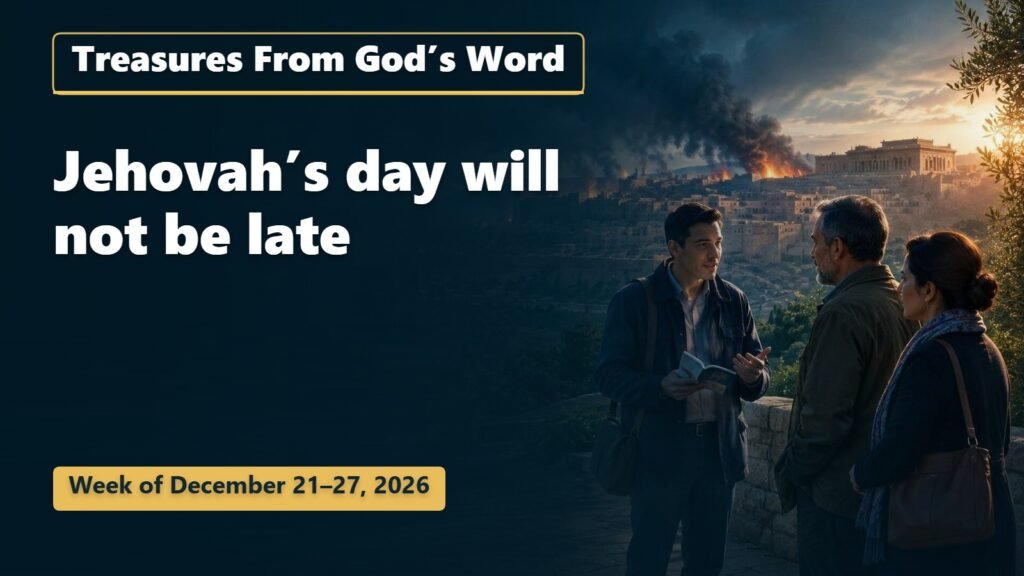
Theme: Jehovah’s day will not be late
When we are waiting for something important, time can seem to pass very slowly. And if the wait continues, we may wonder how much longer it will be. When thinking about Jehovah’s day, we need to look beyond our impatience and remember who made the promise. Jehovah does not lose sight of what is happening or forget what he has announced. The words he transmitted through Ezekiel give us solid reasons to trust him: Jehovah’s day will not be late.
Let us first think about what happened to Jerusalem. Its destruction was not an event that Jehovah announced without knowing when he would act. He had observed the conduct of his people and had determined when he would call them to account. Ezekiel transmitted a message that left no doubt about the seriousness of that warning. Let us read Ezekiel 7:3.
Ezekiel 7:3 — The end is now upon you, and I will unleash my anger against you, and I will judge you according to your ways and call you to account for all your detestable deeds.
These words show that the judgment had a specific reason: the conduct of the Israelites. But Jehovah had also indicated when it would come. He commanded Ezekiel to enact two periods: He was to lie on his left side for 390 days and on his right side for another 40 days. Each day represented a year. This was not simply a striking way to communicate a warning. That enactment pointed to the exact year when Jerusalem would be destroyed. Jehovah knew precisely when he would fulfill what he had announced.
The 390 years of Israel’s error began in 997 B.C.E., when the ten-tribe kingdom was divided. The 40 years of Judah’s error probably began in 647 B.C.E., when Jeremiah received his commission to warn Judah. Both periods ended in 607 B.C.E., the year Jerusalem was destroyed. The fulfillment of this prophecy teaches us something fundamental: Jehovah does not act according to the human perception of time. He acts at the time he has determined.
How does remembering this help us? Perhaps we have been waiting many years for the end of wickedness. That wait does not mean that Jehovah has been late. Rather than measuring the reliability of his promise by how long the wait seems to us, we can strengthen our trust by reviewing what he has already fulfilled. The case of Jerusalem gives us a firm basis for continuing to wait in faith. But why was it necessary for Jehovah to execute that judgment?
It was not simply that a date had arrived. The Israelites had received warnings, but they continued practicing what Jehovah hated. They had not used the time to change. As we listen to the following verses, let us note the connection between their conduct and the consequences they would suffer. Let us read Ezekiel 7:4, 10.
Ezekiel 7:4,10 — My eye will not feel sorry for you; nor will I feel compassion, for I will bring upon you the results of your own ways, and you will suffer the consequences of your detestable deeds. And you will have to know that I am Jehovah.’ “‘Look, the day! Look, it is coming! Your turn has come; the rod has blossomed and presumptuousness has sprouted.
Jehovah made it clear that they would suffer the results of their own actions. Arrogance had grown, and the warnings had not moved them to abandon their detestable conduct. Therefore, those firm words did not describe arbitrary punishment. They explained that Jehovah would call them to account for what they persisted in doing. Belonging to his people would not enable them to avoid the consequences. They needed to make real changes, not merely think that because nothing had happened yet, nothing would happen later.
Here we find a personal lesson. When we recognize that we need to correct something, it is wise to act and not put it off indefinitely. For example, if while studying we discover that certain entertainment is weakening our hatred of what Jehovah hates, what will we do? We could make excuses to keep it, or we could make changes that show how much we value our friendship with him. The issue is not comparing ourselves with those Israelites, but allowing their experience to help us respond well to Jehovah’s guidance.
Nor do we want to confuse the passing of time with God’s approval. The fact that conduct does not produce immediate consequences does not mean that it is acceptable to him. So while we wait for his day, we continue examining our decisions and giving priority to pure worship. In this way, our confidence that Jehovah will act on time influences our life now. And it not only moves us to make personal changes; it also impels us to help others while there is still time.
The warning at Ezekiel 7:3, which we read at the beginning, also gives urgency to our preaching. The statements about Jerusalem’s fall remind us that there is little time left to help others become servants of God. We do not want that conviction to remain merely an idea that we accept. We want it to be reflected in our schedule and in our willingness to make disciples. One very practical way to do this is to preach when people are available, not only when it is convenient for us.
Think of someone who works long hours and is almost never home when we visit. If we always repeat the same schedule, we may continue failing to find that person. Could we try contacting him or her at another appropriate time? This does not necessarily mean spending more hours, but thinking about how to make better use of the hours we have. Taking people’s circumstances into account shows sincere interest in them. We want to give them a real opportunity to hear the message, and this requires some flexibility on our part.
The illustration in the workbook presents a situation that invites reflection: A brother is studying the Bible with a worker in a shop late at night. This does not mean that all of us should preach at that hour. Rather, it highlights the value of adapting. Perhaps an interested person can talk only when his or her work slows down. If the schedule and circumstances allow, arranging a convenient time can open the door to Bible conversations that otherwise would not take place.
We can ask ourselves: Is there someone whom I have difficulty finding? Do I know when it is convenient for that person to talk? Could I adjust a visit or a Bible study, while respecting both my responsibilities and the other person’s? These small adjustments can express great consideration. Urgency does not move us to pressure anyone or ignore his or her obligations. It moves us to search lovingly for opportunities to help. We rejoice when someone who is rightly disposed begins to learn about and worship our Father, Jehovah.
And if many do not respond, we do not conclude that our effort has no value. Ezekiel had to continue transmitting Jehovah’s warning, and we too continue carrying out our assignment. Our confidence does not depend on each person’s response. It depends on Jehovah and on the certainty of his word. So before organizing the coming week, let us think about what realistic adjustment would enable us to help someone more effectively. Making good use of our time is a practical way to keep pure worship first.
Jehovah’s day will not be late. The destruction of Jerusalem proves that he fulfills his word at just the right time and does not overlook wickedness indefinitely. As we wait, let us continue strengthening our trust, making the necessary changes, and helping others to come to know him. May the way we use our time show that we wholeheartedly believe what Jehovah has announced.
More posts for this week





Enjoy every Premium feature
More convenient meeting preparation with full access to the site’s tools.
- Ad-free browsing
- My Recorder and live transcription
- Assignment Review
- Full Academy access
- Audio posts and reading magnifier
- Saved and synced comments
- Support the project and help keep it running
Monthly plan
€3 per monthRenews monthly. Cancel at any time.
Choose monthlyAnnual plan
€30 per yearOne payment for 12 months. No automatic renewal.
Choose annual


