









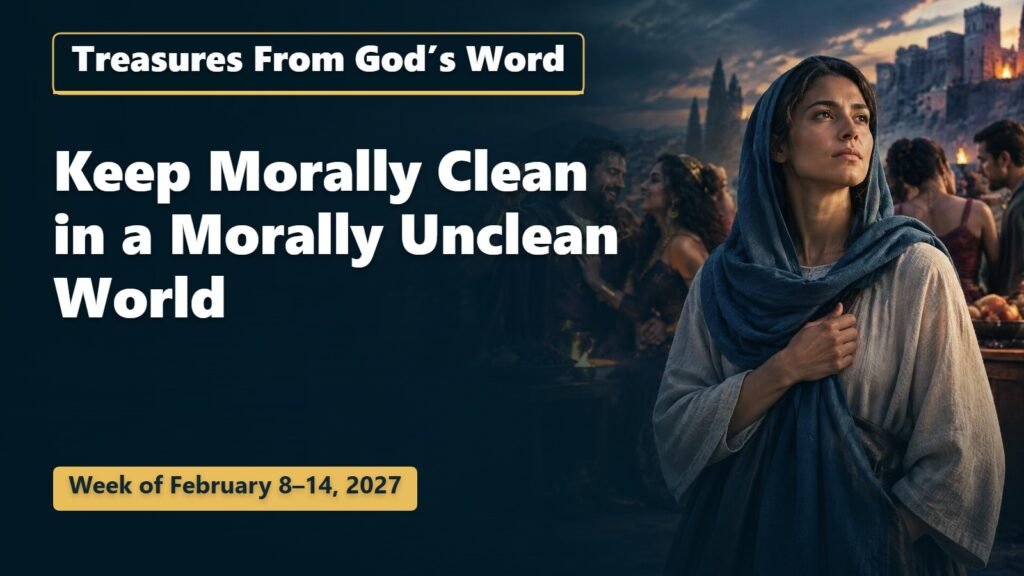
Theme: Keep Morally Clean in a Morally Unclean World
When we want to keep a garment clean, washing it is not enough. We also have to avoid anything that could make it dirty. The same is true of our moral cleanness: We need to guard it every day. We live surrounded by attitudes and conduct that Jehovah disapproves of, but we are not obliged to adopt them. What Ezekiel wrote about the situation of his people helps us recognize that danger and protect our friendship with Jehovah.
In Judah, corruption was not a problem limited to a few people. It had spread from the rulers to the people in general. As we listen to Ezekiel 22:6-12, let us note both the conduct that Jehovah condemned and what it revealed about the people’s relationship with him.
Ezekiel 22:6-12 — Look! Each of the chieftains of Israel among you uses his authority to shed blood. Within you they treat their father and mother with contempt. They defraud the foreign resident, and they mistreat the fatherless child and the widow.”’” “‘My holy places you despise, and my sabbaths you profane. Within you are slanderers intent on shedding blood. Within you they eat sacrifices on the mountains and carry on obscene conduct in your midst. Within you they dishonor their father’s bed, and they violate a woman unclean in her menstruation. Within you one man acts detestably with his neighbor’s wife, another defiles his own daughter-in-law with obscene conduct, and another violates his sister, the daughter of his own father. Within you they take a bribe to shed blood. You lend on interest or for a profit, and you extort money from your neighbors. Yes, you have entirely forgotten me,’ declares the Sovereign Lord Jehovah.
How painful it must have been for Jehovah to observe that situation! The rulers used their authority to shed blood, and the people imitated their bad example. Corruption had also entered the homes: Parents were treated with contempt, and serious sexual sins were committed. In addition, those who needed protection, such as foreign residents, fatherless children, and widows, suffered abuse. Greed had displaced the love that should guide the way people treat one another.
The end of the passage points to the root of the problem: The people had forgotten Jehovah. It was not simply that they did not know his standards. They ignored them when making decisions. Thus, this account invites us to look beyond appearances. Moral cleanness is not limited to avoiding sexual immorality; it is also reflected in the respect we show our parents, our honesty, and the way we treat those who are more vulnerable.
We can ask ourselves: “Do I keep Jehovah in mind when no one is watching? Do his standards influence how I treat my family and how I handle financial matters?” These questions are not intended to make us compare ourselves with those Israelites but to help us protect our heart. They allowed the conduct of those around them to weigh more heavily than God’s Law. We too live surrounded by bad influences. What will help us not to become accustomed to them?
The situation in Judah reminds us of the world today. We continue to see abuse of power, oppression, and a lack of respect for life. Even religious leaders, especially those of Christendom, have supported wars and have minimized the seriousness of Bible standards on sexual morality. What should direct people toward God ends up distancing them from his principles. As Christians, we do not take sides in political disputes; we are guided by Jehovah’s standards.
But recognizing that the world is unclean is not enough to keep us clean. If we repeatedly expose ourselves to improper conduct, we may begin to view it as unimportant. Think about the entertainment or conversations we choose. If they present infidelity as something amusing or deception as a sign of intelligence, what attitude are they cultivating in us? The fact that a behavior is popular does not mean that it has stopped saddening Jehovah.
That is why it is wise to pause before accepting a recommendation, continuing a conversation, or watching certain content. We can ask ourselves: “Does this help me maintain Jehovah’s viewpoint, or is it weakening my rejection of what is bad?” This is not about feeling superior to others but about caring for our friendship with him. And that friendship moves us to do more than avoid moral uncleanness: We want our conduct to reflect the beautiful qualities of our Father.
The priests who served at the tabernacle and at the temple had to wash themselves and be clean. We too value physical cleanness, but what matters most is living a clean life in God’s eyes. This requires abandoning bad attitudes and practices and learning to think and act as Jehovah wants. It is not enough to stop a bad habit; we must cultivate the qualities that characterize the new personality.
For example, we do not merely avoid defrauding others; we strive to be honest. We do not merely reject mistreatment; we treat others with kindness. And we do not merely avoid immoral sexual relations; we guard our thoughts and decisions. We may discover an attitude that we need to correct. Instead of justifying ourselves by saying that we have always been that way, let us remember that with Jehovah’s help, change is possible. Jack’s experience demonstrates how completely a person can change.
Jack was such a violent and dangerous man that he was nicknamed the Demon. He was sentenced to death for his crimes. While waiting for his execution, he agreed to study the Bible with a brother who visited the prison. He changed and eventually got baptized as one of Jehovah’s Witnesses. His transformation impressed the guards so much that some of them said goodbye to him with tears in their eyes on the day of his execution.
The following week, another prisoner attended for the first time the meeting that the brothers held there. Jack’s change had impressed him, and he wanted to know how to worship Jehovah. Our conduct can awaken in others the desire to know him! Perhaps our changes are not so striking, but they too bring glory to God. Moreover, by keeping ourselves clean, we help protect the purity of the congregation.
This leads us to consider: What do the angels do to keep the congregations clean, and how can we cooperate with them? Jehovah has assigned them to separate the wicked from the righteous. Their work does not mean that there will never be problems in the congregation or that someone who has strayed can never return. But it assures us that they are concerned about its purity. We share that concern by choosing good association and rejecting anything that could distance us from Jehovah.
We also cooperate by helping our brothers remain faithful. If we learn that one of them has committed a serious sin, love moves us to encourage him to speak with the elders. If he does not do so, we should inform them ourselves so that he can receive spiritual help. And when someone has to be removed from the congregation, we respect the direction to stop associating with him. Such firmness protects the congregation’s cleanness and may motivate him to come to his senses and return.
Even though the world is morally unclean, we can keep ourselves clean. Let us remember what saddened Jehovah in Ezekiel’s day, reject the attitudes that reflect that same corruption today, and continue cultivating the new personality. Every clean decision counts. With Jehovah’s help, our conduct can protect the congregation, encourage others, and bring glory to our heavenly Father.
More posts for this week





Enjoy every Premium feature
More convenient meeting preparation with full access to the site’s tools.
- Ad-free browsing
- My Recorder and live transcription
- Assignment Review
- Full Academy access
- Audio posts and reading magnifier
- Saved and synced comments
- Support the project and help keep it running
Monthly plan
€3 per monthRenews monthly. Cancel at any time.
Choose monthlyAnnual plan
€30 per yearOne payment for 12 months. No automatic renewal.
Choose annual
