










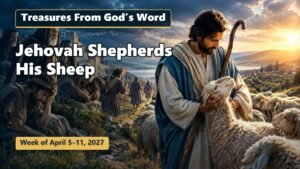
Ezekiel 34:18—What does this verse mean? (it “Sheep,” par. 11)
Answer 1: The verse condemns the selfishness of Israel’s unfaithful leaders. They are compared to animals that take advantage of the best pastures and the clearest water, but then ruin what others need. Those leaders not only took the best for themselves; they also harmed the rest of the people. Thus, the picture describes an abuse of power that left the most vulnerable in an even worse situation.
Answer 2: To understand the comparison, we need to identify the animals mentioned in the context. The rams, the male goats, and the fat sheep represent Israel’s unfaithful leaders. The lean and sick sheep represent the oppressed, exploited, and mistreated people. Therefore, the passage is not simply talking about the behavior of a literal flock but about the unjust way those leaders treated other people.
Answer 3: One important detail is that those leaders had already taken the best. The comparison presents them as feeding on the best pastures and drinking the clearest water. This corresponds to their taking the best for themselves. Jehovah’s reproach highlights their selfishness: They enjoyed those advantages while the people they oppressed had to settle for what they left behind and, in addition, had ruined.
Answer 4: Trampling the pastures and fouling the water represents the harm the leaders caused to what remained for the people. It was not merely that some received more than others. After keeping the best for themselves, those leaders dirtied what the lean and sick sheep needed. This part of the illustration highlights the seriousness of their conduct: Their selfishness was accompanied by exploitation and mistreatment of those who were already disadvantaged.
Answer 5: The questions in the verse express Jehovah’s disapproval. He did not consider it acceptable for the leaders to enjoy the best and ruin what remained for the people. Furthermore, in the context he announces that he will judge between the sheep and save those who were being mistreated. Thus, these words are not simply a description of injustice; they are part of Jehovah’s denunciation of those unfaithful leaders.
What spiritual gems have you found in this week’s Bible reading?
Spiritual Gems for EZEKIEL 34
Ezekiel 34:2 — “Son of man, prophesy against the shepherds of Israel. Prophesy, and say to the shepherds, ‘This is what the Sovereign Lord Jehovah says: “Woe to the shepherds of Israel, who have been feeding themselves! Is it not the flock that the shepherds should feed?
Comment 1: Ezekiel 34:2 shows that the shepherds were supposed to feed the flock, not take advantage of it. This reminds me that a responsibility in the congregation is an opportunity to serve, not to seek personal advantages. When I help others, I can ask myself whether I am thinking mainly about my own comfort or about what they need.
Ezekiel 34:4 — You have not strengthened the weak or healed the sick or bandaged the injured or brought back the strays or looked for the lost; rather, you have ruled them with harshness and tyranny.
Comment 2: Ezekiel 34:4 mentions weak, sick, injured, and lost sheep. Not all of them needed the same kind of help. This teaches me that, in order to encourage a brother, I should first listen and try to understand his situation. Perhaps he needs comfort, practical support, or someone to accompany him patiently. Giving everyone the same advice without listening to them could leave their real need unattended. Loving care takes each person into account.
Ezekiel 34:6 — My sheep were straying on all the mountains and on every high hill; my sheep were scattered over all the surface of the earth, with no one searching for them or seeking to find them.
Comment 3: At Ezekiel 34:6, I am struck by the fact that Jehovah still considered the scattered sheep to be his own. Although no one was looking for them, he had not forgotten them. This encourages me not to become indifferent when I stop seeing someone at the meetings. Instead of assuming that he no longer wants companionship, I can show interest with a warm greeting or a caring phone call, without reproaches or conclusions about his motives.
Ezekiel 34:10 — This is what the Sovereign Lord Jehovah says: ‘I am against the shepherds, and I will demand an accounting of them for my sheep, and I will dismiss them from feeding my sheep, and the shepherds will no longer feed themselves. I will rescue my sheep from their mouth, and they will no longer be food for them.’”
Comment 4: Ezekiel 34:10 shows that Jehovah would call the shepherds who were taking advantage of their sheep to account. The position they held did not protect them from his judgment. This teaches me that, to Jehovah, how we treat people matters, not just what responsibility we have. It also reassures me to see that he did not approve of abuse or overlook it. His purpose was to put an end to that exploitation and rescue those who suffered from it.
Ezekiel 34:11 — “‘For this is what the Sovereign Lord Jehovah says: “Here I am, and I myself will search for my sheep, and I will care for them.
Comment 5: Ezekiel 34:11 reveals Jehovah’s initiative: He committed himself to searching for his sheep and caring for them. He did not merely point out what the bad shepherds had done. This teaches me that genuine concern is demonstrated by action. If I notice that someone needs encouragement, I do not always have to wait for him to ask me for help. I can respectfully approach him and offer support, trying to turn my good intentions into something useful.
Ezekiel 34:14 — In a good pasture I will feed them, and the land where they graze will be on Israel’s high mountains. They will lie down there in a good grazing land, and they will feed on choice pastures on the mountains of Israel.”
Comment 6: At Ezekiel 34:14, Jehovah promises his sheep good pastures where they could feed and rest. The picture highlights the quality of the care he wanted to give them, in contrast with the neglect they had suffered. This makes me think about the importance of feeding myself well spiritually. I do not want to read the Bible merely to fulfill an obligation. Taking time to understand it and meditate on it allows me to benefit from its teachings and find the encouragement I need to keep going.
Ezekiel 34:16 — “The lost one I will search for, the stray I will bring back, the injured I will bandage, and the weak I will strengthen; but the fat one and the strong one I will annihilate. I will feed that one with judgment.”
Comment 7: Ezekiel 34:16 distinguishes between the sheep that needed help and those that, according to the context, were oppressing others. Jehovah promised to care for the former and judge the latter. This helps me understand that his tenderness does not mean tolerating mistreatment. In imitating him, I should be patient with the weaknesses of others, but I should never justify harmful conduct as if it were simply a way of being that everyone must accept.
Ezekiel 34:17 — “‘As for you, my sheep, this is what the Sovereign Lord Jehovah says: “I am about to judge between one sheep and another sheep, between the rams and the male goats.
Comment 8: Ezekiel 34:17 shows that Jehovah judges between one sheep and another. He does not consider that all behave the same simply because they belong to the same flock. This reminds me of my personal responsibility: It is not enough to be among those who serve Jehovah; I must also watch my own conduct. Rather than comparing myself with others or relying on their good example without making changes, I want to examine how I treat my brothers and what I need to improve.
Ezekiel 34:21 — for with your flank and shoulder you kept pushing, and with your horns you kept shoving all the sick ones until you had scattered them abroad.
Comment 9: Ezekiel 34:21 describes how the sick sheep were pushed until they were scattered. It makes me think about the effect that harsh treatment can have on someone who is already discouraged. Perhaps a sharp word or insisting on imposing my own viewpoint adds an unnecessary burden to him. Therefore, I want my way of speaking to make it easier for others to draw close and feel supported, rather than making them feel rejected or inferior.
More posts for this week


Enjoy every Premium feature
More convenient meeting preparation with full access to the site’s tools.
- Ad-free browsing
- My Recorder and live transcription
- Assignment Review
- Full Academy access
- Audio posts and reading magnifier
- Saved and synced comments
- Support the project and help keep it running
Monthly plan
€3 per monthRenews monthly. Cancel at any time.
Choose monthlyAnnual plan
€30 per yearOne payment for 12 months. No automatic renewal.
Choose annual


