









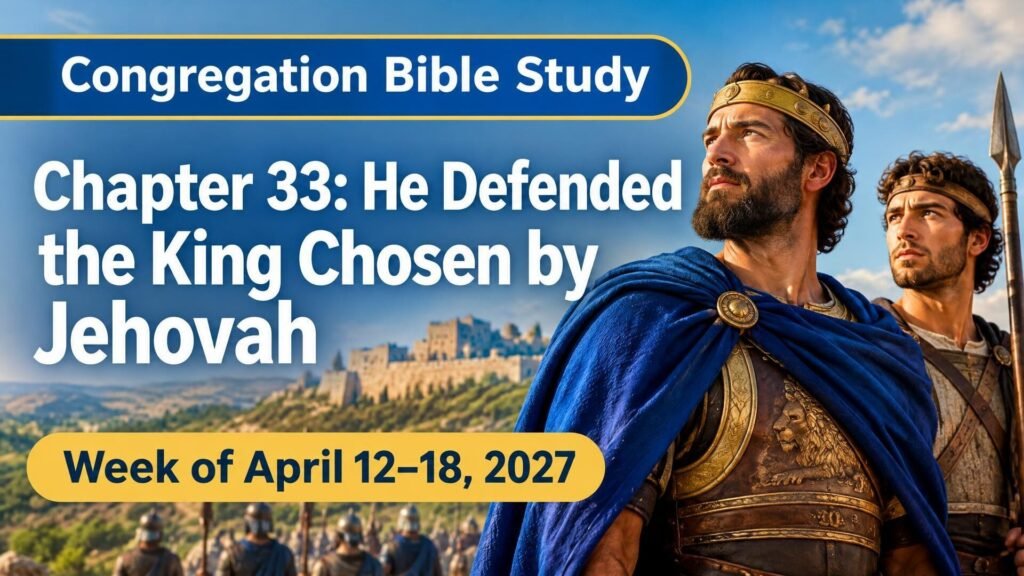
Chapter 33: He Defended the King Chosen by Jehovah
In what ways did Jehoiada show courage?
Comment 1: Jehoiada showed courage by protecting Jehoash even though it could have cost him his life. Athaliah had ordered the killing of her own grandchildren to keep the throne, so the danger was real. Nevertheless, Jehoiada and Jehosheba hid the child in the temple for six years. This was not merely a brave decision made at one moment; they had to maintain it for a long time. Their example teaches us that courage also means continuing to do what is right when the pressure does not go away.
Comment 2: He was also courageous when he decided to make known that a legitimate heir of David was still alive. He gathered five military chiefs, organized Jehoash’s protection, and directed his coronation. But his courage was not recklessness: he took concrete measures to protect the child. This helps me see that trusting in Jehovah does not mean acting without thinking. We can stand up for what is right while also preparing carefully and acting in an orderly way.
Comment 3: His courage did not end when Athaliah stopped ruling. Jehoiada made the king and the people commit themselves to being loyal to Jehovah, and he promoted the removal of Baal worship. Afterward he continued helping Jehoash do what was right. For him, it was not enough to resolve the immediate danger; pure worship also had to be restored. We can imitate him by not only rejecting what is bad but also patiently helping others strengthen their relationship with Jehovah.
1. According to some scholars, who made up “the Carian bodyguard” that helped Jehoiada overthrow Athaliah?
Comment 1: Many scholars consider the Carian bodyguard to be another name for the Cherethites, who had served in the military forces of David and Solomon. Some understand these soldiers to have formed the personal guard of those kings. For that reason, a connection between the two groups has been proposed. It is wise to preserve this nuance: this is an identification made by scholars, not something that the account of Jehoash’s coronation explains directly. In this way, we distinguish what we know from what is considered probable.
Comment 2: One reason for linking the Carian bodyguard with the Cherethites appears in the information about the Hebrew text of 2 Samuel 20:23. The Masoretic text there uses the expression translated “Carian bodyguard,” whereas its marginal note uses “Cherethites,” as do other Hebrew manuscripts. This difference in designation helps explain why many scholars think that the two names may have referred to the same body of soldiers.
Comment 3: It has also been proposed that its members came from Caria, a region in southwestern Asia Minor, and arrived by way of Crete. This possibility is connected with references to the Cherethites and the Philistines, and with the way the Greek translation identifies them as Cretans. But we should not turn this possibility into a certainty. The information allows us to consider an explanation of their possible origin without claiming that every detail has been proved.
2. What probably was “the Testimony,” and why did Jehoiada put it on Jehoash?
2 Kings 11:12 — Then Jehoiada brought the king’s son out and put on him the crown and the Testimony, and they made him king and anointed him. They began to clap their hands and say: “Long live the king!”
Comment 1: The Testimony was probably the book of the Law, where the decrees of Moses were recorded. It has been explained that it may have been symbolically placed on the king’s head after the crown was put on him. Although the verse does not describe every detail of the gesture, its meaning would have been very appropriate on that occasion: Jehoash received authority to rule, but he had to exercise it in harmony with Jehovah’s Law. The coronation did not place him above God’s standards.
Comment 2: The crown and the Testimony highlighted two different aspects of his new responsibility. Jehoash was the king, but he could not decide for himself what was right and what was wrong. He had to submit to Jehovah. This seems to me a very valuable lesson: receiving authority does not make a person need less direction from God. On the contrary, the greater his responsibility, the more important it is for him to let Jehovah’s Word guide his decisions.
Comment 3: Deuteronomy 17:18-20 helps us understand the meaning of that gesture. Jehovah had commanded the king to write his own copy of the Law and read it all the days of his life. Therefore, knowing the Law was not to be limited to the day of his coronation. The king had to keep learning and obeying. This also encourages us to maintain a regular Bible reading routine, rather than simply remembering what we learned in the past.
3. Why did Jehoash order that Jehovah’s house be repaired?
Comment 1: Jehovah’s house needed repairs mainly because of the neglect and plundering it had suffered during Athaliah’s reign. The problem was not primarily wear caused by age, since the temple was still less than 150 years old. Jehoash wanted to correct the situation. This context helps us understand that the work was not simply a repair of a building: damage connected with a period when pure worship had been despised had to be repaired.
2 Chronicles 24:4-7 — Afterward it was the heart’s desire of Jehoash to renovate the house of Jehovah. So he gathered the priests and the Levites together and said to them: “Go out to the cities of Judah and collect money from all Israel to repair the house of your God from year to year; and you should act quickly in the matter.” But the Levites did not act quickly. So the king called Jehoiada the chief and said to him: “Why have you not required the Levites to bring in from Judah and Jerusalem the sacred tax ordered by Moses the servant of Jehovah, the sacred tax of the congregation of Israel, for the tent of the Testimony? For the sons of Athaliah, that wicked woman, had broken into the house of the true God, and they had used all the holy things of the house of Jehovah for the Baals.”
Comment 2: The passage explains that Athaliah’s sons had forcibly entered the house of God and had used its holy things for the Baals. So there were serious reasons to intervene. Jehoash wanted to renew Jehovah’s house and asked that action be taken quickly. His initiative reminds us that valuing worship of Jehovah is also shown by caring for the material needs connected with it, not merely by saying that it matters to us.
Comment 3: At first, the Levites did not act quickly, and the restoration was not carried out. Later, the method of collecting and administering the money was changed, and the work moved forward. This adds a practical lesson: having a good desire is not enough unless measures are taken to make it possible. When we cooperate in a task related to worship of Jehovah, it is important to fulfill our part and willingly support the arrangements that are established.
4. If Zechariah was Jehoiada’s son, why did Jesus call him “the son of Barachiah”?
Comment 1: The account in Chronicles identifies Zechariah as the son of Jehoiada, whereas Matthew records the expression “son of Barachiah.” The available passages do not by themselves explain the reason for this difference, and here we do not have the content of the indicated study note. So it would not be correct to present a possible explanation as confirmed. To answer that detail accurately, the note needs to be consulted before drawing a conclusion.
Matthew 23:35 — so that there may come upon you all the righteous blood spilled on earth, from the blood of righteous Abel to the blood of Zechariah son of Barachiah, whom you murdered between the sanctuary and the altar.
Comment 2: Without resolving the detail about the name, we can comment on what Jesus highlighted: Zechariah was a victim of the shedding of righteous blood. The place of the murder mentioned by Matthew agrees with the context of the Chronicles account, which says that he was stoned in the courtyard of Jehovah’s house. Jesus’ words show that this crime had not been forgotten. Jehovah does not consider the life of those who loyally serve him to be insignificant.
Comment 3: The chapter highlights a lesson that does not depend on clarifying the name Barachiah: Zechariah was courageous like his father. He delivered Jehovah’s warning and remained faithful, although Jehoash ordered him killed. Centuries later, Jesus referred to him. This encourages us to value loyalty more than the approval of those who hear us. Other people’s reaction does not determine how valuable it is to Jehovah when we respectfully defend what he considers right.
Jehoiada was probably over 100 years old when he hid Jehoash. How can this servant of God’s example encourage older brothers?
Psalms 92:12,14 — But the righteous will flourish like a palm tree And grow big like a cedar in Lebanon. Even in old age they will still be thriving; They will remain vigorous and fresh,
Comment 1: This psalm shows that old age does not prevent a person from continuing to prosper spiritually. Jehoiada is a good example: although very old, he protected Jehoash and helped restore pure worship. This does not mean that all older brothers have the same strength or responsibilities. The encouraging point is that age does not take away their value to Jehovah. Their faith, loyalty, and interest in others can continue to produce much fruit.
Comment 2: Jehoiada continued to be a good influence on Jehoash until the day he died. This can encourage an older brother who can no longer do as much as before. Perhaps his strength has diminished, but he can still listen to a young person, show interest in him, and share what he has learned while serving Jehovah. The account helps us not to measure a person’s usefulness only by physical activity, but also by the spiritual help he can offer.
Comment 3: The picture of a brother using a walker and enthusiastically greeting a child shows a very simple application. We do not have to do something extraordinary to convey affection and interest. An older brother can help a child feel welcome in the congregation. That gesture is within the reach of many and reflects the desire to continue helping. Jehoiada reminds us of the good an older person can do when he takes an interest in someone from another generation.
Jehoash did well while he listened to Jehoiada. What can young ones learn from this?
Comment 1: Young ones can learn to value the counsel of those who have faithfully served Jehovah for many years. Jehoash did what was right while Jehoiada instructed him. Listening to him did not take away his dignity as king; it helped him fulfill his responsibility. Similarly, accepting guidance from parents and spiritually mature brothers is not a sign of weakness. It can help us see consequences we have not yet considered and make decisions that please Jehovah.
Comment 2: We also learn that it is not enough to have someone nearby who gives us good advice. After Jehoiada’s death, Jehoash listened to the princes of Judah and abandoned pure worship. Therefore, a young person needs to make the reasons for obeying Jehovah his own. He can ask himself whether he does what is right only because someone encourages him or because he is convinced that it is best. The help of others should strengthen our own friendship with Jehovah.
Comment 3: Jehoash’s change shows how much influence the people we choose to listen to can have. First he received Jehoiada’s good influence; afterward he accepted the influence of those who led him away from Jehovah. Moreover, when the prophets tried to correct him, he refused to listen. A young person can learn to examine where the advice he receives is leading him and to accept correction in time. Someone telling us what we want to hear does not mean that he is truly helping us.
In what ways can you imitate Jehoiada’s example of courage?
Comment 1: I can imitate him by deciding to do what Jehovah considers right even when others disagree. Jehoiada did not allow Athaliah’s threat to make him disregard Jehoash. My circumstances are different, but I too may feel pressure to keep silent about my convictions or take part in something wrong. His example encourages me to be firm without being aggressive and to explain my decisions respectfully, rather than letting fear of other people’s reaction decide for me.
Comment 2: I can imitate his courage combined with prudence. Before the coronation, Jehoiada gathered loyal people and organized the child’s protection. He did not act rashly to prove that he was brave. If I have to face a difficult situation, I can prepare, seek Bible-based guidance, and ask for appropriate help. The objective is not to expose myself unnecessarily to danger or win an argument, but to remain faithful to Jehovah and act in a way that also takes others’ welfare into account.
Comment 3: Another way to imitate him is not to grow tired of supporting those who need spiritual help. Jehoiada did not merely protect Jehoash when he was a baby; afterward he continued guiding him as king. This reminds me that some forms of help require perseverance. It may be easier to make one courageous gesture than to keep showing interest in someone for a long time. I can strive to support my words of encouragement with sincere and continuing interest, without assuming that one conversation will solve everything.
What does this account teach me about Jehovah?
Comment 1: It teaches me that Jehovah fulfills his promises even when it seems that someone might prevent him. Athaliah tried to eliminate the heirs to the throne, but Jehoash survived and David’s royal line was not wiped out. Jehovah had promised that a descendant of David would rule forever. Seeing how the account fits that promise strengthens my confidence: one person’s wickedness cannot make Jehovah forget what he has said or stop fulfilling his purpose.
Comment 2: It also teaches me that Jehovah gives people opportunities to correct their course. When Jehoash and the people abandoned pure worship, Jehovah continued sending prophets to help them return to him. They did not lack warnings; the problem was that they refused to listen. This encourages me to view Bible-based counsel as a help and not as a nuisance. If I discover that I am heading in a bad direction, the best course is to listen and change before I go farther away.
Comment 3: The account teaches me that Jehovah does not forget those who are loyal to him. Jehoash forgot the loyal love he had received from Jehoiada and eventually ordered the killing of his son. But that ingratitude did not erase the value of the faithfulness of Jehoiada and Zechariah. Jesus remembered Zechariah centuries later. Even if others do not appreciate what we do or treat us unjustly, we can be sure that our loyalty does not go unnoticed by Jehovah.
How does this account relate to Jehovah’s purpose and the main theme of the Bible?
2 Samuel 7:12-13 — When your days come to an end and you are laid to rest with your forefathers, then I will raise up your offspring after you, your own son, and I will firmly establish his kingdom. He is the one who will build a house for my name, and I will firmly establish the throne of his kingdom forever.
Comment 1: The main connection is the promise Jehovah made to David concerning his offspring and his kingdom. Thus, protecting Jehoash was not merely a matter of saving a child from a cruel queen. It also meant preserving an heir of the royal line connected with that promise. Jehoiada and Jehosheba acted with what Jehovah had said in mind. The account helps us see the connection between one concrete act of faithfulness and the fulfillment of God’s purpose.
Comment 2: It also highlights respect for Jehovah’s right to decide who should rule his people. Athaliah had seized the throne, but Jehoiada supported David’s heir in harmony with the divine promise. This was not simply a matter of preferring one person over another. The issue was respecting what Jehovah had established. Thus, this episode is related to God’s rulership and to the importance of recognizing his authority instead of imposing human will.
Comment 3: The restoration of pure worship is also part of the picture. After the coronation, Jehoiada had the king and the people commit themselves to continuing as Jehovah’s people, and Baal’s temple was destroyed. So the purpose was not merely to change who occupied the throne. Jehovah had to be honored and obeyed. The account links respect for his rulership with the worship he deserves—two matters far more important than the ambitions of any human.
What would I like to ask Jehoiada when he is resurrected?
Comment 1: I would like to ask him how he and Jehosheba organized themselves to care for Jehoash during the six years he was hidden. The account tells us where they protected him and how long the situation lasted, but it does not describe their daily life. It would be very interesting to hear how they carried out that responsibility and supported each other. We cannot fill in those details imaginatively now, but we can appreciate that their loyalty involved years of care, not only the moment when the child was rescued.
Comment 2: I would ask him how he experienced the moment when he showed Jehoash to the military chiefs and prepared his coronation. We know that he acted courageously and carefully organized the child’s protection. I would like to hear from him what it was like to go from keeping the heir hidden to presenting him as king. The account does not tell us everything he felt, so we cannot state it as fact; but learning about his experience would help us appreciate that demonstration of faith and loyalty even more.
Comment 3: I would like to ask him what advice he gave Jehoash to help him become a good king. The Bible highlights the good influence he had on him, but it does not record all their conversations. It would be very valuable to know how he used his experience to guide someone so young. That question also makes me think about the present: I do not have to wait to show interest in older brothers and learn from them. I can listen to them now and appreciate the good their example does for me.
More posts for this week

Enjoy every Premium feature
More convenient meeting preparation with full access to the site’s tools.
- Ad-free browsing
- My Recorder and live transcription
- Assignment Review
- Full Academy access
- Audio posts and reading magnifier
- Saved and synced comments
- Support the project and help keep it running
Monthly plan
€3 per monthRenews monthly. Cancel at any time.
Choose monthlyAnnual plan
€30 per yearOne payment for 12 months. No automatic renewal.
Choose annual


