










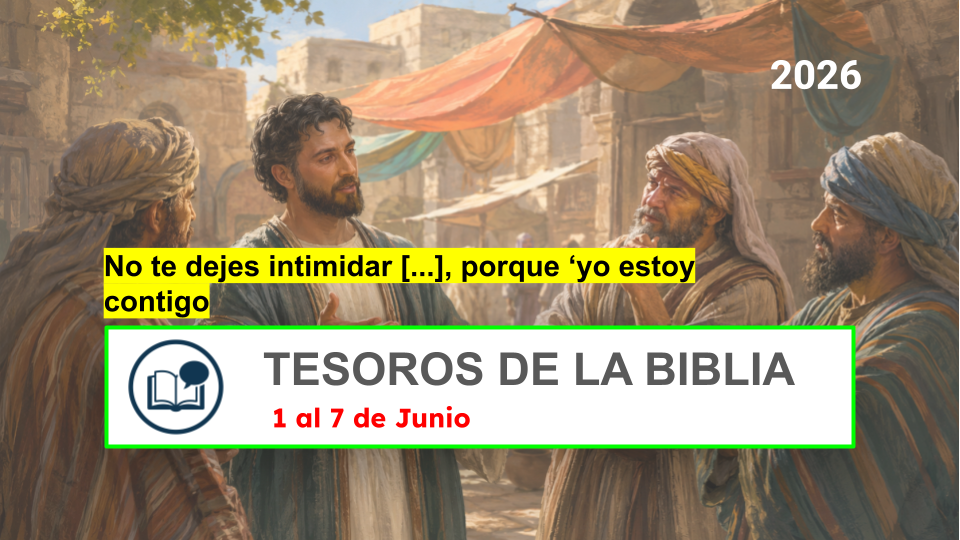
Theme: Don’t be intimidated, Jehovah is with you.
Let us imagine Jeremiah the moment Jehovah gave him his assignment. I wasn’t getting a simple or comfortable task. I had to talk to a town I often didn’t want to hear. He had to announce strong messages, denounce infidelity and stay loyal even if others mock, oppose or threatened him. If we think about that, we understand why Jeremiah didn’t respond with superficial enthusiasm, as if everything were easy. He saw his limitations.
Let us read Jeremiah 1:6 .
But I said, Alas, Sovereign Lord Jehovah. I can’t talk. I’m just a boy.
After reading it, let us look at how Jeremiah describes himself: he says he can’t speak and that he’s just a boy. He’s not making an excuse to disobey; he’s expressing what he really feels. Maybe he looked too young, too inexperienced or too insecure for such an important mission.
Has anything like that happened to us? Maybe before we preach we feel nervous. You may think about starting a biblical conversation with a co-worker or classmate comes to mind the idea: I won’t know what to say. Perhaps when we received an assignment in the congregation, we would think: “Others would do better than me.” In those moments, Jeremiah’s experience helps us a lot, because Jehovah did not rule out Jeremiah for feeling incapable. He also didn’t squander him for admitting his fears. Jehovah saw in him something more important than safety in himself: he saw a willing heart.
Now let us read Jeremiah 1:8, 9 .
Let not let thee be intimidated by his appearance, because I am with thee to save thee, saith Jehovah. And Jehovah stretched out his hand, and touched my mouth. And Jehovah said unto me, I have put my words in thy mouth.
As we read these verses, let us pay attention to two ideas: first, Jehovah tells him not to be intimidated; second, Jehovah Himself enables him. The guarantee was not Jessiah, you can because you’re so strong. The guarantee was: Jehovah is with you. That difference is huge. If our trust depended on our personality, our experience or our ease of speech, many would feel out of place. But our trust depends on Jehovah.
Verse 9 shows that Jehovah put his words in the mouth of Jeremiah. This teaches us that Jehovah not only commands to do something; he also gives what is necessary to do so. In our case, Jehovah has given us the Bible, the meetings, the organized ministry, the biblical publications and the support of the congregation. Each of these aids shows that we do not go out to preach or serve alone.
Let’s think of a practical example. A brother prepares to go out to the ministry, but he’s nervous. Maybe he hasn’t preached much lately or feels intimidated by the area. Before you knock on the first door or start a conversation, pray. He does not make a long or complicated prayer; he simply says to Jehovah, Help me to speak with respect, with affection and courage. That sentence does not change all circumstances, but it changes its approach. He no longer looks at the door as a gigantic obstacle; he sees it as an opportunity for Jehovah to use.
A young sister may also feel like Jeremiah when she wants to defend her beliefs at school. Maybe she’ll be afraid of being ridiculed or someone misunderstood what she says. But if you remember that Jehovah does not ask him to win debates, but to testify with respect, he can feel peace. Maybe he just says one simple phrase, share a biblical text or explain why he trusts Jehovah. In the human eyes that may seem little, but for Jehovah it is a show of courage.
The activity guide highlights that, like Jeremiah, we may be afraid to preach or feel that we are not able to do well. That phrase is very realistic. He doesn’t say if it ever happens to us, but he recognizes that it can happen. Christian courage is not to feel nothing. It consists in obeying Jehovah though we are afraid, trusting that he will sustain us.
Moreover, Jehovah did not promise Jeremiah a life without opposition. He promised her presence. That prepares us, too. Some people may not accept the message. Others may respond with indifference. A relative may tell us he doesn’t understand why we spend so much time serving Jehovah. But the key question is not: Are you going to approve of me? The question is, am I sure that Jehovah is with me?
Another important lesson is that Jehovah can use our limitations to teach humility. If Jeremiah had relied too much on himself, perhaps he would have forgotten where the force came from. But since he knew he needed Jehovah, it was up to him. The same can happen to us. When we feel unable, we pray more. When we know we don’t have all the answers, we study better. When we recognize that we need help, we accept suggestions from experienced siblings. Thus, the feeling of limitation can become an opportunity to bring us closer to Jehovah.
We can also encourage others with this lesson. Perhaps a new publisher says, “I dare not comment,” or I find it hard to preach. Instead of comparing it to others, we can remember him fondly that Jehovah enabled Jeremiah and that he can also train him. A brief comment, simple participation or a biblical conversation of a few minutes can be a great step of faith.
Therefore, at the end, let us keep a simple idea: Jehovah does not seek servants who are never afraid; seek servants to allow him to strengthen them. Jeremiah looked like only one lad, but Jehovah saw a faithful prophet. We may be seen shy, limited or unprepared, but Jehovah can see in us loyal and useful servants.
So, when an assignment appears, a difficult conversation or a chance to preach, let’s not let the intimidation decide for us. Let us remember the words which Jehovah said unto Jeremiah, and let us do them our own: Jehovah is with his servants. And when Jehovah is with us, we can do his will with courage, humility, and trust.
Discover more from Comentarios para la Reunión TJ
Subscribe to get the latest posts sent to your email.
Receive new posts by email
Create a free account or choose the ad-free plan. During registration, you can choose to receive new posts by email.
Register


