









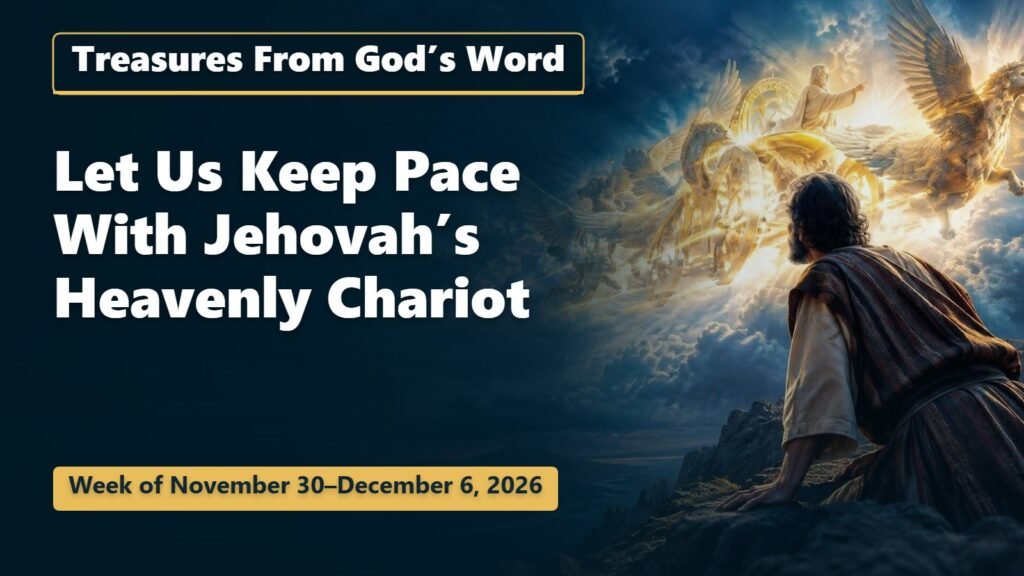
Theme: Let Us Keep Pace With Jehovah’s Heavenly Chariot
When we think about our obligations and concerns, it is easy for all our attention to become focused on what lies ahead of us. But Jehovah helps us lift our eyes and contemplate spiritual realities that we cannot see. The vision that Ezekiel received enables us to do just that. It shows us an impressive heavenly organization and invites us to ask ourselves whether we are keeping pace with Jehovah.
Ezekiel received visions from God while he was among the exiles in the land of the Chaldeans. In those circumstances, Jehovah allowed him to see something far greater than what surrounded him. The book bearing his name upholds pure worship. To get an overview of its contents, let us watch the video Information About Ezekiel.
As we approach this book, it is good to remember that Jehovah does not give us these visions simply to arouse our curiosity. They help us to know him better and to strengthen our confidence in him. So when examining the chariot that Ezekiel saw, let us not focus only on its extraordinary details. Let us also think about what they teach us about Jehovah’s organization and our attitude toward his direction.
The immense chariot represents the heavenly part of Jehovah’s organization. We are not dealing with a literal vehicle subject to the limitations of a human machine. It is a representation of a spiritual reality. Even so, every detail that Jehovah chose to show has value for us. Let us note the size, structure, and ability of its wheels to move as we read Ezekiel 1:16-18.
Ezekiel 1:16-18 — The wheels and their structure appeared to glow like chrysolite, and the four of them looked alike. Their appearance and structure looked as though a wheel were within a wheel. When they moved, they could go in any of the four directions without turning as they went. Their rims were so high that they inspired awe, and the rims of all four were full of eyes all around.
Imagine Ezekiel looking up to see those enormous gleaming wheels. Their size and brilliance convey greatness and glory. In addition, the arrangement of the wheels allowed them to move in any direction without having to turn. Everything seems to indicate that each one consisted of two wheels crossing at right angles. The image highlights a maneuvering ability that no vehicle built by humans can equal.
The enormous wheels could cover a great distance with a single revolution. And the account describes movements comparable to those of lightning. This chariot is the fastest and most maneuverable vehicle in existence. But its speed does not mean that it moves without knowing where it is going. The rims full of eyes indicate that the heavenly part of Jehovah’s organization is aware of everything. Nothing escapes Jehovah’s notice.
How does thinking about this help us? At times, a concern can take up so much space in our mind that it seems to eclipse everything else. We may feel that our circumstances are too complicated or that no one fully understands them. The vision reminds us that Jehovah does see what is happening. He has millions upon millions of angels who carry out his commands. Our vision is limited; his is not.
Meditating on these realities does not automatically eliminate our difficulties, but it helps us to view them from another perspective. Instead of thinking only about daily needs, we make room for spiritual matters. Still, the speed and maneuverability of the chariot raise an important question: Who decides where it moves? To trust fully in its direction, we need to look not only at the wheels but also at what is above them.
Above the living creatures, Ezekiel saw an impressive platform and, higher up, something that looked like a throne. That detail takes us to the center of the vision. The chariot does not move independently, nor do its various parts act each on its own. There is a common direction. Let us listen to how it is described and who occupies the highest position. Let us read Ezekiel 1:20, 26-28.
Ezekiel 1:20,26-28 — They would go where the spirit inclined them to go, wherever the spirit went. The wheels would be lifted up together with them, for the spirit operating on the living creatures was also in the wheels. Above the expanse that was over their heads was what looked like a sapphire stone, and it resembled a throne. Sitting on the throne up above was someone whose appearance resembled that of a human. I saw something glowing like electrum that was like a fire radiating from what appeared to be his waist and upward; and from his waist down, I saw something that resembled fire. There was a brilliance all around him like that of a rainbow in a cloud on a rainy day. That was how the surrounding brilliant light appeared. It was like the appearance of the glory of Jehovah. When I saw it, I fell facedown and began to hear the voice of someone speaking.
The same spirit acted both in the living creatures and in the wheels. That is why their movements were coordinated. And the figure Ezekiel saw on the throne represented Jehovah in his glory. Thus we understand the main point: Jehovah directs all the movements of the chariot. We do not need to resolve mechanical questions about this vision. We need to grasp what it reveals about the authority and direction of our God.
The combination of a throne with wheels is striking. The thrones of human rulers usually remain in one place, and their authority has limits. Jehovah’s sovereignty is different: He can exercise his authority anywhere. For Ezekiel, who was in exile, that vision gave him a powerful reason to trust. His circumstances had not placed him beyond Jehovah’s reach. Neither should we think that way.
When contemplating that manifestation of divine glory, Ezekiel fell facedown. His reaction invites us to cultivate deep respect and humility. If Jehovah directs the chariot, keeping pace with him requires more than admiring the vision. It involves being willing to listen and learn. Rather than clinging to our preferences, we can ask ourselves how we can best respond to the spiritual instruction we receive. That willingness is demonstrated by concrete decisions.
For example, we can set aside time to watch the monthly program on JW Broadcasting, prepare for the Watchtower Study, and attend assemblies. But it is not merely a matter of being present or watching an entire program. Afterward, it is good to ask ourselves: What have I learned about Jehovah? What do I need to put into practice? In this way, the instruction does not remain mere information that we hear but influences the way we think and act.
At this point, let us make the question our own: What do I need to do to keep pace with the heavenly chariot? Perhaps we need to organize our time better so that we can take advantage of spiritual food. Or perhaps we already know what counsel we should apply but have kept putting it off. Instead of resolving to make many changes at once, let us identify one specific step and take it. Humility will help us to keep learning and moving forward.
Ezekiel’s vision encourages us to look beyond our concerns. The heavenly part of Jehovah’s organization is glorious, it is aware of everything, and it moves under his direction. We can trust the One who occupies the throne. Let us continue listening humbly and applying what we learn. In this way, we will show that we want to keep pace with Jehovah’s heavenly chariot.
Enjoy every Premium feature
More convenient meeting preparation with full access to the site’s tools.
- Ad-free browsing
- My Recorder and live transcription
- Assignment Review
- Full Academy access
- Audio posts and reading magnifier
- Saved and synced comments
Monthly plan
€3 per monthRenews monthly. Cancel at any time.
Choose monthlyAnnual plan
€30 per yearOne payment for 12 months. No automatic renewal.
Choose annual


