










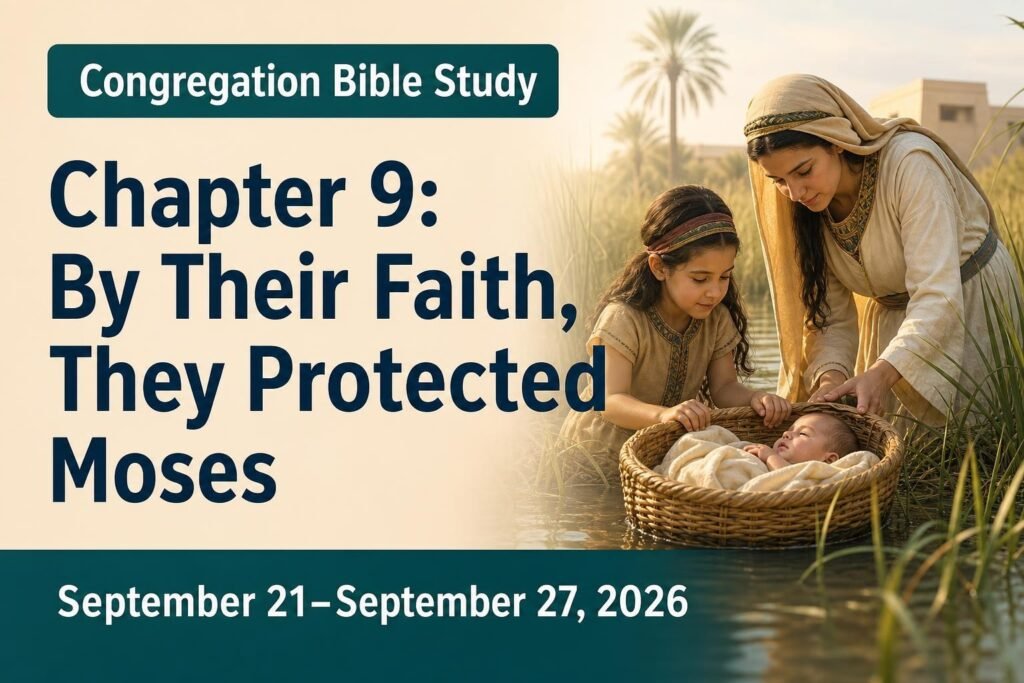
Chapter 9: By Their Faith, They Protected Moses
1. How does archaeology show that the Israelites lived in Egypt? (g04 4/8 pp. 4-5)
Comment 1: Although no direct physical evidence has been found for all the years that the Israelites were in Egypt, there is indirect evidence that supports the Bible account.
Comment 2: Archaeological evidence shows that peoples from the Levant frequently went to Egypt, especially when they experienced droughts. This agrees with the fact that people who spoke Semitic languages emigrated there between 1800 and 1540 B.C.E.
Comment 3: This background makes it very realistic that Jacob’s family arrived in Egypt and that, in time, the Israelites greatly increased in number there.
Comment 4: An Egyptian tomb painting has also been found that depicts slaves making mud bricks. This harmonizes with the Bible’s description of the cruel oppression that the Israelites suffered.
Comment 5: Thus, archaeology does not contradict the account. Rather, several details about the Egyptian setting support the conclusion that the Bible narrative is historical and accurate.
2. What evidence supports what the Bible says about the papyrus basket and Pharaoh’s order to kill the Hebrew babies? (g04 4/8 pp. 5-6)
Comment 1: The basket that Jochebed prepared is a very realistic detail. Papyrus was widely used in Egypt, even to make light, fast boats.
Comment 2: So it made sense to use a papyrus basket and cover it with tar and bitumen. The account reflects materials and practices that were characteristic of that place.
Comment 3: Pharaoh’s order is also believable. Infanticide was viewed as a normal practice in various places and periods of antiquity.
Comment 4: The cruelty of that order helps us understand the tremendous danger faced by Hebrew families. Protecting a baby boy required real faith and courage.
Comment 5: These details do not make the disturbing account less serious, but they do show that the Bible presents a credible and realistic historical situation.
3. What do we know about the Hebrew midwives, and how did Jehovah bless them? (w03 11/1 p. 8 pars. 3-4; it “Midwife”)
Comment 1: Midwives assisted the mother during childbirth, cared for the newborn, and needed skill and experience. It was important work, especially when the birth was difficult.
Comment 2: Shiphrah and Puah were probably chief midwives. Perhaps they were responsible for conveying Pharaoh’s orders to other midwives.
Comment 3: They faced a criminal order: to kill the Hebrew boys. But they did not give in to the fear of man because they feared the true God.
Comment 4: Jehovah protected them from Pharaoh’s anger. In addition, he blessed them by granting them families of their own, a very meaningful reward for them.
Comment 5: Their names and courage were recorded in the inspired Word, whereas the name of that Pharaoh has not been preserved. Jehovah honors those who courageously obey him.
4. How did Miriam demonstrate outstanding faith even when she was already very old? (ijwia article 7 pars. 14-18)
Comment 1: When Moses returned to deliver Israel, Miriam would have been in her eighties. Even so, she supported and encouraged her people during those decisive events.
Comment 2: She saw how Jehovah used Moses and Aaron before Pharaoh, as well as the Ten Plagues. Her faith grew stronger when she saw Jehovah fulfill his promises.
Comment 3: At the Red Sea, Miriam saw that Jehovah could save his people from a humanly impossible situation. She saw that he was more powerful than the Egyptian army.
Comment 4: After the deliverance, she encouraged the women to praise Jehovah. The Bible calls her a prophetess, a special privilege that shows that Jehovah valued her service.
Comment 5: Her example confirms that age does not prevent us from showing faith. Jehovah observes the patience, efforts, and desire to praise him, and he forgets none of them.
What can parents learn from the example of Amram and Jochebed?
Comment 1: Amram and Jochebed did everything they could to protect their son in a very dangerous situation. Parents can trust that Jehovah sees their efforts to care for their family.
Comment 2: They used the time they had with Moses to teach him about Jehovah. This reminds parents that spiritual education should begin when children are very young.
Comment 3: Jochebed showed initiative and prudence when she prepared the basket and placed it among the reeds. Faith does not eliminate the need to take sensible measures.
Comment 4: Although they had to give Moses to Pharaoh’s daughter, they continued trusting in Jehovah. Parents can leave in his hands what they cannot control.
Comment 5: Their good training also benefited Miriam and Aaron, who became faithful servants of God. Spiritual instruction can profoundly influence the whole family.
What can children who have brothers or sisters learn from Miriam’s example?
Comment 1: Miriam kept watch over her baby brother when Jochebed placed him among the reeds. Older siblings can show loving concern for their younger brothers and sisters.
Comment 2: She did not merely watch. When the opportunity arose, she courageously spoke to Pharaoh’s daughter and offered to find someone to nurse the baby.
Comment 3: Miriam used her initiative to help her family. Children too can think of practical ways to help at home and care for their siblings.
Comment 4: In time, Miriam continued serving Jehovah along with Moses and Aaron. Her example teaches that siblings can help one another remain faithful.
Comment 5: Her courage did not depend on being an adult. Jehovah can use and value the faith of young people who do what is right and support their family.
In what ways can you imitate the courage of Shiphrah and Puah?
Comment 1: Shiphrah and Puah teach us to obey Jehovah even when someone in authority pressures us to do something wrong.
Comment 2: They did not allow fear of Pharaoh to become stronger than their fear of God. We too can ask ourselves, “What pleases Jehovah?”
Comment 3: We can imitate their courage by rejecting practices that devalue human life, even if other people consider them normal or acceptable.
Comment 4: Their example also encourages us not to justify a wrong action by saying that we were merely obeying orders. Each person is accountable to Jehovah for his decisions.
Comment 5: When doing what is right seems difficult, let us remember that Jehovah saw what these women did and blessed them. He also appreciates our loyalty.
What does this account teach me about Jehovah?
Comment 1: Jehovah sees those who faithfully serve him, even when they act discreetly. He was watching what Shiphrah and Puah were doing and blessed them.
Comment 2: The account shows that Jehovah equally values the faith and courage of men, women, young people, and older ones. Every faithful servant can be useful to him.
Comment 3: Jehovah can protect his servants and open up unexpected opportunities. Jochebed was able to care for Moses safely and even received payment for doing so.
Comment 4: We also learn that Jehovah is far stronger than human rulers. Pharaoh had power, but he could not prevent Jehovah from protecting Moses.
Comment 5: Jehovah does not forget the efforts of those who praise him. Miriam saw that he fulfills his promises and deserves all honor.
How does this account relate to Jehovah’s purpose and the main theme of the Bible?
Comment 1: Jehovah protected Moses when he was a baby because later he would use him to deliver the Israelites from slavery in Egypt.
Comment 2: Despite the oppression, the people of Israel continued to multiply because Jehovah was blessing them. Human plans could not stop his purpose.
Comment 3: Israel’s deliverance showed that Jehovah fulfills what he promises and acts in behalf of his people. His power was evident when he brought them out of Egypt.
Comment 4: Moses’ family cooperated with faith and courage during an important period in Israel’s history. Jehovah can use his servants to carry out his purpose.
Comment 5: This account strengthens our confidence that no one can thwart Jehovah’s purpose. He always fulfills his promises at the right time.
What would I like to ask the characters in this account when they are resurrected?
Comment 1: We could ask Shiphrah and Puah how they managed to stand firm when Pharaoh gave them such a terrifying order.
Comment 2: It would be interesting to ask Jochebed how she felt when she again had Moses in her care and what she did to teach him about Jehovah.
Comment 3: We could ask Amram how he helped his family remain united and confident in Jehovah during that persecution.
Comment 4: We might want to ask Miriam what she thought when Pharaoh’s daughter found the basket and agreed that she should find a woman to nurse the baby.
Comment 5: It would also be exciting to ask Miriam how seeing the deliverance at the Red Sea and leading the women in praise strengthened her faith.
Discover more from Comentarios para la Reunión TJ
Subscribe to get the latest posts sent to your email.
Receive new posts by email
Create a free account or choose the ad-free plan. During registration, you can choose to receive new posts by email.
Register


