









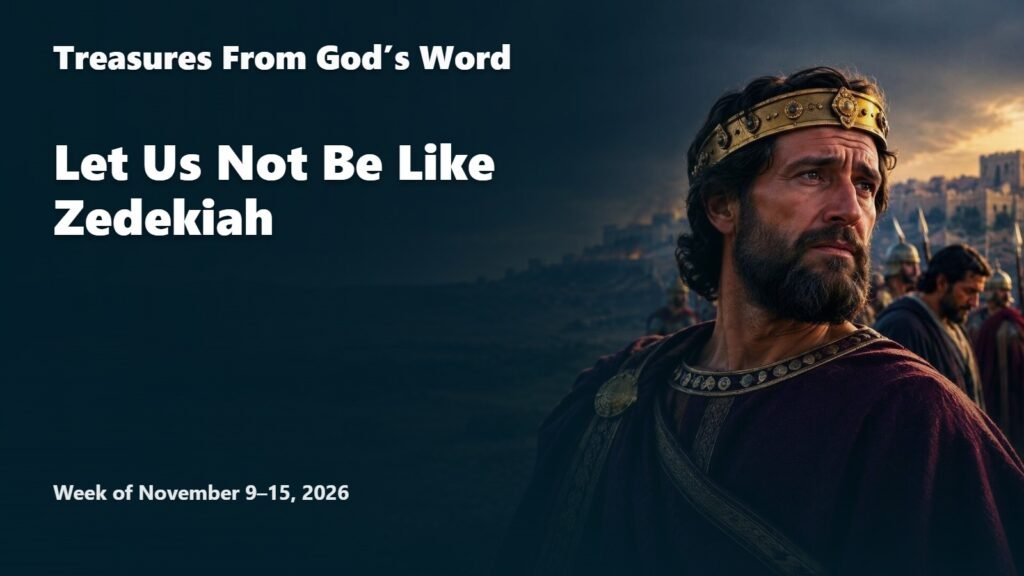
Theme: Let Us Not Be Like Zedekiah
Promising to do what is right may be easy. The difficult part is maintaining that decision when obedience requires us to give up something or face an uncomfortable situation. At such times, we show how much we value our relationship with Jehovah. The account of Zedekiah invites us to examine ourselves, not simply to judge a king of the past. His conduct contains a warning that can protect us. So let us keep this thought in mind: Let us not be like Zedekiah.
Zedekiah lived during a very difficult time for Judah. Through Jeremiah, Jehovah had warned that the people’s continued unfaithfulness would bring calamity from Babylon. So there was no shortage of reasons to listen to Jehovah and change their conduct. But what course did that king take? Let us note how the Bible summarizes his reign. Let us read Jeremiah 52:1, 2.
Jeremiah 52:1-2 — Zedekiah was 21 years old when he became king, and he reigned for 11 years in Jerusalem. His mother’s name was Hamutal the daughter of Jeremiah of Libnah. He continued to do what was bad in Jehovah’s eyes, according to all that Jehoiakim had done.
The account mentions his age and the years he ruled, but the most important detail is Jehovah’s evaluation of his conduct. Zedekiah continued to do what was bad in His eyes. He followed the bad example of Jehoiakim. This helps us remember that what matters is not occupying a position of responsibility or how others view us. What truly matters is whether our decisions agree with what Jehovah considers good.
This also makes us think about the examples we choose to follow. The fact that others act in a certain way does not make that conduct acceptable to Jehovah. Imagine that at work it is considered normal to hide a mistake to avoid a reprimand. A Christian might feel pressure to do the same. But instead of asking only what others are doing, he will ask what decision will please Jehovah. That question helps us keep our judgment clear.
We do not want merely to know what is right; we want to do it. So when reading the Bible, it is good to look for something we can apply to our conduct. Perhaps we need to correct a habit or stop justifying a bad decision. The sooner we respond to Jehovah’s guidance, the better. In Zedekiah’s case, his bad conduct included something especially serious: He did not respect a promise made in God’s name.
Zedekiah had sworn in Jehovah’s name that he would submit to the king of Babylon. Therefore, it was not a commitment that he could simply discard. He had invoked God’s name. Let us see what he did afterward, according to Jeremiah 52:3.
Jeremiah 52:3 — It was because of Jehovah’s anger that these things took place in Jerusalem and in Judah, until he cast them out of his sight. And Zedekiah rebelled against the king of Babylon.
The rebellion mentioned in the verse meant that Zedekiah broke that oath. The problem was not simply a change in his relationship with another king. He had violated a solemn promise made in Jehovah’s name. God considered that unfaithfulness so serious that he announced that Zedekiah would die in Babylon. This account teaches us that a promise to Jehovah does not lose its value when keeping it becomes difficult or when our circumstances change.
Jehovah also hears the promises we make. The most important one is our dedication. When we dedicate our life to him, we promise that we will serve him no matter what happens. That promise does not mean that we will never face pressures. It means that when they come, we will continue to view Jehovah as the One whom we want to obey. We do not want our faithfulness to depend on everything going well, on receiving support from others, or on obedience costing us nothing.
For example, if someone at work or school flirts with us, rejecting that attention may test our determination to obey Jehovah. Or, if we are the only Jehovah’s Witnesses in our family, maintaining Christian conduct may require much effort. In both situations, we can ask Jehovah for help. In this way, we show that our dedication continues to guide our decisions. Zedekiah took the opposite course. Could he escape the consequences because he had decided to act in his own way?
The outcome of his story is painful, but Jehovah preserved it in his Word so that we can learn. As we read it, let us observe whether Zedekiah managed to escape the consequences of his conduct. Let us read Jeremiah 52:8-11.
Jeremiah 52:8-11 — But the Chaldean army pursued the king, and they overtook Zedekiah in the desert plains of Jericho, and all his troops were scattered from his side. Then they seized the king and brought him up to the king of Babylon at Riblah in the land of Hamath, and he passed sentence on him. And the king of Babylon slaughtered Zedekiah’s sons before his eyes, and he also slaughtered all the princes of Judah there at Riblah. Then the king of Babylon blinded Zedekiah’s eyes, bound him with copper fetters, brought him to Babylon, and kept him imprisoned until the day of his death.
Zedekiah was overtaken, his soldiers scattered, and he ended up as a captive. He lost his sons, lost his eyesight, and spent the rest of his life in prison. He could not avoid that terrible outcome. The account does not invite us to dwell on his suffering, but to take the warning seriously. Disobeying Jehovah does not provide a safe way out, even if for a moment it seems to be the easiest solution to a situation that worries us.
Of course, not all our difficulties are the result of a personal mistake. But we must recognize that our decisions have consequences. Before acting, we can stop and think: How will this affect my friendship with Jehovah? What effect might it have on my family? Am I trying to avoid immediate discomfort at the cost of something much more valuable? Thinking this way helps us look beyond the moment and not minimize wrong conduct.
All of this leads us to a very personal question: What can I do to avoid being like Zedekiah? A good answer begins in our daily life. Do we pray to Jehovah to thank him for his love and guidance? Do we make time to read the Bible? These activities help us keep our dedication in mind. They are not merely tasks that we perform out of habit. They allow us to listen to Jehovah’s direction and express our desire to remain faithful.
In addition, we can identify a specific situation in which we need to obey more decisively. Perhaps we need to reject certain attention, improve our conduct at home, or make more room for Bible reading. Instead of being satisfied with a good intention, let us decide what we will do. Our response to trials, whether great or small, shows how much we value what we promised Jehovah. Serving him is not a mere formality; it is a way of life that demonstrates our love for him and benefits us.
Let us not be like Zedekiah. Let us do what is right in Jehovah’s eyes, keep our promises, and think about the consequences before making decisions. We do not have to repeat that king’s mistakes. We can learn from them and choose obedience each day. Jehovah wants what is best for us and promises a wonderful future to those who remain faithful. Let us show by our conduct that we trust in him.
Enjoy every Premium feature
More convenient meeting preparation with full access to the site’s tools.
- Ad-free browsing
- My Recorder and live transcription
- Assignment Review
- Full Academy access
- Audio posts and reading magnifier
- Saved and synced comments
Monthly plan
€3 per monthRenews monthly. Cancel at any time.
Choose monthlyAnnual plan
€30 per yearOne payment for 12 months. No automatic renewal.
Choose annual


