










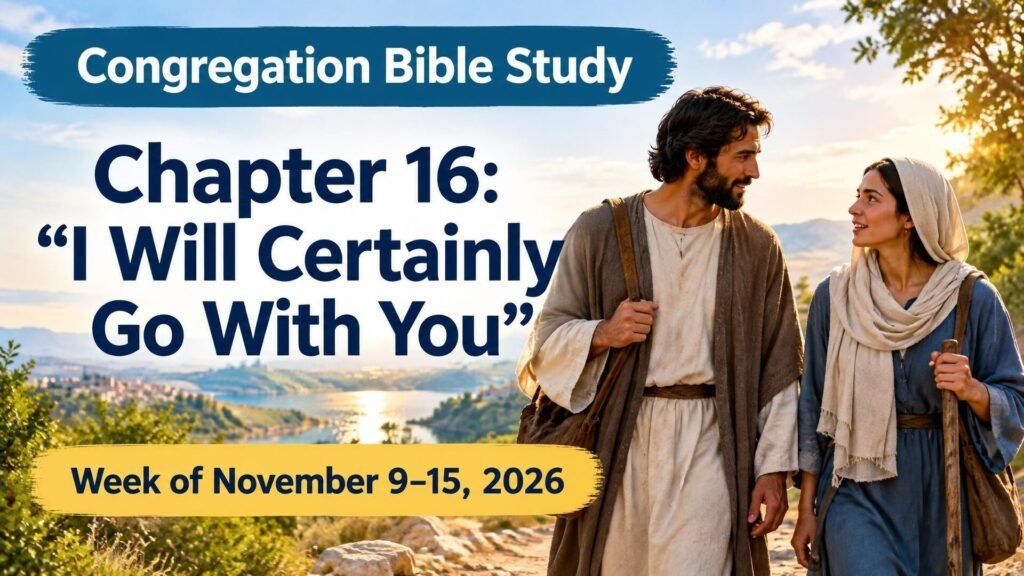
Chapter 16: “I Will Certainly Go With You”
In what ways did Barak and Deborah show courage?
Comment 1: Barak showed courage by gathering 10,000 men to face an army that had 900 war chariots with iron weapons. The difference in weaponry was enormous. Even so, when he received Jehovah’s instruction through Deborah to attack, he descended from Mount Tabor toward the plain. He did not wait until he had an obvious military advantage. His decision shows that he trusted Jehovah’s promise more than what the situation seemed to indicate.
Comment 2: Deborah was courageous because she did not limit herself to conveying Jehovah’s instructions from a place away from the danger. She agreed to accompany Barak and was with him and his men as Sisera’s army approached. She knew how cruel that enemy was, but she was willing to support the assignment Jehovah had given. Her example teaches us that encouraging others sometimes means standing beside them when they have to face a difficult situation.
Comment 3: I am also struck by the fact that Barak’s courage was accompanied by humility. He did not think that asking for help would make him appear weak. He wanted Deborah to accompany him because he knew that Jehovah was using her to guide his people. In addition, he went ahead even though she explained that a woman would receive the honor of putting Sisera to death. For him, obeying Jehovah and delivering the people was more important than receiving all the recognition.
1. What was life like for the Israelites when Sisera dominated them? (w15 8/1 12 par. 6)
Comment 1: It was a life marked by terror. Sisera not only led a powerful army but was also a ruthless general, and the Israelites had suffered that oppression for 20 years. The chapter explains that most people had no weapons or means of defending themselves. Therefore, the danger was not limited to soldiers who might fight; it affected entire families who were defenseless. That setting helps us understand how much courage was needed to face him.
Judges 5:6-7 — In the days of Shamgar the son of Anath, In the days of Jael, the roads were deserted; Travelers kept to the back roads. The villagers in Israel were no more; They were no more until I, Deborah, rose up, Until I arose as a mother in Israel.
Comment 2: Judges 5:6 and 7 shows that the oppression had disrupted even the most normal activities. Travelers avoided the main roads, and villagers had disappeared from the areas where they worked. This was not simply a matter of living under another government; people lacked the security needed to travel and cultivate the land. The contrast with Deborah’s appearance highlights how much the people needed Jehovah’s help.
Comment 3: The reference explains that Canaanite culture and religion were characterized by great cruelty, including child sacrifice and temple prostitution. Being at the mercy of an army from such an environment was terrifying. In addition, the chapter mentions that when attacking towns, the soldiers apparently customarily kidnapped and sexually assaulted young women. This helps us understand why the villages were empty and why the people were so afraid.
Comment 4: The publication indicates that many people probably had to hide in the forests and hills. It presents this as an explanation of the conditions described, not as a confirmed detail about every family. Think of what it would mean to abandon village life and be unable to work the fields in peace. Sisera’s domination had affected the Israelites’ security, livelihood, and family life. They needed a deliverance they could not achieve by their own strength.
2. Why is Deborah not usually included among the 12 judges who served in Israel before Samuel became a prophet? (w86 6/1 31 pars. 6-8)
Comment 1: The reason is that that list of 12 refers to men whom Jehovah specially raised up to save Israel from its oppressors. Deborah did judge the people, but she is first identified as a prophetess. In delivering Israel from Canaanite domination, Barak took the lead at the head of the army. That is why he is normally included in the list. The difference lies in the function used as the basis for counting the judges.
Judges 2:16 — So Jehovah would raise up judges who would save them from the hand of their plunderers.
Comment 2: Judges 2:16 highlights the function of rescuing the people from those who plundered them. That is the sense of the word judge used when speaking of the 12. It is not counting everyone who ever settled a legal case in Israel. Therefore, recognizing that Deborah administered justice does not require including her in that particular list. Both statements fit when we consider which work is being highlighted.
Comment 3: As early as the days of Moses and Joshua, men served as judges to hear legal matters and make decisions. The reference mentions those cases to show that the word judge could include different responsibilities. Thus, it is not enough to find that someone judged Israel to conclude that he belonged to the group of 12 deliverers. This distinction helps us read the account more carefully and understand why the number depends on the criterion being used.
Comment 4: Othniel helps us see clearly what kind of judges are counted in that group. The reference explains that he was the first man Jehovah raised up as a savior after Israel asked for help. It then lists 11 others, including Barak, down to Samson. Thus, the number 12 corresponds to that group of men. It is not intended to be a list of everyone who performed judicial duties during those centuries.
Comment 5: Eli’s case serves as a comparison. The Bible says that he judged Israel, but his principal function was that of high priest, not that of a savior who led the people to freedom through a battle. That is why he too is not usually counted among the 12. This confirms that it is not denying that Deborah judged. Simply put, the list groups those who notably performed the work of deliverance, not everyone who administered justice.
Comment 6: The reference also explains that Acts 13:20 places the period of the judges up to Samuel the prophet. This helps us understand why Samuel and his sons are also not normally included in the list of 12, although they judged the people. In the end, both the period and the function must be considered. In Deborah’s case, not including her in that group does not lessen the importance of her service: Jehovah used her as a prophetess and to help Israel.
3. In what sense was Deborah “a mother in Israel”? (Judg. 4:4, 5; 5:7; w15 8/1 13 par. 1)
Comment 1: She was a mother to Israel because Jehovah chose her to care for the nation as a mother cares for her children. This does not mean that she was a mother in a literal sense. The reference clarifies that she was married to Lappidoth, but we do not know whether they had children. What matters is the work Jehovah entrusted to her in behalf of a suffering people. Deborah fulfilled that responsibility and took part in the steps that would lead to their deliverance.
Judges 4:4-5 — Now Deborah, a prophetess, the wife of Lappidoth, was judging Israel at that time. She used to sit under Deborah’s palm tree between Ramah and Bethel in the mountainous region of Ephraim; the Israelites would go up to her for judgment.
Comment 2: These verses show one specific way Deborah cared for the people: the Israelites went to her to settle their affairs. Her help did not consist only of conveying a message about a future battle. She also dealt with problems affecting people’s lives. That work of listening and judging helps us understand the comparison with a mother. Jehovah used her to give guidance to a nation going through very difficult times.
Comment 3: Another expression of that care was that she sent for Barak and conveyed Jehovah’s instructions to him for delivering Israel. The nation had been under cruel domination for 20 years, and Jehovah had seen a change in the people’s attitude. Deborah cooperated with the help he was giving them. Thus, being a mother to Israel included acting in behalf of their welfare, not merely feeling concern about what was happening to them.
Comment 4: Deborah was also willing to accompany Barak. That detail makes the comparison with a mother especially close: she did not merely say what had to be done but offered her presence and support in a dangerous situation. Without attributing feelings to her that the account does not describe, we can see her willingness to help. Her example reminds me that caring for others means giving them time and, when possible, accompanying them through the difficulties they face.
4. What did Deborah and Barak mean when they sang that the stars “fought against Sisera”? (Judg. 5:20; w05 1/15 25 par. 5)
Judges 5:20 — From heaven the stars fought; From their orbits they fought against Sisera.
Comment 1: The sure point is that there was divine intervention in behalf of Israel. The Bible does not explain exactly how the stars participated, so we cannot identify a specific mechanism. Deborah and Barak were acknowledging that the victory had not been achieved solely by the soldiers’ efforts. Jehovah had acted in behalf of his people, and that is the point the reference emphasizes as certain.
Comment 2: The publication mentions possibilities such as angelic help, meteors interpreted as bad omens, or astrological predictions that proved false. But it does not state that any of these is the explanation. I think it is important to maintain that same caution when commenting on the text. We can explain what we know without turning a possibility into a fact. The passage allows us to recognize Jehovah’s intervention, although it does not give us every detail of the expression used by Deborah and Barak.
Comment 3: The context of the chapter helps us appreciate why they attributed the victory to Jehovah. He threw the Canaanite army into confusion, and the downpour turned the ground into mud, rendering those fearsome chariots useless. This does not by itself settle the exact meaning of the mention of the stars, but it confirms the central idea: Israel received divine help. Barak and Deborah had good reason to praise Jehovah rather than present the victory as an exclusively human achievement.
In what situations could a brother imitate Barak’s humble attitude when he accepted the help of a woman servant of God?
Comment 1: An example appears in the illustration: A sister trains several brothers in operating the heating and air-conditioning system. They listen and take notes. A brother imitates Barak when he recognizes that a sister has knowledge he needs and accepts learning from her. What matters is not proving that he already knows how to do everything but receiving the training and doing the work well. Listening respectfully benefits those who cooperate in that assignment.
Comment 2: He could also imitate Barak if a sister gives him a useful observation about an assignment on which they are both working. For example, she may know a procedure better and point out something that should be corrected. Instead of becoming defensive, he can listen, check what she says, and thank her for the help. Barak did not reject the instructions because they came from a woman. His humility teaches us to value a contribution for its content, without dismissing it because of who makes it.
Comment 3: In marriage, a brother can show that attitude by listening carefully to an observation from his wife that is based on the Bible. It would not be reasonable to think that having a responsibility means never needing help. Barak had an assignment to fulfill and yet sought Deborah’s support. A husband can learn from that example and appreciate his wife’s help in considering a Bible principle or an aspect of a decision he had not taken into account.
Why did Deborah have to be courageous to accompany Barak? In what situations should we be just as courageous as she was?
Comment 1: Deborah needed courage because accompanying Barak meant approaching a confrontation with a ruthless and heavily armed enemy. From Mount Tabor she could see, along with the others, Sisera’s chariots approaching. It was not an imaginary danger. Even so, she was willing to go because Jehovah had given the instructions and promised victory. Her courage was not based on thinking that the enemy was harmless but on trusting Jehovah’s guidance.
Comment 2: We can show similar courage when we support a brother who is facing opposition because of his faith. Perhaps approaching him or accompanying him will cause others to criticize us as well. Deborah’s example encourages us not to let that fear keep us on the sidelines. Without seeking unnecessary dangers, we can consider what specific support is within our reach. At times, being present and listening is a way to show that our desire to help goes beyond words.
Comment 3: We also need courage to support someone who wants to do what is right even though those around him pressure him. It could be a relative or a brother who needs encouragement to remain faithful to a Bible principle. Deborah did not replace Barak in his responsibility, but she stood beside him and conveyed Jehovah’s guidance. We can accompany and encourage others in a similar way, without deciding for them and without allowing the reaction of others to make us withdraw our support.
In what other ways can you imitate the courageous example of Barak and Deborah?
Comment 1: I can imitate Barak when I clearly understand what Jehovah expects of me but find it difficult to do. He did not wait on the mountain until everything seemed favorable. He acted when he received Jehovah’s instruction. In my case, this could mean putting a Bible principle into practice even if it requires changing a custom or facing an uncomfortable conversation. The lesson is not to act impulsively but not to postpone obedience simply because it requires courage.
Comment 2: Another way is to ask for help when I need it. At times pride might make me think that I should solve everything on my own, but Barak sought Deborah’s support because he wanted Jehovah’s guidance. If a responsibility is difficult for me or a problem overwhelms me, I can approach a mature brother and explain what help I need. Recognizing my limitations does not mean that I lack courage. It may be precisely what enables me to move forward and fulfill my responsibility better.
Comment 3: I would like to imitate their willingness to serve without seeking prominence. Barak went ahead even though he knew he would not receive the honor of putting Sisera to death. And Deborah used her position to convey Jehovah’s guidance and support the people. If I focus on having what is right done, rather than on who receives the recognition, it will be easier for me to cooperate. Sometimes courage is needed to put pride aside and sincerely rejoice in another person’s contribution.
What does this account teach me about Jehovah?
Comment 1: It teaches me that Jehovah keeps his word. He had warned the Israelites about the consequences of turning away from him, and he allowed their enemies to dominate them when they rebelled. But he also fulfilled his promise to give Barak the victory. Both parts of the account remind me that his warnings and promises deserve to be taken seriously. It would not be balanced to trust in his help while at the same time disregarding the importance of obeying his instructions.
Comment 2: It also teaches me that Jehovah is merciful. The Israelites had reached that situation because they had turned away from him, but when they changed their attitude and asked him for help, he did not ignore their suffering. He provided guidance and a means of deliverance. This does not mean that their disobedience had no consequences. Rather, it shows that Jehovah does not merely see past mistakes; he also takes into account a change of attitude and listens to those who turn to him again for help.
Comment 3: The account highlights Jehovah’s power. What seemed to make Sisera’s army invincible—its war chariots—became useless when the ground turned into a swamp. For Jehovah, that military superiority was not an insurmountable obstacle. This strengthens my trust in him. It does not mean that I can demand a miraculous solution to every problem, but it does mean that I should not measure what Jehovah can do solely by the resources or possibilities I have before me.
How does this account relate to Jehovah’s purpose and the main theme of the Bible?
Comment 1: The account relates to the sanctification of Jehovah’s name because it makes clear who deserved the credit for the deliverance. The chariots, weaponry, and human strategy did not determine the outcome. Jehovah fulfilled his promise, and Deborah and Barak praised him after the victory. Thus, the account shows that he is powerful and trustworthy. His servants contribute to honoring his name when they acknowledge his help instead of taking all the credit.
Comment 2: It also shows the importance of recognizing Jehovah’s authority. Israel had suffered because of turning away from true worship, whereas Barak received his help by following his instructions. The contrast helps us see that independence from God had not brought security to the people. Deliverance came from him. This fits the Bible’s theme of Jehovah’s sovereignty: the account gives us reasons to trust his way of directing matters and to willingly accept his guidance.
Comment 3: In relation to his purpose, the account shows that Jehovah can deliver his people and that the cruelty of oppressors is not beyond his reach. For 20 years, Sisera had seemed impossible to defeat, but he could not prevent Jehovah from fulfilling what he had announced. That deliverance helps us know the God who carries out his purpose. We do not need to turn every detail of the battle into a prophetic representation in order to learn that no opposition is too powerful for him.
What would I like to ask Barak and Deborah when they are resurrected?
Comment 1: I would like to ask Barak how he experienced the moment of descending from Mount Tabor. The account tells us what he did, but it does not describe everything that went through his mind when he saw Sisera’s chariots. I would also ask him what helped him maintain his confidence while leading those 10,000 men. I would be interested in hearing this because he had to act on the basis of Jehovah’s promise before seeing the outcome. His answers could help us appreciate his faith even more.
Comment 2: I would ask Deborah what it was like to care for the Israelites who came to her to settle their problems. The chapter mentions that work, but I would like to understand better what caring for the nation meant during such a difficult time. I would also ask her how she experienced the opportunity to accompany Barak. We do not know what details she would tell us, but it would be wonderful to hear from her how Jehovah used her to guide and support his people.
Comment 3: I would like to ask both of them what it meant to sing praises to Jehovah after the victory. They had seen a situation that appeared hopeless and then witnessed the deliverance of the people. I would be interested to know which aspects of what happened they remembered most vividly and how that experience affected their trust in Jehovah. The account preserves their song, but conversing with them would allow us to learn many details we do not have now and share in their gratitude.
Enjoy every Premium feature
More convenient meeting preparation with full access to the site’s tools.
- Ad-free browsing
- My Recorder and live transcription
- Assignment Review
- Full Academy access
- Audio posts and reading magnifier
- Saved and synced comments
Monthly plan
€3 per monthRenews monthly. Cancel at any time.
Choose monthlyAnnual plan
€30 per yearOne payment for 12 months. No automatic renewal.
Choose annual


