









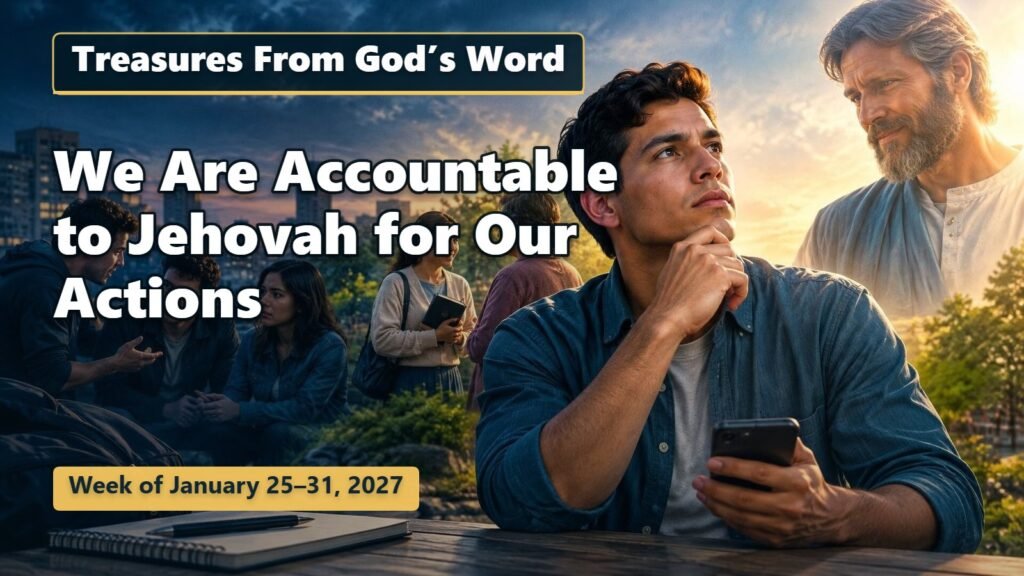
Theme: We Are Accountable to Jehovah for Our Actions
When someone we love makes a bad decision, we may feel guilty. And when we are the ones who make a mistake, it may seem easier to focus on what others have done. To maintain balance, we need to understand how Jehovah views us. He distinguishes between our responsibility and that of others. This distinction helps us accept our mistakes without carrying guilt that does not belong to us.
Chapter 18 of Ezekiel clearly explains this personal responsibility. As soon as we learn what is right and what is wrong, Jehovah holds us accountable for our actions. He does not judge us simply because we belong to a family. What we do matters to him. Let us listen to the basis for this principle at Ezekiel 18:4.
Ezekiel 18:4 — Look! All the souls—to me they belong. As the soul of the father so also the soul of the son —to me they belong. The soul who sins is the one who will die.
Both the father and the son belong to Jehovah. Therefore, each one must answer to him for his own conduct. The text does not indiscriminately assign guilt to the entire family; it identifies the one who sins as responsible. Thus, everyone who has the capacity to reason is judged according to his actions. This reminds us that knowing Jehovah’s standards is not enough; we need to allow them to guide our daily decisions.
For example, think of a situation in which telling the truth might harm us. Perhaps others encourage us to hide it and assure us that everyone does so. But if we know what Jehovah expects, the decision is still ours. Instead of looking for an excuse in the conduct of others, we can ask ourselves, “What must I do to please him?” Recognizing our responsibility helps us act honestly, even when those around us choose a different course.
This principle, however, does not merely require us to answer for our actions; it also relieves us. Since Jehovah distinguishes our decisions from those of others, he does not hold us responsible for what they do. Let us see how he explains this through the case of a father and his son. Let us read Ezekiel 18:14-20.
Ezekiel 18:14-20 — “‘But suppose that a father has a son who sees all the sins his father has committed, and though he sees them, he does not do such things. He does not eat idolatrous sacrifices on the mountains; he does not look up to the disgusting idols of the house of Israel; he does not defile his neighbor’s wife; he does not mistreat anyone; he does not seize what was pledged; he does not take anything in robbery; he gives his own food to the hungry one and covers the naked one with a garment; he refrains from oppressing the poor; he does not engage in usury or charge interest; and he carries out my judicial decisions and walks in my statutes. Such a man will not die because of the error of his father. He will surely keep living. But because his father practiced fraud, robbed his brother, and did what was wrong among his people, he will die for his error. “‘But you will say: “Why does the son not bear guilt because of his father’s error?” Since the son has done what is just and righteous, has kept all my statutes and has observed them, he will surely keep living. The soul who sins is the one who will die. A son will bear no guilt because of the error of his father, and a father will bear no guilt because of the error of his son. The righteousness of the righteous one will be accounted to him alone, and the wickedness of the wicked one will be accounted to him alone.
The son sees his father’s bad conduct, but he decides not to imitate it. Instead of mistreating or stealing, he helps those in need and obeys Jehovah. Does Jehovah condemn him because he comes from that family? No. He takes his own decisions into account. And he also makes the opposite clear: The father does not carry the son’s guilt. Family relationship does not transfer guilt from one person to another. What a just way to treat each one!
This can comfort us if a family member decides to stop serving Jehovah. We may love that person very much and suffer because of the decision, but that pain does not mean that we are guilty of his or her sin. Each dedicated and baptized family member must carry his or her own load of responsibility. We are responsible for examining our conduct, not for assuming the responsibility of others or looking for someone to blame. We will also respect Jehovah’s discipline and the shepherds who protect the congregation, even though the situation may be painful for us.
But what if we are the ones who have done wrong? Does being accountable mean that we can no longer change our standing before Jehovah? His justice does not move him to seek punishment only. He wants to help us do what is right. Let us read Ezekiel 18:21-23.
Ezekiel 18:21-23 — “‘Now if someone wicked turns away from all the sins he has committed and keeps my statutes and does what is just and righteous, he will surely keep living. He will not die. None of the transgressions that he has committed will be held against him. He will keep living for doing what is righteous.’ “‘Do I take any pleasure at all in the death of a wicked person?’ declares the Sovereign Lord Jehovah. ‘Do I not prefer that he turn away from his ways and keep living?’
Jehovah does not minimize sin. The change he describes includes abandoning wrong conduct, obeying his standards, and doing what is just. But neither does he consider someone who has sinned to be condemned to remain the same forever. He takes into account that person’s repentance and new way of acting. If we need to correct something, let us not think that trying is pointless. We can acknowledge the mistake, abandon it, and accept Jehovah’s help to follow a different course.
Thus we see a tender but firm Father, not a cold judge who thinks only about punishment. Remembering this also affects how we read the Bible. It is worth asking ourselves, “When I read the Bible, why is it important to remember that Jehovah is never unjust?” Some Israelites questioned his way of acting. Let us listen to the answer he gave them at Ezekiel 18:25.
Ezekiel 18:25 — “‘But you will say: “The way of Jehovah is unjust.” Please listen, O house of Israel! Is it my way that is unjust? Is it not your ways that are unjust?
If an account raises questions for us, let us remember that the Bible does not always provide every detail. Jehovah does know all the facts. In addition, imperfection can cloud our sense of justice. Therefore, before concluding that one of his decisions was unjust, we need to recognize the limits of our information and of our own judgment.
Jehovah is not obligated to explain every decision to us, nor does he need our approval. That does not prevent us from seeking to understand his way of acting better. As we come to know him and his standards, our trust grows. Even if some questions remain unanswered, we know enough about his justice and compassion to continue trusting in him.
We are accountable to Jehovah for our actions. This truth motivates us to make good decisions, frees us from carrying the sins of others, and gives us hope when we need to make changes. Jehovah is not a cold judge who seeks only to punish. He is a just, tender, and firm Father. Let us accept our responsibility, trust in his way of judging, and allow him to help us do what is right.
More posts for this week





Enjoy every Premium feature
More convenient meeting preparation with full access to the site’s tools.
- Ad-free browsing
- My Recorder and live transcription
- Assignment Review
- Full Academy access
- Audio posts and reading magnifier
- Saved and synced comments
- Support the project and help keep it running
Monthly plan
€3 per monthRenews monthly. Cancel at any time.
Choose monthlyAnnual plan
€30 per yearOne payment for 12 months. No automatic renewal.
Choose annual


