










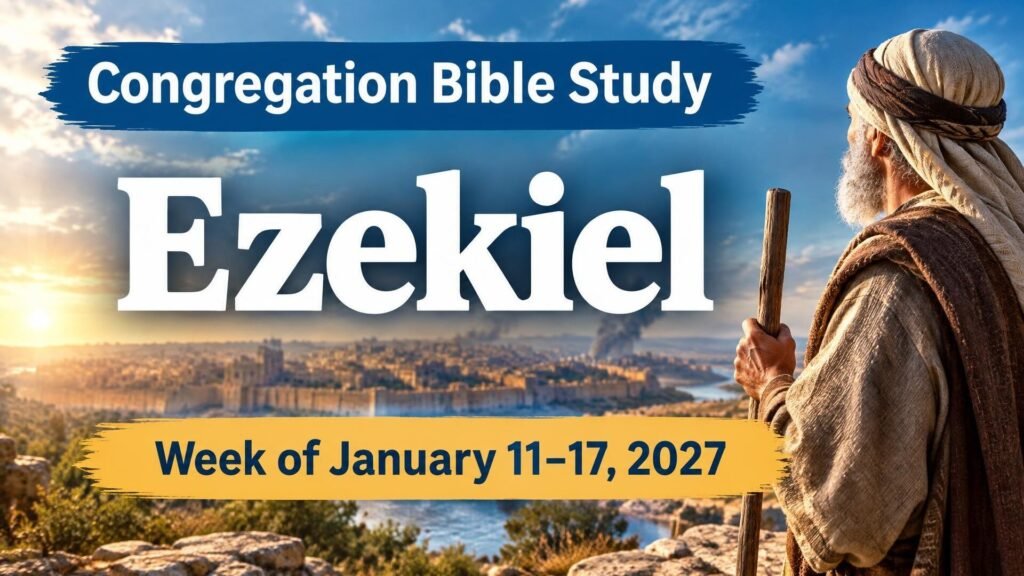
Ezekiel
1, 2. What does the book of Ezekiel teach us about Jehovah’s name?
Comment 1: The book highlights that Jehovah’s name represents his reputation and that clearing it of all lies is what matters most. That is why Ezekiel uses expressions about 60 times indicating that people will have to recognize who Jehovah is. It is not merely a matter of knowing his name but of admitting that he is the Sovereign.
Comment 2: Something that stands out to me is that knowing Jehovah also involves recognizing that he always keeps his word. The disobedient Jews saw this when they received discipline. The nations will have to recognize him as Judge. In contrast, those who worship him as he wishes will come to know him better and better as they experience the fulfillment of his promises and enjoy peace.
Comment 3: The sanctification of Jehovah’s name is closely related to the well-being of those who worship him. The book does not present the clearing of his reputation as something distant from us. When Jehovah acts in behalf of his name, his servants will receive blessings. This helps us give priority to his reputation, confident that he is also interested in our happiness.
3. What does the book of Ezekiel say about the promised Messiah?
Comment 1: Ezekiel announced that David’s throne would not remain empty forever. Although many years would pass, Jehovah would give it to the Messiah, who would have the legal right to occupy it. Jesus, who was a descendant of David, fulfilled that prophecy. This strengthens our confidence in Jehovah: the passing of time does not make him forget his promises or change his purpose.
Comment 2: The Messiah would be more than just a ruler. Jehovah also presented him as a shepherd who would care for his sheep. The reference to his servant David was fulfilled in Jesus, a descendant of that king. This comparison allows us to see what kind of care God’s people would receive: that of a shepherd who is interested in his sheep and feeds them.
John 10:11 — I am the fine shepherd; the fine shepherd surrenders his life in behalf of the sheep.
Comment 3: At John 10:11, Jesus identifies himself as the shepherd who gives his life for the sheep. This fits Ezekiel’s promise that Jehovah would place a shepherd over his people. Knowing that Jesus was willing to sacrifice himself for us helps us to trust his direction. His authority is accompanied by deep love for those he cares for.
4. What do Ezekiel’s visions teach us about the heavenly part of Jehovah’s organization?
Comment 1: The vision of the celestial chariot shows that the heavenly part of Jehovah’s organization is awe-inspiring and very well organized. It is not presented as something disorderly or without direction. This vision helps us broaden our perspective: although we see only a small part of what is happening, Jehovah has a heavenly organization that carries out his will.
Comment 2: Ezekiel was also able to observe the activity of the angels, especially the cherubs. Thus, these visions do not show only the greatness of the heavenly organization; they also allow us to learn something about the service performed by its members. Jehovah wanted his servants on earth to know about that reality, even though they normally cannot see it with their own eyes.
Comment 3: I find it valuable that Jehovah allowed Ezekiel to see these things while he was exiled in Babylon. His situation on earth did not prevent him from receiving a vision of the greatness of the heavenly organization. As we read it, we too can remember that difficult circumstances do not change who Jehovah is or diminish his ability to direct his servants.
5. What does the book of Ezekiel teach us about Jehovah?
Comment 1: It teaches us that Jehovah is kind and merciful. Although the Jews had disobeyed him again and again, he did not punish them without warning them. He explained the consequences of their conduct and offered them forgiveness if they repented. This shows that his warnings were not a lack of love. On the contrary, they gave them the opportunity to change.
Comment 2: Jehovah allowed his people to go into exile, but he did not stop caring for them. He even announced that he would punish the nations that mistreated them. This helps us distinguish between disciplining and abandoning. The Jews needed correction, but Jehovah continued to care about them. His discipline did not give other nations permission to treat them cruelly.
Comment 3: In addition to correcting his people, Jehovah gave them hope. He promised that the exiles would return to Jerusalem and receive blessings. He did not want them to think that their situation would be irreversible. This balance between justice and mercy draws us closer to him: he takes sin seriously, but he also offers a future to those who repent and return to worshipping him as he desires.
6. What important lessons do we find in the book of Ezekiel?
Comment 1: One lesson is that each person is accountable to Jehovah for his or her own actions. We cannot leave our relationship with him in the hands of our family or think that others can obey for us. This personal responsibility moves us to examine our decisions and ask ourselves whether they really reflect respect for Jehovah and his standards.
Comment 2: We also learn that our actions affect Jehovah and his name. What we do is not a matter of indifference to him. The unfaithful conduct of the Israelites caused him pain and damaged his reputation among the nations. Keeping this in mind gives us a very deep reason to obey: we do not want to sadden Jehovah or cause others to have a bad impression of him.
Comment 3: The book connects our life with respecting Jehovah’s name and giving him pure worship. Therefore, it is not enough to claim that we know him or that we belong to his people. Our way of life must agree with what he asks. This teaching encourages us to review both our worship and the everyday decisions we make.
7. What do we know about the prophet Ezekiel?
Comment 1: Ezekiel wrote the book that bears his name, and his name means “God strengthens.” His father was a priest and served in Jerusalem. Ezekiel may have been born around 643 B.C.E. These details help us place him in context: He was a real person, with a family connected with service in Jerusalem, who later had to live in exile.
Comment 2: In 617 B.C.E., when Jehoiachin surrendered to Nebuchadnezzar, Ezekiel was taken to Babylon. He would have been about 26 years old. Four years later, when he was about 30, Jehovah appointed him as a prophet. So his prophetic service began while he was in exile. His experience reminds us that difficult circumstances do not necessarily prevent us from continuing to be useful to Jehovah.
Comment 3: Ezekiel was a contemporary of Jeremiah, Daniel, and Obadiah. Jeremiah served in Judah, while Daniel was in Babylon, as was Ezekiel. Knowing this helps us relate the Bible accounts to one another and understand that Jehovah was providing direction through several prophets. Their messages complemented one another and addressed the needs of his people during those difficult years.
8. Whom were Ezekiel’s prophecies directed to?
Comment 1: They were directed to the Jews exiled in Babylon. Some, like Ezekiel, had arrived before the destruction of Jerusalem, while others arrived afterward. This difference is important for understanding their messages. The exiles needed to understand both what would happen to Jerusalem and the hope that Jehovah would offer them after its fall.
Comment 2: Box 26-B helps us understand what those who listened to Ezekiel were experiencing. The Babylonians taunted them, and returning to their homeland must have seemed impossible to them because Babylon did not release its prisoners. With that background, we better understand how much they needed Jehovah’s guidance and why his restoration promises could give them such valuable hope.
Comment 3: Although they were exiles, they enjoyed a measure of freedom. Faithful ones could meet together to read the Scriptures, and some had houses and engaged in commercial activities. Jehovah had instructed them to lead a peaceful life there. This shows that they could continue worshipping him even without access to the temple. Their example encourages us to take advantage of the opportunities for worship that we have, even when our circumstances are not ideal.
9. What did Jehovah want the Jews who were in Babylon to understand?
Comment 1: Jehovah wanted them to accept his discipline and understand why they were in exile. It was not simply a political or military misfortune. Their apostate practices had profaned God’s name. Therefore, they needed to acknowledge their responsibility and understand that Jehovah deserved obedience and worship that was in harmony with his standards, not with their own preferences.
Comment 2: The content of the message changed when Jerusalem was destroyed. Before that, Ezekiel announced the city’s condemnation because of the horrible things being done there. Afterward, Jehovah conveyed words filled with hope. This change shows that Jehovah wanted them not only to acknowledge their errors but also to help them look ahead and trust in the restoration he promised.
Comment 3: Not everyone reacted in the same way: Some mocked Ezekiel, while others believed him. This leads us to think about our own reaction to correction. What matters is not merely listening to advice but recognizing whether we need to change. Accepting Jehovah’s discipline means stopping our excuses and showing by our conduct that we respect his way of viewing matters.
10. How is the book of Ezekiel organized?
Comment 1: The book follows a chronological order for the most part, but it is also arranged by themes. After Ezekiel’s appointment, it presents three major groups of prophecies: the destruction of Jerusalem, the condemnation of the surrounding nations, and the restoration of Israel. Keeping this outline in mind helps us locate each vision and better understand its purpose.
Comment 2: Ezekiel indicated the year, month, and day of many of his prophecies. To count the years, he used the exile of King Jehoiachin in 617 B.C.E. as the starting point. These details make it possible to relate the messages to specific events. These are not prophecies presented without context; we can see when he received them and what was happening.
Comment 3: The time line in Box 26-C makes it possible to see that Jehovah warned about Jerusalem long before the siege. Ezekiel began prophesying in 613 B.C.E., and the siege began in 609 B.C.E. Afterward came messages against the nations and words of hope. That sequence highlights both Jehovah’s patience in giving warning and his interest in comforting his people.
11. What things did Jehovah ask Ezekiel to do, and why?
Comment 1: Jehovah asked him to act out some prophetic messages. For example, he had to lie on his side with a brick in front of him, shave his head and beard, prepare baggage and take it out of the city, and join two sticks together. Although these were unusual actions, they served a purpose: to awaken the interest of the exiles so that they would want to understand the message Jehovah was giving them.
Ezekiel 4:1-3 — “And you, son of man, take a brick and put it in front of you. Engrave on it a city—Jerusalem. Lay siege to it, build a siege wall against it, raise up a siege rampart against it, set up camps against it, and surround it with battering rams. Take an iron griddle and place it as an iron wall between you and the city. Then set your face against it, and it will be under siege; you are to besiege it. This is a sign to the house of Israel.
Comment 2: At Ezekiel 4:1-3, we see how specific one of those portrayals was. The brick represented Jerusalem, and the items placed around it represented a siege. It was not a strange action without explanation but a sign for Israel. Jehovah was communicating visibly what would happen, so that observers would pay attention to the warning.
Comment 3: Ezekiel’s willingness to obey also teaches us something. His assignment did not consist only of speaking; at times he had to do difficult or unusual things because Jehovah asked him to. We do not need to imitate those portrayals, but we can imitate his humility. When teaching, what matters is communicating God’s message clearly, not drawing attention to ourselves.
12. What did Ezekiel see before Jehovah appointed him as a prophet?
Comment 1: In 613 B.C.E., Ezekiel received an impressive vision of the heavens. He saw living creatures that were later identified as cherubs, a celestial chariot, and a bright light associated with Jehovah’s glory. Before receiving his commission, he was able to behold that manifestation of the greatness of the God whom he was going to represent.
Comment 2: An interesting detail is that the account later identifies those living creatures as cherubs. This reminds us of the importance of allowing the Bible itself to explain its visions. Instead of assigning meanings that the text does not provide, we can compare related passages. In this way, we better understand what Jehovah wanted to reveal and avoid adding personal ideas.
Comment 3: After the vision, Jehovah appointed Ezekiel as a prophet and watchman. He would have to deliver a warning, whether people listened or not. This sequence helps us appreciate the seriousness of his commission: the message came from the God whose glory he had just beheld. Ezekiel had to be faithful to that responsibility, without allowing the people’s reaction to determine whether he would speak or not.
13. What prophecies did Ezekiel act out?
Comment 1: Ezekiel acted out the siege that Jerusalem would suffer and the famine that would occur inside the city. These scenes gave visible form to Jehovah’s warning. It was not a matter of announcing difficulties in a vague way; the inhabitants of Jerusalem would suffer concrete consequences for their rebellion. The dramatization helped the exiles understand the seriousness of what was approaching.
Comment 2: Another dramatization involved shaving his head and beard and doing with the hair whatever Jehovah directed him to do. This showed what would happen to the inhabitants when Jerusalem was destroyed. Ezekiel did not choose the symbols or their meaning on his own. His responsibility was to follow Jehovah’s instructions and communicate the message faithfully.
Comment 3: The context explains why those judgments were announced: the Israelites were practicing idolatry. Therefore, the scenes of the siege and destruction should not be separated from the spiritual problem behind them. For us, the lesson is to take pure worship seriously. Jehovah does not consider it a minor matter when those who bear his name turn away from him.
14, 15. What did Jehovah foretell about Jerusalem?
Comment 1: Jehovah foretold that he would punish Jerusalem for the detestable things being done there. In the vision, a man marked those who were sighing and groaning over that situation, and those without the mark were executed. This shows that Jehovah saw the differences between people. He was not indifferent when someone sincerely rejected the wickedness surrounding him.
Comment 2: Although Jerusalem’s destruction was certain, Jehovah also announced that some exiles would return. Thus, the message included judgment, but it did not eliminate all hope. It helps us understand Jehovah’s balance: He does not overlook rebellion, while at the same time he can ensure a future for those who return to worship him in the way he approves.
Comment 3: Ezekiel had to act out the exile and prophesy against the false prophets. In addition, he explained to the elders that nothing would prevent Jerusalem’s destruction. This reminds us that a reassuring message is not always true. The Jews needed to accept Jehovah’s warning, even though it was painful, rather than trust in words that allowed them to continue without changing.
16-18. What comparisons did Jehovah use?
Comment 1: Jehovah compared Jerusalem to a worthless vine that was useful only as firewood and to a beloved wife who had become unfaithful. The two comparisons highlighted different aspects of the problem: the city was not fulfilling its purpose and had betrayed its relationship with Jehovah. Thus, it was clear that its condemnation was not arbitrary but was the consequence of persistent conduct.
Comment 2: He also compared King Zedekiah to a vine that would dry up. And he presented Samaria and Jerusalem as two sisters who had become prostitutes, called Oholah and Oholibah. Samaria had already been destroyed, but Jerusalem had not learned from that example. These comparisons encourage us to take warnings seriously and not repeat mistakes whose consequences we already know.
Comment 3: When the attack on Jerusalem began, Jehovah compared it to a rusty cooking pot that had to be put on the fire. That image emphasized how deeply rooted its corruption was. However, amid those messages Jehovah assured that he would judge each person for his own actions. The city’s condemnation did not mean that he had stopped distinguishing the righteous.
19, 20. Which nations did Jehovah condemn, and why?
Comment 1: Jehovah condemned Ammon, Moab, Edom, and Philistia, and afterward announced judgments against Tyre, Sidon, and Egypt. These messages appear in the part of the book that deals with the nations that rejoiced over Jerusalem’s fall. Although Jehovah was disciplining his people, he did not approve of the attitude of those who enjoyed their suffering.
Comment 2: Between 607 and 606 B.C.E., Ezekiel announced the destruction of Tyre and Sidon and was instructed to sing a dirge over Tyre. This shows that the judgment messages were not limited to Jerusalem. The neighboring nations also had to answer to Jehovah for their conduct and for the way they treated his people.
Comment 3: Chapters 29 through 32 contain messages against Egypt that were received between 607 and 591 B.C.E. Jehovah announced that Babylon would invade that country. One lesson from all these prophecies is that we should not rejoice over the misfortunes of others. The fact that someone is suffering the consequences of his mistakes does not give us reason to treat him with contempt.
21, 22. What positive things does Ezekiel prophesy for the Israelites?
Comment 1: Jehovah promised to care for his sheep and to appoint one shepherd over them. This contrasted with the conduct of Israel’s false shepherds, against whom he was very angry. The exiles could know that the poor care they had received did not reflect what Jehovah was like. He was interested in their welfare and assured them of very different care.
Comment 2: Ezekiel announced that the Jews would return to their land. The vision of a valley full of bones coming to life illustrated the hope of restoration in a very striking way. Although the destruction of Jerusalem could make everything seem lost, Jehovah could change the situation. His promises gave the exiles reasons to look to the future with confidence.
Comment 3: By joining two sticks together, Ezekiel represented that the two-tribe kingdom and the ten-tribe kingdom would once again become one nation. So restoration would not consist merely of returning to a territory. There would also be unity among God’s people. That promise highlights how much Jehovah values those who worship him being united rather than remaining divided.
23, 24. What will Jehovah do when Gog attacks his people, and what vision does Ezekiel have?
Comment 1: When Gog attacks his people, Jehovah will intervene to defend them and will put an end to Gog and his army. The message does not leave deliverance in the hands of God’s people’s military ability. Jehovah is the one who will act. Knowing this helps us to focus our confidence on him and to remember that opposition cannot prevent him from accomplishing his purpose.
Comment 2: In 593 B.C.E., Ezekiel received a vision of an immense temple. An angel measured its different parts, and Jehovah’s glory filled the temple. Ezekiel also received instructions about sacrifices, priests, and the distribution of the land. The vision highlighted Jehovah’s righteous standards and assured that pure worship would be restored.
Comment 3: Other details of the vision included the river flowing from the temple and the city whose name indicated that Jehovah was there. For the exiles, the most important part of restoration would not simply be having a land in which to live again. They would regain pure worship. This reminds us that enjoying Jehovah’s approval is worth more than any material comfort.
a. According to Ezekiel 18:19-22, how does Jehovah decide whether a person is good or bad?
Ezekiel 18:19-22 — “‘But you will say: “Why does the son not bear guilt because of his father’s error?” Since the son has done what is just and righteous, has kept all my statutes and has observed them, he will surely keep living. The soul who sins is the one who will die. A son will bear no guilt because of the error of his father, and a father will bear no guilt because of the error of his son. The righteousness of the righteous one will be accounted to him alone, and the wickedness of the wicked one will be accounted to him alone. “‘Now if someone wicked turns away from all the sins he has committed and keeps my statutes and does what is just and righteous, he will surely keep living. He will not die. None of the transgressions that he has committed will be held against him. He will keep living for doing what is righteous.’
Comment 1: Jehovah judges each person by his own conduct. These verses explain that a son does not bear the guilt of his father’s sin, nor does the reverse happen. This shows how just Jehovah is: He does not consider us good or bad simply because of our family. Each one can show, by his decisions and obedience, what kind of person he wants to be.
Comment 2: The passage also shows that Jehovah takes sincere changes into account. If someone abandons his bad conduct and begins to practice what is righteous, his past does not condemn him forever. Jehovah does not confine him to a label. This encourages us to trust in His mercy and not to consider lost someone who is making real efforts to change.
Comment 3: Jehovah’s evaluation is based on facts, not merely on what a person claims to be. The text speaks of abandoning sins, obeying, and doing what is right. Therefore, repentance must be seen in one’s conduct. When examining ourselves, we can ask whether our changes are merely words or whether our daily decisions show that we want to please Jehovah.
b. Notice how Jehovah will react when Gog attacks his people (38:18, 19, 22). How does this make you feel?
Ezekiel 38:18-19 — “‘On that day, the day when Gog invades the land of Israel,’ declares the Sovereign Lord Jehovah, ‘my great rage will flare up. In my zeal, in the fire of my fury, I will speak; and in that day there will be a great earthquake in the land of Israel.
Comment 1: Jehovah’s reaction gives us security because it shows that he will not be indifferent to the attack against his people. The passage describes the intensity of his indignation. We are not speaking about a distant God who watches without acting. Knowing that he cares so deeply about his servants helps us trust in his protection and strengthen our relationship with him now.
Comment 2: It also fills us with gratitude. Jehovah’s people will not have to face Gog alone; Jehovah has promised to defend them. Thinking about this helps us not to measure the future solely by the strength the enemies may appear to have. What will be decisive is what Jehovah does. That confidence does not come from feeling strong, but from knowing the God we serve.
Comment 3: At the same time, this prophecy inspires deep respect for Jehovah. His love for his people does not mean that he will tolerate aggression against them indefinitely. The time will come for him to act with justice. Rather than fueling fear or speculation about details, we can focus on what the prophecy makes clear: Jehovah will defend his people and fulfill his word.
c. Jehovah promises his people “showers of blessings” (34:26). How have these words come true in your life?
Ezekiel 34:26 — I will make them and the area around my hill a blessing, and I will cause the rain to fall at the proper time. Blessings will pour down like the rains.
Comment 1: One blessing we can value is getting to know Jehovah better through his Word. The book of Ezekiel itself teaches us that he is just, merciful, and faithful to his promises. As we think about how that knowledge influences our decisions and gives us hope, we can identify specific blessings. Not everything valuable that we receive from Jehovah can be measured in material things.
Comment 2: Another blessing we can recognize is the opportunity to meet together to worship Jehovah and listen to the Scriptures. Faithful exiles valued that opportunity even while far from the temple. Their example helps us think about our own meetings: what we learn, the encouragement we receive, and the help to remain faithful. These are good reasons to express gratitude to Jehovah.
Comment 3: We can also meditate on the hope Jehovah has given us. The exiles needed to know that their situation would not last forever, and his promises helped them look beyond the present. Similarly, knowing Jehovah’s purpose can help us cope with our difficulties. When preparing a personal comment, we can mention how that hope is really helping us.
a. Why is Ezekiel called “son of man”? (3:17; nwt glossary). Who else is called that in the Bible? (Mt 20:28).
Ezekiel 3:17 — “Son of man, I have appointed you as a watchman to the house of Israel; and when you hear a word from my mouth, you must warn them from me.
Comment 1: The expression applied to Ezekiel highlights that he was a human being. Although Jehovah had given him a very important responsibility as a watchman, the message did not originate with him. He had to listen to Jehovah and warn on His behalf. This helps us to keep the right perspective: what gave authority to his words was not his personal greatness, but the God who sent him.
Matthew 20:28 — Just as the Son of man came, not to be ministered to, but to minister and to give his life as a ransom in exchange for many.”
Comment 2: At Matthew 20:28, Jesus also uses that expression to refer to himself. The verse explains that he came to minister and to give his life as a ransom. Therefore, in our answer we can identify Jesus and highlight what he said about his mission. His example teaches us that true greatness is shown by serving, not by expecting others to attend to us.
Comment 3: Although the expression appears in both cases, the responsibilities mentioned are different. Ezekiel had to convey Jehovah’s warnings; Jesus came to minister and give his life as a ransom. Comparing the passages helps us to focus on the context instead of assuming that the same expression makes their functions identical. Each text highlights a specific task that we should respect when explaining it.
b. How was Ezekiel 17:16 fulfilled? (Jer 52:11).
Ezekiel 17:16 — “‘“As surely as I am alive,” declares the Sovereign Lord Jehovah, “he will die in Babylon, in the place where the king who made him king lives, the one whose oath he despised and whose covenant he broke.
Comment 1: Ezekiel announced that Zedekiah would die in Babylon. The prophecy connected that outcome with his despising an oath and breaking a covenant. It was not a general warning about possible difficulties; it indicated where his life would end. The later account by Jeremiah confirms that Zedekiah was taken precisely to Babylon and remained imprisoned there until his death.
Jeremiah 52:11 — Then the king of Babylon blinded Zedekiah’s eyes, bound him with copper fetters, brought him to Babylon, and kept him imprisoned until the day of his death.
Comment 2: Jeremiah 52:11 relates that the king of Babylon blinded Zedekiah, bound him with fetters, and took him captive. The detail that directly confirms the prophecy is that he remained imprisoned until he died. By comparing both accounts, we see how one book announces the outcome and another records its fulfillment. That agreement strengthens our confidence in Jehovah’s word.
Comment 3: This fulfillment also reminds us that Jehovah takes the word given seriously. The prophecy does not present breaking an oath as an unimportant matter. Although we may not be in Zedekiah’s situation, we can learn to be trustworthy people and not treat our commitments lightly. Decisions have consequences, and Jehovah’s warnings deserve our attention.
c. How does Matthew’s genealogy show that Jesus had “the legal right” to receive “the crown”? (21:26, 27).
Ezekiel 21:26-27 — This is what the Sovereign Lord Jehovah says: ‘Remove the turban, and take off the crown. This will not remain the same. Raise up the low one, and bring low the high one. A ruin, a ruin, a ruin I will make it. And it will not belong to anyone until the one who has the legal right comes, and I will give it to him.’
Comment 1: Ezekiel announced that the crown would belong to no one until the one with the legal right to receive it came. Matthew’s genealogy connects Jesus with the family of King David, from which the Messiah was to come. Thus, it helps to identify him as the promised heir. His right was not based on personal ambition, but on Jehovah’s purpose.
Comment 2: The genealogy helps us to understand that the promise made to David’s family was not lost during the many years when his throne was vacant. Jesus belonged to that family. In this way, Matthew’s information and Ezekiel’s prophecy complement each other: one announces the future heir, and the other helps us to recognize his connection with the promised line.
Comment 3: An important detail of the prophecy is that Jehovah would be the one to give the crown. The genealogy points to Jesus’ connection with David, but his appointment as King depends on Jehovah. This helps us to view the Kingdom as part of God’s purpose, not as a human project. It also assures us that Jehovah fulfills his promises even if many years pass between the announcement and the fulfillment.
a. How can what Ezekiel 18:21, 22 says help you if you feel bad about past mistakes?
Ezekiel 18:21-22 — “‘Now if someone wicked turns away from all the sins he has committed and keeps my statutes and does what is just and righteous, he will surely keep living. He will not die. None of the transgressions that he has committed will be held against him. He will keep living for doing what is righteous.’
Comment 1: These verses assure us that Jehovah does not condemn forever a person who repents and changes his conduct. If we have abandoned our wrongs and strive to obey him, we can trust his promise of forgiveness. This does not mean minimizing what we did, but giving importance also to what Jehovah says: He allows a repentant person to have a future.
Comment 2: The passage helps us to concentrate on what we can do now. We cannot change the past, but we can abandon what is bad, obey Jehovah, and practice what is righteous. Those changes are important to him. Rather than thinking that our mistakes define us forever, we can continue building a relationship with Jehovah through decisions that demonstrate sincere repentance.
Comment 3: At times, continuing to feel sad about a mistake could lead us to think that Jehovah has not forgiven us. But this passage directs our attention to his way of judging, not merely to our feelings. We can acknowledge the harm caused and at the same time accept his mercy. Trusting in Jehovah also includes believing that he fulfills what he promises regarding forgiveness.
b. How does Ezekiel 3:18, 19 relate to the preaching work?
Ezekiel 3:18-19 — When I say to someone wicked, ‘You will surely die,’ but you do not warn him, and you fail to speak in order to warn the wicked one to turn from his wicked course so that he may stay alive, he will die for his error because he is wicked, but I will ask his blood back from you. But if you warn someone wicked and he does not turn back from his wickedness and from his wicked course, he will die for his error, but you will certainly save your own life.
Comment 1: Ezekiel had the responsibility to convey Jehovah’s warning. He could not decide to remain silent because the message was difficult. That sense of responsibility helps us to value the preaching work. What we share can help people to change and draw close to Jehovah. Therefore, we strive to participate seriously, without treating the message as though it were something of little importance.
Comment 2: The text distinguishes between the responsibility to warn and the decision of the one who listens. Ezekiel had to speak, but he could not force anyone to change. This can help us when a person does not accept the message. We strive to explain it clearly and respectfully, but we do not measure our faithfulness solely by the response we receive. Each listener has to make his own decision.
Comment 3: The warning had a positive purpose: that the person would abandon his bad course and keep living. This detail helps us to maintain the right motive when preaching. We are not seeking to condemn or win arguments; we want others to receive help. When we remember that the message can benefit the person listening to us, it is easier to convey it with sincere interest and not in a cold or mechanical way.
c. What can the elders learn from Ezekiel 34:11-16? (1Pe 5:2).
Ezekiel 34:11-16 — “‘For this is what the Sovereign Lord Jehovah says: “Here I am, and I myself will search for my sheep, and I will care for them. I will care for my sheep like a shepherd who has found his scattered sheep and is feeding them. I will rescue them from all the places where they were scattered in the day of clouds and thick gloom. I will bring them out from the peoples and collect them together from the lands and bring them into their land and feed them on the mountains of Israel, by the streams and by all the dwelling places of the land. In a good pasture I will feed them, and the land where they graze will be on Israel’s high mountains. They will lie down there in a good grazing land, and they will feed on choice pastures on the mountains of Israel.” “‘“I myself will feed my sheep, and I myself will make them lie down,” declares the Sovereign Lord Jehovah. “The lost one I will search for, the stray I will bring back, the injured I will bandage, and the weak I will strengthen; but the fat one and the strong one I will annihilate. I will feed that one with judgment.”
Comment 1: Jehovah presents himself as a shepherd who searches for his sheep and personally cares for them. The elders can imitate that interest by taking the initiative to help instead of always waiting for someone to ask. The passage mentions lost, straying, injured, and weak sheep. This reminds us that needs differ and that care must be adapted to each person.
Comment 2: Another lesson is the importance of feeding the flock. Jehovah not only gathers his sheep; he also leads them to good pastures and gives them rest. The elders can reflect that care by using God’s Word to strengthen the brothers. Their attention should not be limited to correcting problems; it should also help each one to be well-fed spiritually.
1 Peter 5:2 — Shepherd the flock of God under your care, serving as overseers, not under compulsion, but willingly before God; not for love of dishonest gain, but eagerly;
Comment 3: First Peter 5:2 highlights the attitude with which they should care for the flock: willingly and eagerly, not under compulsion or for financial gain. This complements Ezekiel’s description very well. It is not enough to carry out certain tasks; the motive matters. The elders imitate Jehovah when they view the brothers as valuable sheep who deserve attention, not as a burden to be endured.
4. WHAT OTHER VALUABLE POINTS HAVE YOU FOUND IN THIS BIBLE BOOK?
Comment 1: I find it valuable that the box about the exile shows faithful Jews gathering to read the Scriptures even though they could not offer sacrifices at the temple. They did not allow the lack of ideal conditions to bring their worship to an end. This encourages us to focus on what we can do to stay close to Jehovah when our circumstances change.
Comment 2: Another detail is that life in Babylon eventually became relatively peaceful, and many Jews preferred to stay there when the exile ended. Without judging each person’s motives, this fact invites us to examine our priorities. We can ask ourselves whether comfort influences our decisions too much and whether we maintain our interest in the opportunities we have to support pure worship.
Comment 3: It is also valuable to observe when Jehovah gave each message. He warned before the destruction and offered hope when Jerusalem had fallen. He did not always speak in the same way; rather, he addressed the situation of his people. We can learn from that balance when helping others: sometimes a clear warning is needed, while at other times what they need most is comfort and hope.
More posts for this week


Enjoy every Premium feature
More convenient meeting preparation with full access to the site’s tools.
- Ad-free browsing
- My Recorder and live transcription
- Assignment Review
- Full Academy access
- Audio posts and reading magnifier
- Saved and synced comments
- Support the project and help keep it running
Monthly plan
€3 per monthRenews monthly. Cancel at any time.
Choose monthlyAnnual plan
€30 per yearOne payment for 12 months. No automatic renewal.
Choose annual


