









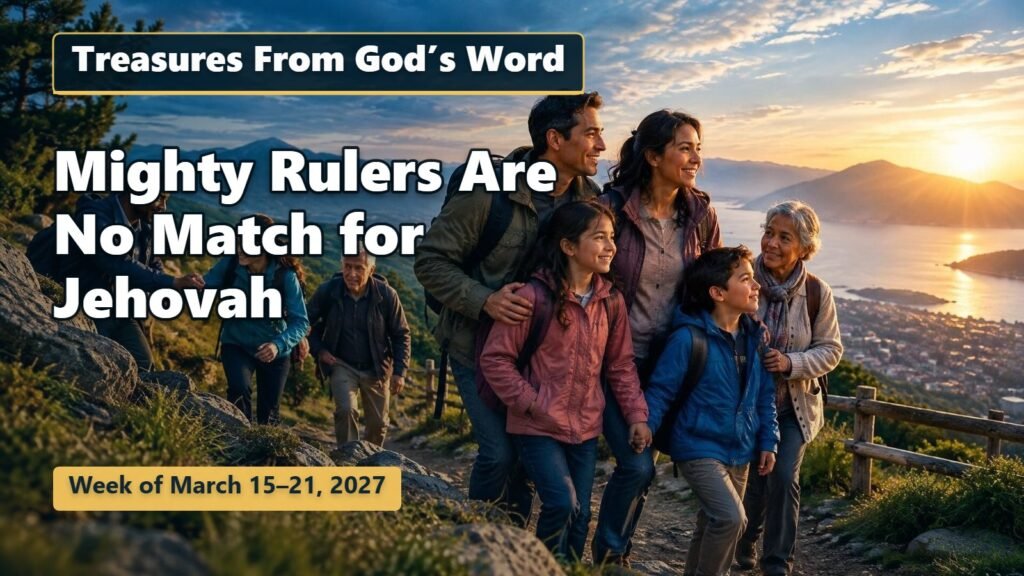
Theme: Mighty Rulers Are No Match for Jehovah
When rulers make a show of strength, it is easy to feel small. Their decisions can affect countless people, and their threats can cause fear. But there is something we should never lose sight of: their power has limits. Jehovah’s does not. Remembering that difference helps us look to the future calmly. Mighty rulers are no match for Jehovah. What he said about Pharaoh helps us understand why.
First, let us consider the images Jehovah used to describe the king of Egypt. He did not compare him to a helpless animal but to creatures that could command respect and inspire fear. In this way, he acknowledged that Pharaoh wielded considerable power. However, the description also showed what that ruler did with his strength and what his end would be. Let us listen to Ezekiel 32:2.
Ezekiel 32:2 — “Son of man, sing a dirge concerning Pharaoh king of Egypt, and say to him, ‘You were like a strong young lion of the nations, But you have been silenced. You were like a sea monster, thrashing about in your rivers, Muddying the waters with your feet and fouling the rivers.’
A young lion conveys a sense of vigor. The image of a sea monster also suggests a strength that is difficult to contain. But notice the effect Pharaoh had: Instead of keeping the waters clean, he muddied them. The comparison does not present power that benefited everyone. It describes a ruler whose activity disturbed others. His strength could impress people, but it did not make him worthy of trust.
In addition, Jehovah commanded that a dirge be sung concerning him. No matter how strong he seemed, his power would not last. What do we learn? We should not confuse an imposing appearance with lasting security. When a ruler impresses us because of his authority or threats, let us remember Pharaoh. Jehovah saw his limitations. And he not only announced Pharaoh’s fall; he also explained how those who saw it would react.
The destruction of Egypt would not go unnoticed. Other peoples and their kings would have to face an unsettling reality: A power that had seemed so strong had been unable to avoid Jehovah’s judgment. That fall would expose the fragility of human power. Those who had previously felt secure would realize that they too were vulnerable. Let us note the intensity of their reaction as we read Ezekiel 32:10.
Ezekiel 32:10 — I will cause many peoples to be awestruck, And their kings will shudder in horror over you when I brandish my sword before them. They will tremble continually, each fearing for his life, On the day of your downfall.’
This was not simply a matter of surprise. Jehovah announced astonishment and continuing fear. Those kings would be concerned about their own lives. Why? Because Egypt’s fall would demonstrate that a ruler’s power could not protect him from Jehovah. What happened to Pharaoh would shatter the confidence of others. No one could observe that divine intervention and conclude that his own position made him untouchable.
This warning also helps us put our concerns into perspective. If news about governments makes us anxious, we can ask ourselves: “Am I looking only at their power, or am I also taking Jehovah’s power into account?” We do not need to minimize threats in order to remain calm. We need to remember who is superior to all rulers. And that lesson will be especially important when the confrontation announced for Armageddon arrives.
What happened to Pharaoh helps us understand why rulers will also be no match for Jehovah in the future. Armageddon will not be a struggle between equal forces. Although the kings of the entire earth will be involved, they will still be humans facing the Almighty. The number of participants does not change that fundamental difference. Let us read how the war is identified at Revelation 16:14.
Revelation 16:14 — They are, in fact, expressions inspired by demons and they perform signs, and they go out to the kings of the entire inhabited earth, to gather them together to the war of the great day of God the Almighty.
The passage shows that behind the gathering of those kings is the influence of the demons. It is not an initiative capable of thwarting God’s purpose. According to the material we are considering, Satan will incite the nations to try to eliminate Jehovah’s servants and pure worship. The governments will attack with all their strength. But their determination will not give them the victory.
Jehovah will have a heavenly army directed by Jesus. Think about what that means for us. Jesus loves his Father and wants to protect those who also love and serve Him. He will not view the attack against them with indifference. The very One who will direct the action against God’s enemies will be defending the loyal servants. That prospect gives us good reasons to trust.
The 144,000 will also fight alongside Jesus. Before Armageddon begins, the remaining anointed ones on earth will have gone to heaven. Many of them have worked closely with the other sheep and have formed deep friendships. Then they will have the authority and power to defend those who loyally supported them. Thinking about those bonds of affection makes the promised protection even more comforting.
In addition, the angels will be part of that army. They already helped Jesus expel Satan and the demons from heaven, and they participate in gathering people who want to worship Jehovah. They will also be able to protect his loyal servants. All the members of the heavenly army will have the honor of sanctifying and vindicating Jehovah’s name. Human power will not prevail against them.
At this point, let us ask ourselves: “Why should we not be afraid of Armageddon?” Not because the attack by the nations is insignificant, but because Jehovah has promised to protect his servants. Our peace of mind depends on who cares for us, not on how many oppose us. To strengthen that confidence, let us listen to the images of refuge and protection found at Psalm 91:1 and 5-10.
Psalms 91:1,5-10 — Anyone dwelling in the secret place of the Most High Will lodge under the shadow of the Almighty. You will not fear the terrors of the night, Nor the arrow that flies by day, Nor the pestilence that stalks in the gloom, Nor the destruction that ravages at midday. A thousand will fall at your side And ten thousand at your right hand, But to you it will not come near. You will only see it with your eyes As you witness the punishment of the wicked. Because you said: “Jehovah is my refuge,” You have made the Most High your dwelling; No disaster will befall you, And no plague will come near your tent.
The psalm directs our attention to the refuge Jehovah provides. Therefore, when thinking about Armageddon, let us not focus only on the destruction. Let us also think about the salvation of his servants and the beginning of the new world. If fears arise, let us return to these promises and draw close to Jehovah in prayer. Cultivating our trust in him now will help us look ahead with hope.
Pharaoh seemed formidable, but he could not put himself above Jehovah. His fall would make other kings tremble. And at Armageddon, united rulers will likewise be unable to defeat the heavenly army. So when we feel anxious, let us remember where our refuge is. We do not need to know every detail of the future in order to trust in the One who has it under control. Mighty rulers are no match for Jehovah.
More posts for this week


Enjoy every Premium feature
More convenient meeting preparation with full access to the site’s tools.
- Ad-free browsing
- My Recorder and live transcription
- Assignment Review
- Full Academy access
- Audio posts and reading magnifier
- Saved and synced comments
- Support the project and help keep it running
Monthly plan
€3 per monthRenews monthly. Cancel at any time.
Choose monthlyAnnual plan
€30 per yearOne payment for 12 months. No automatic renewal.
Choose annual


