











Eze. 36:35. What does this promise mean for us? (rr pp. 109-110 pars. 35-37).
Ezekiel 36:35 — And people will say: “The desolate land has become like the garden of Eden, and the cities that were in ruins and desolate and torn down are now fortified and inhabited.”
Answer 1: This promise does not mean that we expect a literal restoration like the garden of Eden in the midst of today’s wicked world. The world is still under Satan’s rule. So when explaining what these words mean for us now, we must distinguish between a literal transformation of the earth and the spiritual restoration that we already enjoy. The promise has a spiritual fulfillment in our day, not the literal fulfillment we might imagine when reading it.
Answer 2: For us, the promise means that we already live in a spiritually restored land, a spiritual paradise. It does not refer to a geographical territory that has been turned into a garden, but to the spiritual condition of Jehovah’s servants. So these words do not speak only about something that we do not yet enjoy. The explanation highlights a present reality: although we continue living in this world, as Jehovah’s people we enjoy a spiritual restoration.
Answer 3: One aspect of this promise is that, within the spiritual paradise, Jehovah’s servants are useful people. The restoration does not simply involve changing the appearance of a place. It has to do with the people who make it up and with the life they lead. Thus, when speaking of a restored land, the explanation directs attention to a people whose members lead useful lives within that spiritual environment.
Answer 4: Another important aspect is that our life revolves around sacred service. That is a specific feature of the spiritual paradise mentioned in the explanation. It is not defined by material prosperity or by living in a physically perfect environment. What occupies the center of our life is service to Jehovah. Therefore, the promise describes a spiritual restoration reflected in the activity and direction of the lives of his servants.
Answer 5: The explanation also points out that this spiritual land is becoming increasingly paradiselike. So it does not present spiritual restoration as a condition that remains undeveloped. Jehovah’s servants already enjoy this paradise, and it continues to become more paradiselike. This completes the meaning of the promise for us now: not only is there a spiritually restored land, but the description highlights its progress, even though the world around us continues to be wicked.
What spiritual gems from this week’s Bible reading have you enjoyed?
Spiritual Gems for EZEKIEL 35
Ezekiel 35:1 — The word of Jehovah again came to me, saying:
Comment 1: Ezekiel 35:1 emphasizes that the message came from Jehovah, not from the prophet’s opinions. This reminds me of the importance of basing what I teach on God’s Word. When preparing a comment or speaking with someone in the ministry, I want the main idea to come from the Bible text and not from my personal preferences.
Ezekiel 35:2 — “Son of man, turn your face toward the mountainous region of Seir, and prophesy against it.
Comment 2: At Ezekiel 35:2, Jehovah assigned the prophet a message against the mountainous region of Seir. It was not a pleasant message, but it was part of his assignment. This teaches me that faithfulness to Jehovah does not mean speaking only about what is comfortable. In the ministry, I can respectfully explain both his promises and his warnings, without softening what the Bible says or expressing it with unnecessary harshness.
Ezekiel 35:3 — Say to it, ‘This is what the Sovereign Lord Jehovah says: “Here I am against you, O mountainous region of Seir, and I will stretch out my hand against you and make you a desolate wasteland.
Comment 3: Ezekiel 35:3 presents Jehovah as the Sovereign Lord and announces that he would act against Seir. This reminds us that no region or human power is above his authority. At times, those who oppose what is right may seem very strong. But their strength does not limit Jehovah. Keeping his sovereignty in mind helps us remain calm and not think that human opposition always has the final word.
Ezekiel 35:5 — For you showed unrelenting hostility, and you gave the Israelites over to the sword at the time of their disaster, at the time of their final punishment.”’
Comment 4: Ezekiel 35:5 shows that Jehovah took into account Seir’s constant hostility and that it had handed the Israelites over to the sword at a time of disaster. This teaches me how serious it is to feed resentment until we take advantage of another person’s weakness to harm him. If someone with whom I have had differences goes through difficulties, I do not want to see it as an opportunity to settle scores. It is the time to put hostility aside.
Ezekiel 35:6 — “‘Therefore as surely as I am alive,’ declares the Sovereign Lord Jehovah, ‘I will prepare you for bloodshed, and bloodshed will pursue you. Since it was blood that you hated, bloodshed will pursue you.
Comment 5: At Ezekiel 35:6, Jehovah announced that Seir would have to face bloodshed. Read together with the preceding verse, the announcement shows that its participation in violence against Israel would not go without consequences. This reminds me that causing harm is not a small matter to Jehovah. I want to avoid allowing hostility to become normal for me, even in the way I speak, and I want to cultivate deep respect for human life.
Ezekiel 35:9 — I will make you a perpetual desolation, and your cities will not be inhabited; and you will have to know that I am Jehovah.’
Comment 6: Ezekiel 35:9 shows the seriousness of Jehovah’s judgment against Seir. The desolation announced was not presented as something temporary that its inhabitants could ignore. This helps me not take divine warnings lightly. When reading a judgment passage, I do not want to think only about what happened to others. I can also ask myself whether there is an attitude I should correct before it takes root in my heart.
Ezekiel 35:10 — “Because you said, ‘These two nations and these two lands will become mine, and we will take possession of both,’ even though Jehovah himself was there,
Comment 7: At Ezekiel 35:10, Seir expressed its desire to take possession of the two nations without considering that Jehovah was there. Ambition caused it to overlook what mattered most: those lands’ relationship with Jehovah. This moves me to examine my own desires. Before trying to obtain something, it is not enough to ask whether I can get it. I also need to think about whether doing so respects Jehovah’s will and the rights of other people.
Ezekiel 35:11 — ‘therefore as surely as I am alive,’ declares the Sovereign Lord Jehovah, ‘I will deal with you according to the same anger and jealousy that you displayed in your hatred toward them; and I will make myself known among them when I judge you.
Comment 8: Ezekiel 35:11 connects Seir’s conduct with rage, jealousy, and hatred. Jehovah focused not only on its actions but also on the attitudes that motivated them. This reminds me that I must pay attention to what is happening inside me. If I am bothered when another person does well, it is wise to stop and correct that feeling. Cultivating appreciation for others can prevent jealousy from affecting the way I treat them.
Ezekiel 35:12 — You will then have to know that I myself, Jehovah, have heard all the insolent things you spoke against the mountains of Israel when you said, “They have been laid desolate and have been given to us to devour.”
Comment 9: Ezekiel 35:12 shows that Jehovah had heard the insults directed against the mountains of Israel. The contemptuous words had not gone unnoticed. This can comfort us when we are the object of ridicule or unfair comments: Jehovah knows what is being said, even when we cannot clarify everything. Rather than responding with more insults, we can guard our conduct and trust in his knowledge of the situation. We do not need to return every offense for him to take it into account.
Spiritual Gems for EZEKIEL 36
Ezekiel 36:8 — But you, O mountains of Israel, will produce branches and bear your fruitage for my people Israel, for they will soon return.
Comment 1: Ezekiel 36:8 announces that the mountains would again produce fruitage for the people who would return. Jehovah described not merely the end of the desolation but a land once again useful for its inhabitants. This helps me appreciate the restorative nature of his promise: where there had been devastation, he announced conditions that would make it possible to live and cultivate the land again.
Ezekiel 36:17 — “Son of man, when the house of Israel was dwelling in their land, they made it unclean by their ways and their dealings. Their ways were like the uncleanness of menstruation to me.
Comment 2: Ezekiel 36:17 shows that the Israelites made their land unclean by their way of life. Being in the land that Jehovah had given them did not automatically make their conduct acceptable. This reminds me that belonging to his people does not replace personal obedience. My worship must be reflected in what I do each day, even when no one in the congregation is watching me. Jehovah takes our conduct into account, not merely the religious identity we claim to have.
Ezekiel 36:19 — So I scattered them among the nations and dispersed them among the lands. I judged them according to their way and according to their dealings.
Comment 3: At Ezekiel 36:19, Jehovah explains that he judged the Israelites according to their way of life and their actions. His decision was not arbitrary; it was related to their conduct. This strengthens my confidence in his justice. It also reminds me that each person must accept responsibility for his decisions. If I receive correction, it will be more useful for me to honestly examine what I have done than to make excuses or compare myself with others in an attempt to justify myself.
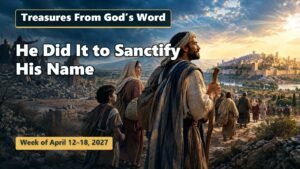
Ezekiel 36:22 — “Therefore say to the house of Israel, ‘This is what the Sovereign Lord Jehovah says: “Not for your sakes am I acting, O house of Israel, but for my holy name, which you profaned among the nations where you have gone.”’
Comment 4: Ezekiel 36:22 clarifies that Jehovah would act for the sake of his holy name, not because the house of Israel deserved restoration. This helps us maintain a humble attitude toward his blessings. It would not be right to interpret them as proof that we are superior to others. Jehovah’s name was at the center of the promise. Therefore, when we speak about what he does for his people, we want to give him the credit, not ourselves.
Ezekiel 36:23 — ‘I will certainly sanctify my great name, which was profaned among the nations, which you profaned among them; and the nations will have to know that I am Jehovah,’ declares the Sovereign Lord Jehovah, ‘when I am sanctified among you before their eyes.
Comment 5: At Ezekiel 36:23, Jehovah promises to sanctify his great name and make the nations know who he is. This shows that his name is not a secondary detail. It is related to the way people know and regard him. In the ministry, we do not want merely to mention his name; we also try to explain his qualities and purposes. In this way we help those listening to form a respectful and accurate view of Jehovah.
Ezekiel 36:25 — I will sprinkle clean water on you, and you will become clean; I will cleanse you from all your uncleanness and from all your disgusting idols.
Comment 6: Ezekiel 36:25 connects the cleansing of the people with the removal of their disgusting idols. Restoration did not simply consist of returning to a place; it also required abandoning what contaminated their worship. This helps me examine whether I am holding on to any practice incompatible with what Jehovah approves. It is not enough to want the blessings of a good relationship with him. I must also be willing to leave behind anything that harms that relationship and accept his help to change.
Ezekiel 36:26 — I will give you a new heart and put a new spirit inside you. I will remove the heart of stone from your body and give you a heart of flesh.
Comment 7: Ezekiel 36:26 presents a contrast between a heart of stone and a heart of flesh. The image highlights a deep change, not merely an improvement in appearance. It makes me think about the difference between resisting Jehovah’s guidance and being willing to respond to it. When I receive Bible counsel, I can ask myself how I am listening to it. A receptive heart does not immediately look for a defense; it considers what needs to change and accepts Jehovah’s help.
Ezekiel 36:27 — I will put my spirit inside you, and I will cause you to walk in my regulations, and you will observe and carry out my judicial decisions.
Comment 8: Ezekiel 36:27 relates Jehovah’s spirit to obedience to his standards. This reminds me that, to make real changes, I must not rely solely on willpower. I can ask Jehovah for his spirit and strive to act in harmony with his guidance. Divine help and obedience are not presented as separate in the verse. So in addition to praying for help, I need to take concrete steps to put what I learn into practice.
Ezekiel 36:28 — Then you will dwell in the land that I gave to your forefathers, and you will be my people and I will be your God.’
Comment 9: Ezekiel 36:28 does not merely promise that the Israelites would again live in their land. It also emphasizes that they would be Jehovah’s people and that he would be their God. This shows that restoration involved something more important than recovering a home: their relationship with him. It helps me put my priorities in order. Material conditions have their place, but the most valuable thing is to enjoy a good relationship with Jehovah and belong to his people.
More posts for this week

Enjoy every Premium feature
More convenient meeting preparation with full access to the site’s tools.
- Ad-free browsing
- My Recorder and live transcription
- Assignment Review
- Full Academy access
- Audio posts and reading magnifier
- Saved and synced comments
- Support the project and help keep it running
Monthly plan
€3 per monthRenews monthly. Cancel at any time.
Choose monthlyAnnual plan
€30 per yearOne payment for 12 months. No automatic renewal.
Choose annual


