










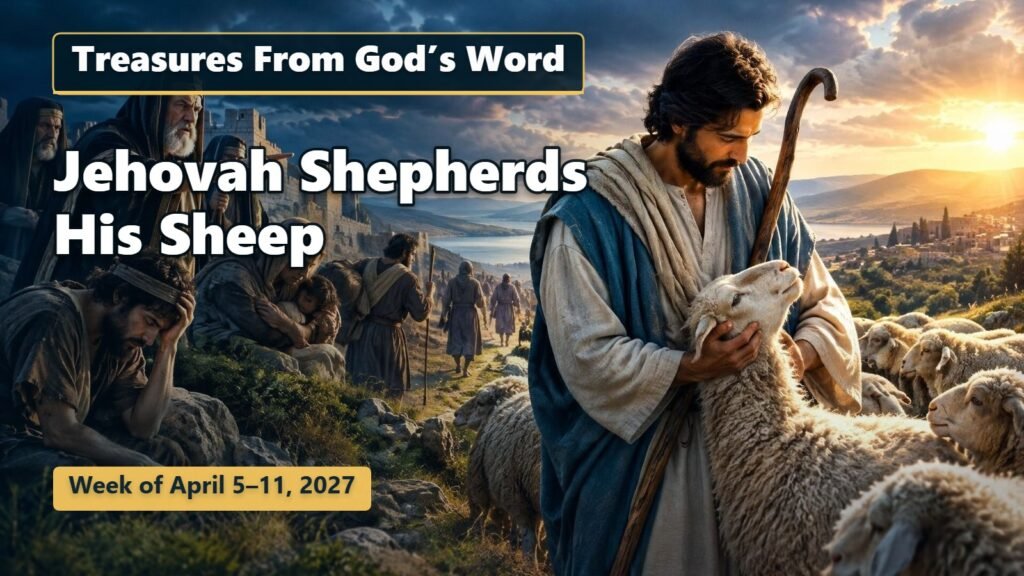
Theme: Jehovah Shepherds His Sheep
An injured sheep needs more than food. It needs someone to draw near, see its suffering, and care for it tenderly. That image helps us understand how Jehovah treats his servants. Ezekiel 34 shows that he knows the needs of his sheep, sees how they are treated, and acts to protect them. How reassuring it is to know that!
In Ezekiel’s day, the leaders of Israel had the responsibility to care for the people. But instead of caring for them, they took advantage of them. Jehovah did not overlook that situation. His words reveal both the seriousness of those shepherds’ conduct and his deep concern for the sheep. Let us read Ezekiel 34:2-6.
Ezekiel 34:2-6 — “Son of man, prophesy against the shepherds of Israel. Prophesy, and say to the shepherds, ‘This is what the Sovereign Lord Jehovah says: “Woe to the shepherds of Israel, who have been feeding themselves! Is it not the flock that the shepherds should feed? You eat the fat, you clothe yourselves with the wool, and you slaughter the fattest animal, but you do not feed the flock. You have not strengthened the weak or healed the sick or bandaged the injured or brought back the strays or looked for the lost; rather, you have ruled them with harshness and tyranny. So they were scattered because there was no shepherd; they were scattered and became food for every wild beast of the field. My sheep were straying on all the mountains and on every high hill; my sheep were scattered over all the surface of the earth, with no one searching for them or seeking to find them.
Notice the contrast. The shepherds benefited from the flock, but they did not care for its needs. Jehovah mentioned the weak, sick, injured, straying, and lost sheep. Each one needed help, although not all needed the same kind of help. Yet those leaders gave them neither food nor care. In addition, they treated them harshly. As a result, the people suffered, and many abandoned pure worship. This was not merely a lack of organization; it was a serious lack of love.
What does this teach us about Jehovah? He carefully observes how those who belong to him are treated. To him, a weak sheep is not a nuisance, nor does a lost sheep cease to have value. If we are discouraged or need help, this account reminds us that our suffering matters to him. But his interest is not limited to feeling compassion. What did he do when those shepherds mistreated the sheep?
Jehovah announced that he would remove from those rulers the responsibility they had used for their own benefit. He would not leave his sheep in their hands indefinitely. Moreover, he himself would search for them and care for them. Let us listen to his promise at Ezekiel 34:10-12.
Ezekiel 34:10-12 — This is what the Sovereign Lord Jehovah says: ‘I am against the shepherds, and I will demand an accounting of them for my sheep, and I will dismiss them from feeding my sheep, and the shepherds will no longer feed themselves. I will rescue my sheep from their mouth, and they will no longer be food for them.’” “‘For this is what the Sovereign Lord Jehovah says: “Here I am, and I myself will search for my sheep, and I will care for them. I will care for my sheep like a shepherd who has found his scattered sheep and is feeding them. I will rescue them from all the places where they were scattered in the day of clouds and thick gloom.
Those words were fulfilled in action. In 607 B.C.E., Jehovah used the Babylonians who invaded the land to take power away from those selfish shepherds. Seventy years later, he rescued his sheep again: He brought his servants out of Babylon and led them back to their land. There they could restore pure worship. In this way, he showed that his promise to care for the flock was not merely an expression of good wishes.
How confidence-inspiring it is to know that Jehovah fulfills what he promises! When we are going through difficulties, remembering his acts of rescue strengthens our faith. This does not mean that all problems disappear immediately. The Israelites who returned would still be under worldly authorities and would face dangers. So the prophecy did not end with their return. Jehovah had announced a much more lasting solution: a shepherd who would truly care for his sheep.
The contrast with the former leaders would be enormous. This shepherd would feed the flock, and under his care the sheep would enjoy Jehovah’s blessings. The promise helps us understand both our present spiritual care and our future. Let us read Ezekiel 34:22-24, 26.
Ezekiel 34:22-24,26 — And I will save my sheep, and they will no longer become something to prey upon; and I will judge between a sheep and a sheep. I will raise up one shepherd over them, my servant David, and he will feed them. He himself will feed them and become their shepherd. And I, Jehovah, will become their God, and my servant David a chieftain among them. I myself, Jehovah, have spoken. I will make them and the area around my hill a blessing, and I will cause the rain to fall at the proper time. Blessings will pour down like the rains.
Who is the shepherd whom the prophecy calls David? He is Jesus, David’s descendant with the legal right to rule. This did not mean beginning another succession of kings, but rather one unique heir who would reign forever. While on earth, Jesus demonstrated how much he loved the sheep: He gave his life for them. Now he shepherds them from heaven. His authority is accompanied by deep concern for their welfare.
In 1914, Jehovah made Jesus King and entrusted him with shepherding and feeding his sheep on earth. In 1919, Jesus appointed the faithful and discreet slave to provide spiritual food for God’s servants, both those with a heavenly hope and those with an earthly hope. Under Christ’s direction, that food helps us promote peace and security in the spiritual paradise. Taking advantage of it means accepting that loving care.
And greater blessings still await us. In the new world, the entire earth will be a paradise. Wars, crime, hunger, sickness, and wild animals will no longer threaten faithful mankind. Jehovah’s sheep will enjoy everlasting life and genuine security. Think of the relief of living without fear. That is the future our Shepherd desires for his servants.
Before we finish, let us meditate on this question: What do we learn from Jehovah, the Grand Shepherd? Caring involves taking an interest in each sheep and acting for its good. Elders should reflect that interest by shepherding willingly, with eagerness, and by being examples. All of us can imitate his tenderness. For example, if a brother is discouraged, we can listen to him patiently instead of judging him. Remembering how valuable he is to Jehovah will help us treat him with dignity and affection, especially when he most needs support.
Jehovah is not indifferent to the suffering of his sheep. He proved this by removing the selfish shepherds, rescuing his people, and placing them in Jesus’ care. Let us continue taking advantage of his spiritual food and reflecting his tenderness. We can look to the future with confidence: Our Shepherd knows us, cares for us, and will fulfill all his promises.
More posts for this week



Enjoy every Premium feature
More convenient meeting preparation with full access to the site’s tools.
- Ad-free browsing
- My Recorder and live transcription
- Assignment Review
- Full Academy access
- Audio posts and reading magnifier
- Saved and synced comments
- Support the project and help keep it running
Monthly plan
€3 per monthRenews monthly. Cancel at any time.
Choose monthlyAnnual plan
€30 per yearOne payment for 12 months. No automatic renewal.
Choose annual


