









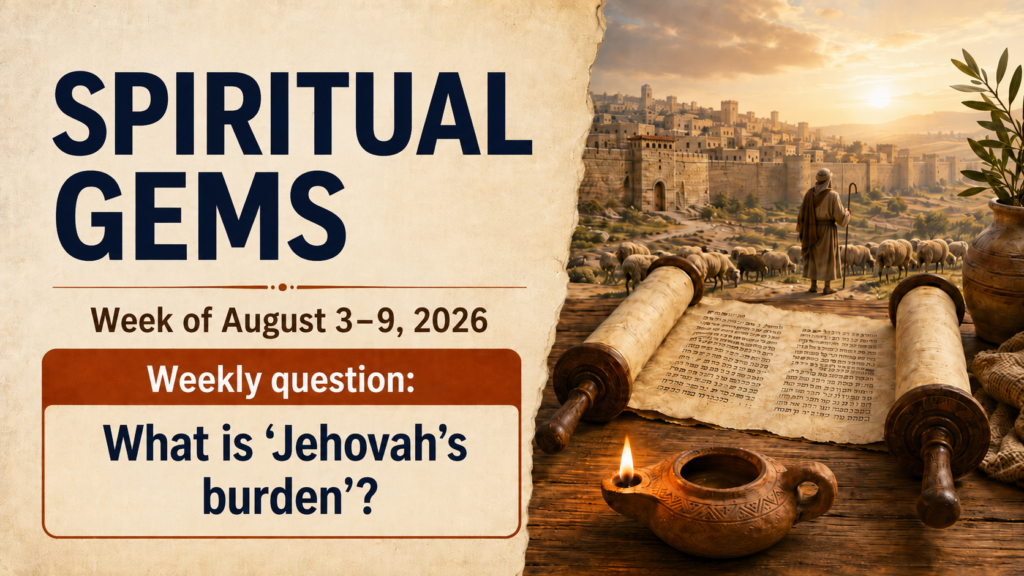
Weekly question: What is “the burden of Jehovah”?
Answer 1:
In Jeremiah’s day, “the burden of Jehovah” was the severe message of judgment that announced the destruction of Jerusalem. Many found it hard to listen to because they did not want to change their conduct. Instead of viewing the warning as an opportunity to repent, they treated it as something annoying and uncomfortable.
Answer 2:
The expression also had an ironic sense. People asked about “the burden of Jehovah” as if the divine message were a nuisance, but Jehovah replied that they themselves were the real burden. Their indifference, disobedience, and constant rejection of the warnings had become something heavy for him, and in the end he would rid himself of that rebellious nation.
Answer 3:
This explanation teaches us that the problem was never Jehovah’s message. His warnings were just and were meant to save lives. The real burden was the apathetic attitude of the people, who preferred to keep on sinning. Today too we do not want to consider Bible counsel burdensome, but to see it as loving protection that can spare us much suffering.
Answer 4:
Today the Bible’s message about the end of this system can also be uncomfortable for those who do not want to change. Christendom finds it hard to hear that the religions that do not obey God will be destroyed. However, Jehovah takes no pleasure in punishment; he first gives a clear warning so that sincere people can respond.
Answer 5:
This gem encourages us to ask ourselves how we react when the Bible touches on an area we need to correct. Do we feel that the counsel is a burden, or are we grateful that Jehovah warns us? If we humbly accept his guidance, we show that we are not a burden to him but people who are willing to listen, obey, and be molded.
Spiritual Gems for Jeremiah Chapter 22
Jeremiah 22:2, 3
“Hear the word of Jehovah, O king of Judah who sits on the throne of David, you and your servants and your people who come in through these gates. This is what Jehovah says: ‘Uphold justice and righteousness. Rescue the one who has been robbed out of the hand of the defrauder. Do not mistreat any foreign resident, and do no harm to any fatherless child or widow. And do not shed innocent blood in this place.’”
Comment 1:
Jehovah expected the king to use his authority to protect those who were vulnerable. For him, ruling well was not a matter of having power but of upholding justice and helping the victims. This teaches us that knowing Jehovah is shown by the way we treat others, especially those who cannot defend themselves.
Jeremiah 22:4
“For if you carefully carry out this word, then kings sitting on the throne of David will come in through the gates of this house, riding in chariots and on horses, they and their servants and their people.”
Comment 2:
Jehovah offered them a specific blessing if they obeyed. The dynasty could continue and there would be stability in the kingdom. This shows that his instructions were not meant to restrict the people but to protect them. We too see that Bible principles produce peace, stability, and good relationships when we apply them consistently.
Jeremiah 22:5
“But if you do not obey these words, I swear by myself, declares Jehovah, that this house will become a ruin.”
Comment 3:
Jehovah clearly warned of the consequences of disobedience. He did not leave the people uninformed, nor did he act unexpectedly. This gem helps us to value his warnings. When the Bible points out the danger of a certain course, we do not want to think that it will never affect us. Listening in time can spare us very painful spiritual consequences.
Jeremiah 22:8, 9
“Many nations will pass by this city and say to one another: ‘Why did Jehovah do this to this great city?’ And they will answer: ‘Because they abandoned the covenant of Jehovah their God and bowed down to other gods and served them.’”
Comment 4:
Jerusalem seemed to be an important and well-protected city, but its greatness could not save it once it abandoned Jehovah. Its destruction would serve as a warning to other nations. This reminds us that no privilege, spiritual record, or religious appearance takes the place of obedience. Our safety depends on remaining loyal to Jehovah every day.
Jeremiah 22:13
“Woe to the one building his house by unrighteousness and his upper rooms by injustice, making his fellow man work for nothing and refusing to give him his wages.”
Comment 5:
Jehovah condemned the one who grew rich by exploiting his workers. This shows that he cares about how we treat people in matters of work and money. A servant of God does not look for unfair gain from someone else’s effort. Being honest with wages, agreements, and responsibilities shows that we respect Jehovah’s justice.
Jeremiah 22:15, 16
“Your father also ate and drank, but he upheld justice and righteousness, and it went well for him. He defended the legal claim of the lowly and the poor, and all went well. ‘Is this not what it means to know me?’ declares Jehovah.”
Comment 6:
Jehovah explained that knowing him is not only a matter of knowing his name or talking about him. Josiah showed that he knew Jehovah because he acted justly and defended the needy. This gem invites us to examine ourselves: our knowledge of God should influence our decisions, our honesty, and the way we treat others.
Jeremiah 22:17
“But your eyes and your heart are set on nothing but your dishonest gain, on shedding innocent blood, and on committing fraud and extortion.”
Comment 7:
Jehoiakim had allowed the desire for gain to dominate his eyes and his heart. It was not an isolated mistake but the main direction of his life. This teaches us to watch our goals. An excessive desire for money or prestige can harden the heart and lead us to justify conduct that Jehovah condemns.
Jeremiah 22:21
“I spoke to you when you felt secure. But you said: ‘I will not obey.’ This is how you have acted since your youth, for you have never obeyed my voice.”
Comment 8:
The people rejected Jehovah precisely when they felt secure. People often look for God in times of distress but forget him when everything is going well. We want to obey Jehovah both in difficulties and in calm times. Prosperity should never make us feel that we no longer need his guidance.
Jeremiah 22:24, 25
“‘As surely as I am alive,’ declares Jehovah, ‘even if you, Coniah the son of Jehoiakim, the king of Judah, were the seal ring on my right hand, I would pull you off from there! I will give you into the hand of those seeking your life.’”
Comment 9:
A seal ring was valuable and was kept very close to its owner. Even so, Jehovah said that he would pull Coniah off because of his unfaithfulness. This shows that no position or privileged relationship allows anyone to ignore divine standards. To keep Jehovah’s favor, we need to remain humble, obedient, and loyal.
Jeremiah 22:29
“O land, land, land, hear the word of Jehovah.”
Comment 10:
The threefold repetition conveys urgency and highlights how important it is to listen. The people had heard many warnings but were not paying real attention to them. This expression encourages us to listen actively to Jehovah’s Word. It is not enough to read it or to be present at the meetings; we must let it influence our decisions and produce changes.
Spiritual Gems for Jeremiah Chapter 23
Jeremiah 23:1, 2
“‘Woe to the shepherds who are destroying and scattering the sheep of my pasture!’ declares Jehovah. ‘You have scattered my sheep; you kept dispersing them, and you have not cared for them. So I will call you to account for the badness of your deeds.’”
Comment 1:
Jehovah held accountable the shepherds who, instead of caring for the people, harmed and scattered them. This shows how much he values each one of his sheep. Those with spiritual responsibilities must care for the brothers tenderly. All of us can support that care by encouraging those who are weak and by avoiding words or actions that would discourage them.
Jeremiah 23:3, 4
“Then I will gather the remnant of my sheep out of all the lands to which I dispersed them, and I will bring them back to their pasture. And I will raise up over them shepherds who will really shepherd them. They will no longer be afraid or be terrified, and none will be missing.”
Comment 2:
Jehovah did not merely condemn the bad shepherds; he promised to gather his sheep and give them caretakers who would really be interested in them. This reveals his tenderness and his ability to repair the damage. In the congregation, Jehovah uses spiritual shepherds so that the brothers feel secure, cared for, and valued.
Jeremiah 23:5, 6
“I will raise up for David a righteous sprout. And a king will reign and show insight and uphold justice and righteousness in the land. In his days Judah will be saved, and Israel will dwell in security.”
Comment 3:
This prophecy points to Jesus, the righteous King who comes from David’s line. Unlike the unfaithful rulers of Judah, Jesus rules with insight, justice, and righteousness. This strengthens our confidence in the Kingdom. Under his rule, no one will be exploited and all faithful servants will be able to live in real security.
Jeremiah 23:10
“For the land is full of adulterers; because of the curse the land mourns and the pastures of the wilderness have dried up. They are doing what is bad, and they abuse their power.”
Comment 4:
Immorality and the abuse of power affected the whole nation. Sin never harms only the one who commits it; it can cause suffering in families, congregations, and communities. This gem encourages us to guard our conduct and to make good use of any authority or influence. Jehovah never approves of anyone using his position to take advantage of others.
Jeremiah 23:14
“They commit adultery and walk in falsehood; they support evildoers, and they do not repent of their badness.”
Comment 5:
The false prophets not only practiced what was bad but also strengthened others to keep on sinning. Instead of helping them to repent, they gave them approval. This teaches us that true love does not consist in justifying any and every course of conduct. If someone needs guidance, we want to help him tactfully, but without lowering Jehovah’s standards.
Jeremiah 23:16, 17
“Do not listen to the words of the prophets who are prophesying to you. They are deceiving you. The vision they speak of springs from their own heart, not from the mouth of Jehovah. They keep saying to those who disrespect me: ‘Jehovah has said: “You will have peace.”’”
Comment 6:
The false prophets offered pleasant messages, but they were invented. They said “peace” to those who did not want to respect Jehovah. This reminds us that a teaching is not true simply because it sounds positive or is popular. We must make sure that what we believe and teach really comes from the Bible and not from personal wishes or human traditions.
Jeremiah 23:22
“But if they had stood in my circle of intimates, they would have made my people hear my words, and they would have turned them back from their evil way and from their evil deeds.”
Comment 7:
Being close to Jehovah would have moved those prophets to help the people to change. This gem shows that friendship with God produces good results. The better we know Jehovah, the more we want to convey his words faithfully and help others. In the ministry we do not aim to entertain but to motivate people kindly to make decisions that save lives.
Jeremiah 23:23, 24
“Am I a God only near by and not a God also far away? Can any man hide in a secret place where I cannot see him? Do I not fill the heavens and the earth?”
Comment 8:
No one can hide from Jehovah or lead a double life without his seeing it. But this truth is also comforting: no matter where we are or how alone we may feel, Jehovah is near and knows our situation. This motivates us to maintain integrity in private and to seek his help in any circumstance.
Jeremiah 23:28, 29
“Let the one who has my word speak my word faithfully. What does the straw have in common with the grain? ‘Is not my word like a fire,’ declares Jehovah, ‘and like a forge hammer that shatters the crag?’”
Comment 9:
Human words with no Bible basis are like straw, but Jehovah’s Word is solid food and has enormous power. It can burn up deception and break even hearts as hard as stone. In the ministry, this teaches us to use the Bible well. A well-chosen text can have more effect than many personal arguments.
Jeremiah 23:33
“And when someone of this people or a prophet or a priest asks you, ‘What is the burden of Jehovah?’ you must say to them: ‘“You are the burden! And I will abandon you,” declares Jehovah.’”
Comment 10:
The people treated the message of judgment as an annoying burden, but Jehovah showed that the real burden was their rebellious attitude. They had rejected so many warnings that they had become heavy to him. This encourages us not to belittle Bible counsel. Accepting it humbly shows that we value Jehovah’s patience and want to keep his favor.
More posts for this week





Enjoy every Premium feature
More convenient meeting preparation with full access to the site’s tools.
- Ad-free browsing
- My Recorder and live transcription
- Assignment Review
- Full Academy access
- Audio posts and reading magnifier
- Saved and synced comments
- Support the project and help keep it running
Monthly plan
€3 per monthRenews monthly. Cancel at any time.
Choose monthlyAnnual plan
€30 per yearOne payment for 12 months. No automatic renewal.
Choose annual


