










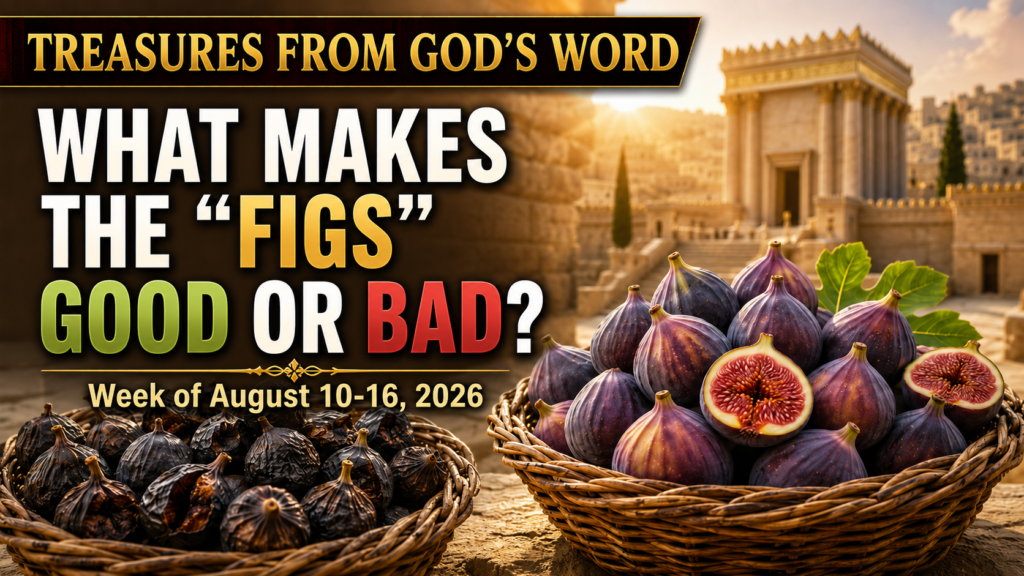
Theme: What makes “figs” good or bad?
Two baskets could look the same on the outside. Both were placed before the temple of Jehovah and contained figs. However, when their contents were examined, the difference was enormous: some were excellent, and the others were so spoiled that they could not be eaten.
Jehovah used that illustration to teach that the most important thing was not where the Jews were located or how they appeared, but the attitude of their heart. Some were exiled in Babylon, but they had repented and wanted to return to Jehovah. Others remained in Jerusalem or had fled to Egypt, but they continued to be disobedient. The difference lay in how they responded to Jehovah’s discipline.
First, the exiled Jews who had repented were like good figs.
Jeremiah 24:1, 2
“Then Jehovah showed me two baskets of figs set before the temple of Jehovah. This was after King Nebuchadnezzar of Babylon took into exile Jeconiah the son of Jehoiakim, the king of Judah, along with the princes of Judah, the craftsmen and the metalworkers; he had taken them from Jerusalem to Babylon. One basket had very good figs, like early figs; but the other basket had very bad figs, so bad that they could not be eaten.”
Jeconiah, also called Jehoiachin, had been king for only three months and ten days when he surrendered Jerusalem to Nebuchadnezzar. Among the captives were Daniel, Hananiah, Mishael, Azariah, and Ezekiel. At first glance, it might seem that those exiles had received the worst treatment: they lost their home, their city, and their freedom.
However, Jehovah saw that among them there were people who would accept discipline and return to him with a repentant heart. That is why he compared them to very good figs.
Jeremiah 24:5-7
“This is what Jehovah the God of Israel says: ‘Like these good figs, I will regard as good the exiles of Judah whom I sent away from this place to the land of the Chaldeans. I will keep my eyes on them for their good, and I will bring them back to this land. I will build them up and not tear them down; I will plant them and not uproot them. And I will give them a heart to know me, that I am Jehovah. They will be my people, and I will be their God, for they will return to me with all their heart.’”
Jehovah would keep his eyes on them “for their good.” The exile was painful discipline, but it did not mean that he had abandoned them. He knew that some would learn from what had happened.
Eighty years later, in the year 537 B.C.E., Jehovah moved King Cyrus to allow a remnant of their descendants to return to Judah. They rebuilt Jerusalem, raised a new temple, and restored true worship. In that way the promise to build them up, plant them, and bring them back was fulfilled.
What made them “good figs”? It was not merely having suffered exile, but their reaction. They accepted the discipline and returned to Jehovah “with all their heart.”
This teaches us that a painful experience can produce good results if we accept Jehovah’s guidance. A Bible-based correction, counsel from the elders, or the consequences of a bad decision can hurt. But if we respond with humility, they can draw us closer to Jehovah.
The second point presents the contrast: the disobedient Jews who had not repented were like bad figs.
Jeremiah 24:8-10
“‘But as for the bad figs that are too bad to be eaten, this is what Jehovah says: “So I will regard King Zedekiah of Judah, his princes, the remnant of Jerusalem who are left in this land, and those who are living in the land of Egypt. I will make them an object of horror and calamity to all the kingdoms of the earth, an object of insults, a topic of proverbs, a cause for mockery, and a curse in all the places where I disperse them. And I will send against them the sword, the famine, and the pestilence until they disappear from the land that I gave to them and their forefathers.”’”
Zedekiah was a clear example of a “bad fig.” He broke the oath of loyalty that he had made to Nebuchadnezzar in Jehovah’s name, and he rejected the compassion that Jehovah showed him through Jeremiah. Instead of humbling himself, he continued doing what was bad and even imprisoned the prophet.
Other Jews fled to Egypt seeking protection despite Jeremiah’s warnings. But they did not change their heart. There they went back to practicing the same idolatry that had brought judgment upon Judah. Finally, Jehovah’s prophecies caught up with them too when Nebuchadnezzar conquered Egypt.
Therefore, the problem was not living in Jerusalem, Babylon, or Egypt. The question was whether they were willing to listen to Jehovah. Those who persisted in disobedience were like rotten figs: they did not accept discipline, nor did they make changes.
This comparison warns us of a danger. A person may remain close to the congregation, attend the meetings, and keep up a spiritual appearance, but if he refuses to correct a bad course, his heart can deteriorate. Being physically close to God’s people is no substitute for sincere repentance.
Neither can we escape the consequences of a bad course simply by changing our circumstances. Moving, changing congregations, or hiding a problem does not transform the heart. What is needed is to acknowledge the mistake, ask for help, and return to Jehovah.
Finally, as Christians we can be like good figs if we honestly examine ourselves and make the necessary changes.
We should not think that this account applies only to those who practice serious wrongdoing. We servants of Jehovah are a clean and faithful people, but we are all imperfect. That is why our heart needs constant examination.
David, although he was a righteous man, did not take for granted that everything was fine inside him. He asked Jehovah to examine him.
Psalm 139:23, 24
“Search through me, O God, and know my heart. Examine me, and know my disquieting thoughts, and see whether there is in me any harmful way.”
What a fine attitude! David did not ask Jehovah to examine others first. He said: “Examine me.” We can do the same when we read the Bible, listen to a talk, or receive counsel. Instead of thinking about who else needs that information, let us ask ourselves: “What is Jehovah saying to me? Is there something I should correct?”
Self-examination can cover the way we speak, our entertainment, our use of the internet, our friendships, the way we treat our family, or our attitude toward the preaching work and the meetings. We may discover a tendency that is beginning to weaken our friendship with Jehovah.
In that case, it is not enough to recognize it. The good figs represented those who returned to Jehovah with all their heart. We must make specific changes: eliminate something harmful, ask for help, strengthen our spiritual routine, or accept counsel that we previously found hard to take.
Let us not be discouraged if Jehovah helps us to discover a weakness. Seeing it is an opportunity to correct it. Jehovah kept his eyes on the exiles “for their good.” When he corrects us, he is not trying to humiliate us either, but to protect us and help us grow.
So then, what makes “figs” good or bad? It is not their appearance, the place where they are, or the hardships they have gone through. The difference lies in the attitude of the heart. The good figs accepted discipline, repented, and returned to Jehovah. The bad ones insisted on their own ways and rejected the warnings.
Let us keep asking Jehovah to examine our heart. And when his Word shows us something we need to change, let us act with humility. In this way we will show that we want to serve him with all our heart, and we will be to him like those very good figs.
More posts for this week




Enjoy every Premium feature
More convenient meeting preparation with full access to the site’s tools.
- Ad-free browsing
- My Recorder and live transcription
- Assignment Review
- Full Academy access
- Audio posts and reading magnifier
- Saved and synced comments
- Support the project and help keep it running
Monthly plan
€3 per monthRenews monthly. Cancel at any time.
Choose monthlyAnnual plan
€30 per yearOne payment for 12 months. No automatic renewal.
Choose annual


