










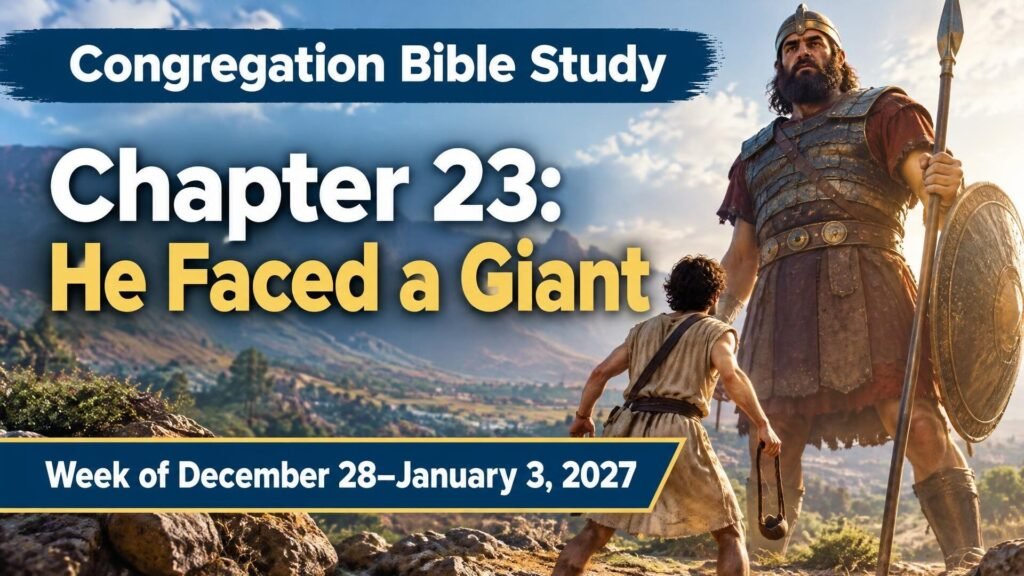
Chapter 23: He Faced a Giant
In what ways did David show courage when he was young?
Comment 1: David had already shown courage before facing Goliath. While caring for his father’s sheep, he faced a lion and a bear to rescue them. He did not consider protecting the flock an unimportant responsibility. Also, when he spoke to Saul about those experiences, he acknowledged that Jehovah had helped him. His courage was not based simply on being skilled or strong, but on the trust he had developed in Jehovah.
Comment 2: He was also courageous when he offered to fight Goliath while the Israelite soldiers were terrified. David had heard how that man was taunting Jehovah’s army, and he did not want to stand by and do nothing. Although Saul thought he was too young, David explained why he trusted in God’s help. His example shows that youth does not prevent someone from showing strong faith or acting courageously when honoring Jehovah is at stake.
Comment 3: Something that impresses me is that David did not let the words of others hold him back. Eliab questioned his motives, Saul doubted his ability, and Goliath mocked and threatened him. Even so, he continued forward. He was not focused on proving that he was better than them, but on defending Jehovah’s name. This teaches us that courage also means maintaining a good objective when others discourage us.
2. How do we know that this account is a true story? (wp16.5 13). A
Comment 1: An interesting piece of evidence is the ancient inscription that mentions the house of David. The illustration in the chapter shows that fragment of stone, which dates from the ninth century B.C.E. Its existence contradicts the idea that David was merely a legendary character. Of course, the inscription does not describe his encounter with Goliath, but it does provide historical evidence related to David. It is important to distinguish what that discovery proves and not attribute more to it than it says.
Comment 2: Goliath’s height was extraordinary, but not impossible. The information explains that he was nearly 2.9 meters tall. In modern times, a man more than 2.7 meters tall has been recorded, so the difference does not make the account unbelievable. In addition, an ancient Egyptian document mentions Canaanite warriors more than 2.4 meters tall. Thus, it would not be reasonable to dismiss the account merely because Goliath was much taller than most people.
Matthew 12:3 — He said to them: “Have you not read what David did when he and the men with him were hungry?
Comment 3: Jesus spoke of David as a real person. When answering an objection, he referred to something David and his men had done when they were hungry. His reasoning treated that event as a fact, not as a legend. For us, Jesus’ testimony carries great weight and confirms that David was a historical person.
Comment 4: Jesus’ genealogies also support David’s existence. Both Matthew and Luke include David when presenting Jesus’ ancestry. He does not appear as an isolated character in a story, but within a succession of generations. The information highlights that those genealogies support identifying Jesus as the Messiah. Therefore, David’s existence is connected with a fundamental Bible teaching, not just with the well-known account of his fight against Goliath.
Comment 5: The places mentioned in the account are also real. The Bible places the two armies on opposite sides of the Valley of Elah and locates the Philistines between Socoh and Azekah. The information says that a visitor was able to observe the valley and the ruins of those cities. That correspondence between the account and the terrain is significant. The Bible does not present a battle in an undefined setting, but gives specific geographic details that can be verified.
3. What must David’s life have been like when he was a shepherd? (w11 9/1 27, 28). B
Comment 1: David’s life must have included many quiet and lonely days. The information indicates that he probably spent days and nights outdoors caring for his father’s flock. He was not simply spending a little time with the sheep; he had a responsibility that required constant attention. This helps us imagine a life very different from that of a soldier on a battlefield, but one that gave him daily opportunities to be responsible and strengthen his relationship with Jehovah.
Comment 2: Although shepherding was usually peaceful, it could suddenly become dangerous. David had to pursue a lion and a bear that had carried off sheep from the flock. He rescued the animals and fought the predators when they attacked him. So his life was not free of risks. Those experiences enabled him to experience Jehovah’s help, and later he could remember them when facing a difficulty as great as Goliath.
1 Samuel 17:49 — David thrust his hand into his bag and took a stone from there and slung it. He struck the Philistine in the forehead, and the stone sank into his forehead and he fell facedown on the ground.
Comment 3: David’s accuracy with the sling shows that he knew how to use it very well. The information suggests that he may have developed that skill during his years as a shepherd, although it does not state this as a certainty. His work may have given him opportunities to develop useful abilities. When the time came to face Goliath, he used a weapon he knew, without taking credit for the victory.
Comment 4: David knew how to use the time he spent alone. The information explains that he had many opportunities to meditate, and suggests that some of his youthful reflections may have been included in the Psalms. He could observe the sky, the animals, and the fields around him. Rather than viewing those hours as wasted time, he could use them to think about Jehovah. His example motivates me to use quiet moments to reflect instead of always looking for some distraction.
Comment 5: Being a shepherd also helped David understand Jehovah’s tenderness. He knew what it meant to care for, guide, and protect sheep. So when he later described Jehovah as his Shepherd, he used a comparison he knew very well. His work not only strengthened his courage; it also helped him appreciate God’s care. I like that combination: David learned to be firm in the face of danger and, at the same time, sensitive to Jehovah’s protection.
4. David was underestimated many times. How do we know it? (w21.03 3 par. 6; it “Eliab” no. 4 par. 1).
Comment 1: Saul underestimated him when David offered to fight Goliath. He focused on the fact that David was a boy and that the Philistine had been an experienced warrior from his youth. From that viewpoint, David seemed to have no chance. But Saul was not taking the most important thing into account: Jehovah could help him. David responded by speaking about occasions when he had already received that help, not by boasting that he was stronger or more capable than Goliath.
1 Samuel 17:13 — The three oldest sons of Jesse had followed Saul to the war. The names of his three sons who went to war were Eliab the firstborn, his second son Abinadab, and the third Shammah.
Comment 2: Eliab was David’s older brother and was serving in the army. However, when David arrived, he misinterpreted his motives and accused him of coming only to see the battle. In reality, his father had sent him to find out how his brothers were doing. This contrast shows how unfair it can be to judge someone’s motives without knowing all the facts.
Comment 3: The occasion when Samuel went to anoint the future king also shows how easy it is to be guided by appearances. When Samuel saw Eliab, he was impressed by his appearance and height and thought that he was the chosen one. But Jehovah had chosen David, who was caring for the sheep. This does not mean that Samuel wanted to despise David; rather, it reminds us that Jehovah’s evaluation may be very different from our first impression.
Comment 4: Goliath also despised David as soon as he saw him. He mocked his youth and the staff he carried and assumed that he would defeat him. He was judging by what was before him—a boy without armor like his own. But he did not take Jehovah into account. The outcome shows that neither an enemy’s mockery nor other people’s doubts determine what a servant of God can do with Jehovah’s help.
… our fears? C
Comment 1: David’s example can help me combat my fears by changing where I focus my attention. If I compare only my strength with the size of a problem, it is easy to become discouraged. David did not deny that Goliath was huge and dangerous, but he kept Jehovah’s power in mind. I too can acknowledge that a situation intimidates me without concluding that I am facing it alone. Thinking about Jehovah helps me view the difficulty from a more balanced perspective.
Comment 2: David remembered the help Jehovah had given him when he faced the lion and the bear. Those experiences strengthened his confidence before Goliath. If I feel afraid, I can stop to remember how Jehovah has helped me remain faithful in other situations. This does not mean thinking that all my problems will disappear immediately, but not forgetting the support I have already received. Remembering it can give me strength to face the difficulty before me.
Comment 3: The image of the young person in class makes me think about the fear of expressing our beliefs. David did not allow Goliath’s mockery to determine his conduct. Following his example, a young person can respectfully explain what he believes, even if he is concerned about how others will react. He does not need to turn the conversation into an argument or prove that he is superior. What matters is that his desire to honor Jehovah outweighs his fear of embarrassment.
… wrong desires?
Comment 1: Although David was fighting an enemy and not a wrong desire, his way of thinking teaches me something useful. He did not consider the battle lost before it began. At times, an improper desire may seem too strong, but we do not have to consider it unbeatable. We can recognize that we need Jehovah’s help and decide to resist. The lesson is not to trust blindly in our willpower, but to avoid letting the difficulty make us forget whom we have on our side.
Comment 2: David cared deeply about Jehovah’s name. That concern gave him a powerful reason to act courageously. When I fight a wrong desire, I can think about how my decision will affect my friendship with Jehovah and what kind of conduct honors him. In this way, I do not focus only on what I want to do at that moment. Keeping Jehovah in mind can strengthen my desire to choose what is right, even when resisting is not easy.
Comment 3: David did not merely say that he trusted in Jehovah; he acted in harmony with that trust. This is a useful application when a wrong desire appears. It would not be enough to recognize that something is wrong while continuing to feed the desire. For example, if certain content awakens wrong desires in me, I can decide to stop viewing it. I am not literally repeating David’s situation, but I can imitate his willingness to take concrete steps in harmony with his faith.
What effect can the courage you show have on others? (1 Sam. 17:50-53).
1 Samuel 17:50-53 — So David prevailed over the Philistine with a sling and a stone; he struck down the Philistine and put him to death, though there was no sword in David’s hand. David continued running and stood over him. Then he took hold of the Philistine’s sword and pulled it out of its sheath and made sure that he was dead by cutting off his head with it. When the Philistines saw that their mighty one had died, they fled. At that the men of Israel and of Judah rose and broke into shouting and pursued the Philistines all the way from the valley to the gates of Ekron, and the slain of the Philistines lay fallen along the road from Shaaraim, as far as Gath and Ekron. After the Israelites returned from hotly pursuing the Philistines, they pillaged their camps.
Comment 1: David’s courage helped the Israelites move from fear to action. Earlier they had retreated in terror before Goliath, but after seeing him defeated, they pursued the Philistines. David did not merely gain a personal victory; his confidence in Jehovah benefited the entire army. This reminds me that our conduct can influence others for good. At times, seeing someone act in faith gives others the encouragement they need to do what is right as well.
Comment 2: Our courage can encourage someone facing similar pressure. For example, if a young person respectfully explains his beliefs, another who is afraid to do so may feel more willing to speak. The first person does not need to give a speech about courage; his own conduct may already teach much. In the account, the Israelites saw what David did. Similarly, our actions can give strength to the words of encouragement we offer.
Comment 3: The effect of a good example can last a long time. David encouraged the Israelites who saw him, but his story continues to strengthen Jehovah’s servants. This reminds me that a courageous decision can leave a lasting impression on others, even if we never learn how much it helped them.
In what other ways can you imitate the courage David showed in this account?
Comment 1: I can imitate him when someone misinterprets my motives. Eliab unjustly accused David, but David did not allow that conversation to distract him from what was important. He moved away and continued speaking with other soldiers. If something similar happens to me, I can explain my situation respectfully without insisting on winning an argument. At times, it takes courage not to react harshly and to continue doing what is right, even though the other person still does not understand our intentions.
Comment 2: Another way is to know my limitations without thinking that I therefore cannot be useful. David tried on Saul’s armor, but recognized that he was not accustomed to using it and took it off. He then used his sling. He did not try to appear capable of functioning like an experienced warrior. His example encourages me to be honest about what I can do and to use well the abilities I have, trusting in Jehovah rather than trying to impress others.
Comment 3: I can also imitate his willingness to encourage rather than increase discouragement. When David arrived, he found the soldiers overcome with fear, but he spoke confidently in Jehovah. He even tried to strengthen Saul. If everyone in a conversation is focusing on how difficult a situation is, I can contribute in another way: listen with understanding and recall reasons to trust in Jehovah. In that way, my attitude can help instead of making the problem seem even greater.
What does this account teach me about Jehovah?
Comment 1: It teaches me that Jehovah does not value people as we usually do. Saul focused on David’s youth, and Goliath despised him because of his appearance. But Jehovah knew his heart and had chosen him to be king. This encourages me not to measure my own worth, or that of others, merely by age, appearance, or experience. What Jehovah sees in a person may be much more important than what we perceive.
Comment 2: I also learn that Jehovah’s power does not depend on resources that impress humans. Goliath had extraordinary size, military experience, and weapons. David was not carrying a sword when he brought him down. The result made clear that Jehovah could give the victory without relying on superior weaponry. This helps me avoid thinking that a lack of human resources limits what Jehovah can do to accomplish his will.
Comment 3: Jehovah knew David and had helped him before that confrontation. His support did not begin when the boy appeared before the entire army. David had already experienced his help while caring for the sheep. It encourages me to remember that our relationship with Jehovah is also strengthened in daily life, not only during major trials.
How is this account related to Jehovah’s purpose and the main theme of the Bible?
Comment 1: Jehovah’s name occupies a central place in this account. David did not view Goliath’s words as merely a provocation against the Israelites, but as a challenge to the God they served. That is why he made clear that he depended on Jehovah and that the victory would allow people to recognize His power. Thus, the account relates to the sanctification of Jehovah’s name: what mattered was not that David become famous, but that God receive the honor he deserved.
Comment 2: It also relates to Jehovah’s purpose because he had already chosen David to be Israel’s next king. Samuel had anointed him, and Jehovah’s spirit was strengthening him. Saul’s doubts and Goliath’s threats did not change that choice. The account allows us to see that Jehovah’s purpose does not depend on people considering its fulfillment likely. He can support the one he has chosen even when that person appears to be at a disadvantage.
Comment 3: David also has an important place in the line of descent leading to Jesus, the Messiah. The genealogies mentioned in the information directly connect Jesus with him. Therefore, this account is not merely an isolated story of courage: it helps us learn about someone who had a role in the development of Jehovah’s purpose. We can appreciate that connection without turning every detail of the battle into a symbol or seeking meanings that the material does not explain.
When David is resurrected, what would I like to ask him about this period of his life?
Comment 1: I would like to ask him what he used to meditate on while caring for the sheep and what aspects of creation helped him feel close to Jehovah. The information explains that he made good use of those lonely moments, but we do not know all his thoughts. It would be wonderful to hear how his trust in God grew during that period. That question also makes me think about the present: Am I using quiet moments to strengthen my friendship with Jehovah?
Comment 2: I would ask him how he felt when Samuel anointed him and how he later noticed the help of Jehovah’s spirit. The account says that the spirit strengthened him, but does not describe every detail of that period. I would like to hear them from him. Meanwhile, what we do know enables us to appreciate that his courage did not suddenly appear in front of Goliath: David was already learning to trust in Jehovah.
Comment 3: I would like to ask him what it meant to him to see the Israelites gain courage after Goliath’s defeat. The account explains what the soldiers did, but not everything David thought at that moment. It would be interesting to know how he viewed the effect that his confidence in Jehovah had on others.
More posts for this week




Enjoy every Premium feature
More convenient meeting preparation with full access to the site’s tools.
- Ad-free browsing
- My Recorder and live transcription
- Assignment Review
- Full Academy access
- Audio posts and reading magnifier
- Saved and synced comments
- Support the project and help keep it running
Monthly plan
€3 per monthRenews monthly. Cancel at any time.
Choose monthlyAnnual plan
€30 per yearOne payment for 12 months. No automatic renewal.
Choose annual


