









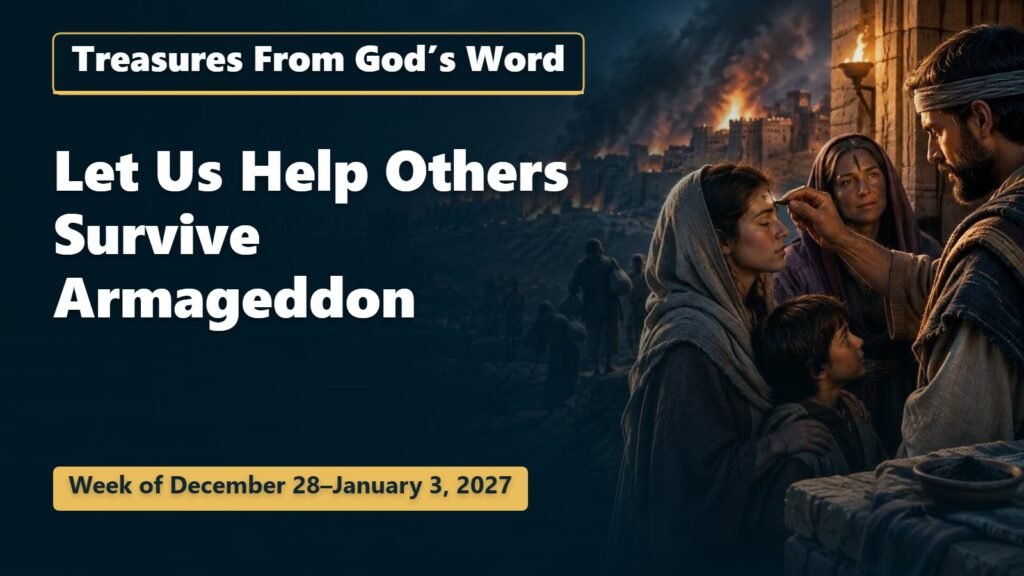
Theme: Let Us Help Others Survive Armageddon
When we know that someone is in danger, love moves us to help him. We are not content merely to be safe ourselves; we want that person to be safe too. This feeling helps us understand the importance of our preaching. The theme “Let Us Help Others Survive Armageddon” invites us to view people with sincere interest and to take advantage of opportunities to draw them closer to Jehovah.
In Ezekiel’s day, Jerusalem was about to receive Jehovah’s punishment. The city and its temple had become contaminated by detestable practices. But there were still faithful people. Would they be destroyed along with the wicked? The vision that the prophet received gave a reassuring answer. Jehovah saw the differences between one person and another. Let us listen to the instruction found at Ezekiel 9:4.
Ezekiel 9:4 — Jehovah said to him: “Go through the city, through Jerusalem, and put a mark on the foreheads of the men who are sighing and groaning over all the detestable things that are being done in the city.”
That mark was symbolic and served a protective purpose. What distinguished those who received it? They were not simply people who were dissatisfied with life’s difficulties. They were deeply distressed by the things that offended Jehovah. They were pained by the idolatry practiced in the temple, the violence, the sexual immorality, and the corruption that prevailed in Jerusalem. They had not come to view wickedness as normal.
Their reaction revealed what was in their heart. Moreover, they probably did not hide what they thought. By their words and actions, they showed that they clung to pure worship and opposed those practices. Jehovah did not overlook that faithfulness. He would show them mercy and save them. What a relief it must have been for Ezekiel to know that the righteous would not be eliminated along with the wicked.
This helps us think about the people to whom we preach. Perhaps someone tells us sadly about violence or corruption. Instead of rushing to give an answer, we can listen to him and try to understand what concerns him. That pain may provide an opportunity to tell him about Jehovah and explain that He too is not indifferent to suffering and does not approve of wickedness.
Of course, helping someone involves more than agreeing that the world is in a bad state. We want to help him get to know Jehovah and understand why it is worthwhile to take his side. Those faithful Israelites did more than lament what was happening: They clung to pure worship. The next part of the vision shows why that difference was so important and why we must take it seriously.
The vision did not describe a mere warning without consequences. The sentence against Jerusalem would be carried out, and the mark would distinguish those who would be protected. To appreciate the seriousness of what was at stake, let us read Ezekiel 9:5, 6. Let us pay particular attention to the order given to the executioners regarding those who had the mark.
Ezekiel 9:5-6 — And to the others he said in my hearing: “Go through the city after him and strike. Do not let your eye feel sorry, and do not feel any compassion. Old man, young man, virgin, little child, and women you should kill offcompletely. But do not go near to any man on whom there is the mark. You should start from my sanctuary.” So they started with the elders who were in front of the house.
These are strong words. Those who did not have the mark died during the destruction of the city. By contrast, the executioners were not to approach those who had it. Jehovah had established a clear distinction. The order to begin at the sanctuary also showed that being near the temple did not guarantee protection. What mattered was not religious appearance, but the position each person took toward Jehovah and wickedness.
This part of the account helps us maintain a sense of urgency. Preaching is not simply a matter of fulfilling an activity or conveying interesting information. We are helping people get to know Jehovah and take their stand for him. Therefore, when someone shows interest, it is worthwhile to follow up. We can remember what concerned him, prepare a useful conversation, and speak with him again when it is convenient for him.
But urgency should not turn into harshness. It is not our responsibility to decide who will respond favorably or to write anyone off. The seriousness of the message should move us to help, not to pressure. And here an important question arises: How long will we be able to continue offering that help? To answer, we must not automatically transfer every detail of what happened in Jerusalem to the time of the end. We need to consider what Jesus explained.
According to the clarification we have received regarding Matthew 24:14, the end that Jesus connected with the preaching of the good news is the definitive end of Satan’s world at Armageddon. Therefore, we will continue preaching until just before that definitive end. This corrects the idea that the preaching of the good news would end when Babylon the Great was destroyed and the great tribulation began.
What does this mean for people? It may mean that they will still have the opportunity to accept the good news after the destruction of Babylon the Great. We should not state that only those who have already demonstrated their faithfulness before the great tribulation begins will be able to survive. The experience of faithful Jews teaches us that Jehovah protects his servants, but it does not by itself establish that time limit.
Those who take their stand for Jehovah after the destruction of Babylon the Great will have the honor of supporting Christ’s brothers who are still on earth and thus being considered sheep. That opportunity will remain open only until shortly before Armageddon begins, when the remaining anointed ones on earth receive their heavenly reward. Therefore, our work of helping others continues to be meaningful.
This clarification is not a reason to postpone the preaching work or to suggest that someone wait. Rather, it moves us to persevere with hope. Think of a family member who until now has not wanted to discuss the Bible. We do not know how he will respond later. We can continue treating him with love and respect, without turning every encounter into an argument, and be available if he begins to express a spiritual concern.
There may also be someone who at one time listened with interest but stopped doing so. If circumstances permit, we could kindly resume contact. Not to reproach him for his lack of interest, but to find out how he is doing and offer him help. Our objective is not to win an argument or obtain an immediate response. It is to help him get to know Jehovah and give him reasons to trust in Him and take his stand for Him.
We might ask ourselves: Is there someone whom I could listen to more attentively or visit again? Does my way of preaching reflect both the urgency of the message and the sincere desire to help? We do not know who will respond or when. But we do know that we will continue announcing the good news until just before the definitive end. As long as we have the opportunity, we want to make good use of it with a patient, positive, and compassionate attitude.
Ezekiel’s vision reminds us that Jehovah distinguishes those who love pure worship and reject wickedness. It also teaches us that his judgments are serious. But knowing these truths should not move us to view others harshly; instead, it should move us to reach out to them. Let us continue preaching with patience, urgency, and love. While the opportunity remains open, let us help others take their stand for Jehovah and survive Armageddon.
More posts for this week





Enjoy every Premium feature
More convenient meeting preparation with full access to the site’s tools.
- Ad-free browsing
- My Recorder and live transcription
- Assignment Review
- Full Academy access
- Audio posts and reading magnifier
- Saved and synced comments
- Support the project and help keep it running
Monthly plan
€3 per monthRenews monthly. Cancel at any time.
Choose monthlyAnnual plan
€30 per yearOne payment for 12 months. No automatic renewal.
Choose annual


