










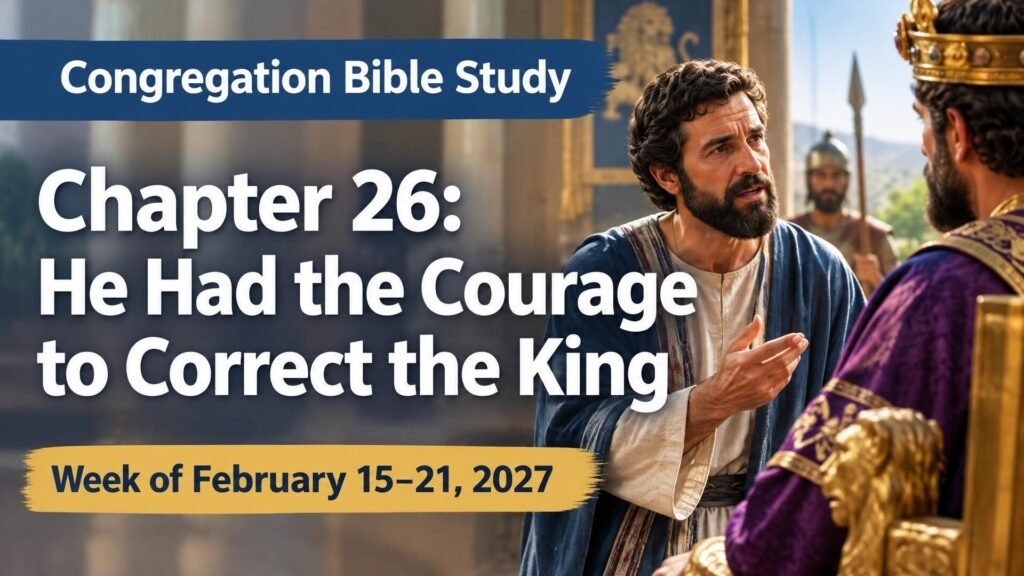
Chapter 26: He Had the Courage to Correct the King
How did Nathan demonstrate courage?
Comment 1: Nathan showed courage by appearing before David and exposing his sins. He was not speaking to just anyone but to a king who had recently arranged for Uriah to die in order to hide what had happened. Even so, Nathan obeyed Jehovah. His example reminds us that courage does not depend on a situation being easy but on our willingness to do what is right even when it is very difficult.
Comment 2: He was also courageous because he did not allow his friendship with David to prevent him from correcting him. He loved and respected him, but he needed to help him recognize the seriousness of what he had done. Nathan did not merely tell him a pleasant illustration; he clearly explained how it applied to him. True love does not mean overlooking a serious sin but seeking the spiritual good of a friend.
Comment 3: Nathan had to deliver a very painful message: David and his family would suffer serious calamities. He did not soften Jehovah’s message to avoid an uncomfortable conversation. But neither was he insensitive. When David repented, Nathan told him that Jehovah had forgiven him. This was a fine balance: Nathan was firm when explaining the sin and was also willing to convey Jehovah’s mercy.
1. Although Nathan was a Bible writer, we know nothing about his background or personal life. What does that tell us about him?
Comment 1: This indicates that Nathan was not seeking fame or prestige. Although he played an important part in events during David’s reign, he did not draw attention to his background or personal life. The material explains that he may have written much of what we know about his service. Yet he did not use that opportunity to make himself the center of the account. His discretion enables us to appreciate his humility.
Comment 2: I am struck by the contrast between the importance of his work and how little we know about his private life. It is generally believed that Nathan and Gad wrote part of First Samuel and all of Second Samuel. Nathan is also credited with an account about Solomon’s affairs. He rendered very valuable service, but what was recorded highlights the events and his relationship with Jehovah, not the writer’s personal prestige.
Comment 3: His example encourages me to serve without needing others to know everything I do. We do not know many personal details about Nathan, but we do know his loyalty and courage. That is what really matters. We can ask ourselves whether we are happy to contribute to a task even when our name receives no special attention. Nathan’s attitude helps us value service more than recognition.
2. How could Uriah be in David’s army if he was a Hittite?
Comment 1: Uriah could serve in David’s army because not all its members were Israelites. David accepted foreigners because he was sure they would be loyal to him and, above all, to Jehovah. Thus, the fact that Uriah was a Hittite does not conflict with his being one of David’s loyal soldiers. To understand his presence in the army, what matters is not only his origin but also the faithfulness David expected from those who accompanied him.
1 Chronicles 11:39,41,46 — Zelek the Ammonite, Naharai the Berothite, the armor-bearer of Joab the son of Zeruiah; Uriah the Hittite, Zabad the son of Ahlai, Eliel the Mahavite, Jeribai and Joshaviah the sons of Elnaam, and Ithmah the Moabite;
Comment 2: This list in First Chronicles shows that Uriah was not an isolated case. Zelek, who was an Ammonite, and Ithmah, who was a Moabite, are also mentioned. So the presence of men from other peoples in David’s army is expressly documented in the Bible. This detail helps us read the account without assuming that all the soldiers had the same background. Among them were foreigners who supported Jehovah’s chosen king.
Comment 3: The case of the Cherethites and the Pelethites helps us understand why David trusted foreign soldiers. When many Israelites followed the rebel Sheba, they remained at David’s side. Later, they also supported Solomon’s becoming king. Their loyalty was not merely words; they demonstrated it during difficult times. Thus, foreign origin did not prevent someone from being a faithful defender of Jehovah’s chosen king.
Comment 4: Ittai the Gittite is another impressive example. When David was fleeing from Absalom, he gave Ittai the opportunity to return because he was a foreigner and had arrived only recently. However, Ittai decided to continue with him, even if that meant dying. The article explains that these foreigners recognized Jehovah as the true God and respected his anointed one. This clarifies what kind of loyalty could unite them to David beyond their nationality.
3. Nathan prophesied that David and his family would suffer calamities. How was this prophecy fulfilled?
Comment 1: The first calamity was the death of the son David had with Bath-sheba. Although David fasted and pleaded for the child while he was sick, the boy died. Thus Nathan’s painful announcement began to be fulfilled. David had received Jehovah’s forgiveness, but that did not eliminate all the consequences of his sin.
Comment 2: Afterward, terrible events occurred within the family. Amnon raped his half sister Tamar, and later Absalom had him killed. These events caused deep suffering and show how violence reached David’s household. Nathan’s prophecy did not refer to a passing difficulty. For years, David had to face family tragedies that illustrated the seriousness of the consequences Jehovah had announced.
Comment 3: Another part of the fulfillment was Absalom’s rebellion. He not only tried to take his father’s throne but also publicly dishonored him by having relations with his concubines. The situation ended in a war in which a son fought against his own father. Thus, the calamities affected more than David’s private life; disloyalty and violence within his family also reached the nation.
2 Samuel 18:33 — This disturbed the king, and he went up to the roof chamber over the gateway and wept, saying as he walked: “My son Absalom, my son, my son Absalom! If only I had died instead of you, Absalom my son, my son!”
Comment 4: David’s reaction to Absalom’s death shows how deeply he suffered. Although his son had rebelled against him, David did not want him to die and was devastated by the news. This passage helps us see Nathan’s announced calamities as more than a list of events. They were real tragedies that caused intense pain to a father and affected his family for a long time.
4. How did Nathan show courage during the final years of David’s reign?
1 Kings 1:5-53 — Meanwhile, Adonijah the son of Haggith was exalting himself, saying: “I am going to be king!” He had a chariot made for himself with horsemen and 50 men to run before him. But his father had never confronted him by saying: “Why have you done this?” He was also very handsome, and his mother had given birth to him after Absalom. He conferred with Joab the son of Zeruiah and Abiathar the priest, and they offered Adonijah help and support. But Zadok the priest, Benaiah the son of Jehoiada, Nathan the prophet, Shimei, Rei, and David’s mighty warriors did not support Adonijah. Eventually Adonijah held a sacrifice of sheep, cattle, and fattened animals by the stone of Zoheleth, which is near Enrogel, and he invited all his brothers the king’s sons, and all the men of Judah the king’s servants. But he did not invite Nathan the prophet, Benaiah and the mighty warriors, or Solomon his brother. Nathan then said to Bath-sheba, Solomon’s mother: “Have you not heard that Adonijah the son of Haggith has become king, and our lord David does not know anything about it? So now come, please, and let me advise you, so that you may save your own life and the life of your son Solomon. Go in to King David and say to him, ‘Was it not you, my lord the king, who swore to your servant, saying: “Your son Solomon will become king after me, and he is the one who will sit on my throne”? So why has Adonijah become king?’ While you are still there speaking with the king, I will come in after you and confirm your words.” So Bath-sheba went in to the king, into his private room. The king was very old, and Abishag the Shunammite was waiting on the king. Then Bath-sheba bowed low and prostrated herself to the king, and the king said: “What is your request?” She replied: “My lord, it was you who swore by Jehovah your God to your servant, ‘Your son Solomon will become king after me, and he is the one who will sit on my throne.’ But look! Adonijah has become king, and my lord the king does not know anything about it. He sacrificed bulls, fattened animals, and sheep in great quantity and invited all the sons of the king and Abiathar the priest and Joab the chief of the army; but he did not invite your servant Solomon. And now, my lord the king, the eyes of all Israel are upon you to tell them who will sit on the throne of my lord the king after him. Otherwise, as soon as my lord the king is laid to rest with his forefathers, I and also my son Solomon will be considered traitors.” And while she was still speaking to the king, Nathan the prophet came in. At once the king was told: “Here is Nathan the prophet!” He came in before the king and prostrated himself to the king with his face to the ground. Then Nathan said: “My lord the king, did you say, ‘Adonijah will become king after me, and he is the one who will sit on my throne’? For today he has gone down to sacrifice bulls, fattened animals, and sheep in great quantity, and he has invited all the sons of the king and the chiefs of the army and Abiathar the priest. They are there eating and drinking with him, and they keep saying, ‘Long live King Adonijah!’ But he did not invite me, your servant, or Zadok the priest, or Benaiah the son of Jehoiada, or your servant Solomon. Has my lord the king authorized this without telling your servant who should sit on the throne of my lord the king after him?” King David now answered: “Call Bath-sheba for me.” At that she came in and stood before the king. The king then swore an oath: “As surely as Jehovah is living, the one who rescued me out of all distress, just as I swore to you by Jehovah the God of Israel, saying, ‘Your son Solomon will become king after me, and he is the one who will sit on my throne in my place!’ that is what I will bring about this day.” Then Bath-sheba bowed low with her face to the ground and prostrated herself to the king and said: “May my lord King David live forever!” Immediately King David said: “Call for me Zadok the priest, Nathan the prophet, and Benaiah the son of Jehoiada.” So they came in before the king. The king said to them: “Take with you the servants of your lord, and have my son Solomon ride on my own mule, and lead him down to Gihon. Zadok the priest and Nathan the prophet will anoint him there as king over Israel; then blow the horn and say, ‘Long live King Solomon!’ Then follow him back, and he will come in and sit on my throne; and he will be king in my place, and I will commission him as leader over Israel and over Judah.” At once Benaiah the son of Jehoiada said to the king: “Amen! May Jehovah the God of my lord the king confirm it. Just as Jehovah was with my lord the king, so let him be with Solomon, and may He make his throne greater than the throne of my lord King David.” Then Zadok the priest, Nathan the prophet, Benaiah the son of Jehoiada, and the Cherethites and the Pelethites went down and had Solomon ride on the mule of King David, and they brought him to Gihon. Zadok the priest now took the horn of oil out of the tent and anointed Solomon, and they began to blow the horn, and all the people began shouting: “Long live King Solomon!” After that all the people followed him and went up, playing flutes and rejoicing greatly, so that the earth was split open by their noise. Adonijah and all those invited by him heard it when they had finished eating. As soon as Joab heard the sound of the horn, he said: “Why is there such a noisy uproar in the city?” While he was still speaking, Jonathan the son of Abiathar the priest came. Then Adonijah said: “Come in, for you are a good man, and you must bring good news.” But Jonathan answered Adonijah: “No! Our lord King David has made Solomon king. The king sent with him Zadok the priest, Nathan the prophet, Benaiah the son of Jehoiada, and the Cherethites and the Pelethites, and they had him ride on the mule of the king. Then Zadok the priest and Nathan the prophet anointed him as king in Gihon. After that they came up from there rejoicing, and the city is in an uproar. That was the noise that you heard. Moreover, Solomon has sat down on the royal throne. Another thing, the servants of the king have come in to congratulate our lord King David, saying, ‘May your God make Solomon’s name more splendid than your name, and may He make his throne greater than your throne!’ At that the king bowed down on the bed. And the king also said, ‘May Jehovah the God of Israel be praised, who today has granted someone to sit on my throne and has allowed my own eyes to see it!’” And all those invited by Adonijah became terrified, and each of them rose up and went his own way. Adonijah was also afraid because of Solomon, so he got up and went and grabbed hold of the horns of the altar. The report was made to Solomon: “Here Adonijah has become afraid of King Solomon; and he has taken hold of the horns of the altar, saying, ‘Let King Solomon first swear to me that he will not put his servant to death by the sword.’” To this Solomon said: “If he behaves in a worthy manner, not a single hair of his will fall to the ground; but if what is bad is found in him, he will have to die.” So King Solomon sent for him to be brought down from the altar. Then he came in and bowed down to King Solomon, after which Solomon said to him: “Go to your own house.”
Comment 1: Nathan showed courage by acting as soon as he learned that Adonijah was trying to make himself king. He knew that Solomon was to succeed David, and he did not support an initiative contrary to that decision. Adonijah had the backing of influential men, such as Joab and Abiathar. Even so, Nathan did not stand aside to see who would win. His loyalty moved him to intervene so that David would know what was happening.
Comment 2: His courage was accompanied by tact and orderly action. First he advised Bath-sheba to remind David of his oath to make Solomon king. Then Nathan himself entered and confirmed the situation. He did not disrespect the elderly king or assume that he had authorized what Adonijah was doing. He asked clear questions so that David would understand the seriousness of the matter and act.
Comment 3: Nathan did not merely point out the problem. When David gave instructions for Solomon to be proclaimed king, Nathan joined other loyal servants in carrying them out. Thus he helped Adonijah’s attempt fail. This teaches me that courage does not consist only in warning that something is wrong. We must also be willing to cooperate loyally in the solution, as Nathan did in that delicate situation.
What does Nathan’s example teach us about helping a friend who has committed a serious sin?
Comment 1: This teaches us that love should not lead us to minimize a serious sin. Nathan was David’s friend, but he understood that David needed to acknowledge what he had done. If we truly love someone, we will be especially interested in helping that person regain friendship with Jehovah. Discussing the matter may be uncomfortable, but avoiding it merely to preserve a peaceful relationship would not imitate the courageous and loyal help Nathan gave David.
Comment 2: We also learn to seek the person’s repentance, not his humiliation. Nathan chose an illustration that helped David recognize the injustice before showing him his own responsibility. He did not hide the truth, but he thought about how to reach David’s heart. When helping a friend, we should ask whether our words will help him understand his situation or merely express how upset we are about what he has done.
Comment 3: The account also reminds us to leave room for hope. When David acknowledged his sin and deeply repented, Nathan conveyed Jehovah’s forgiveness. He did not present the consequences as meaning that David could no longer regain friendship with God. When helping a friend, we can emphasize that distinction: sin is very serious, but sincere repentance makes it possible to seek forgiveness and return to doing what pleases Jehovah.
If we want to reach someone’s heart, how can we imitate the way Nathan handled matters?
Comment 1: We can prepare ourselves with prayer instead of speaking impulsively. The chapter highlights the importance of thinking carefully about how to help, and picture B shows a mother praying before talking with her daughter. A delicate conversation should not focus only on finding the strongest words. We need to ask Jehovah for help and think about the person’s good, speaking in a way that makes it easier for her to listen.
Comment 2: Nathan considered what could touch David’s heart. Because David had been a shepherd and hated injustice, the story about the little sheep helped him see clearly the rich man’s cruelty. We can imitate that tact by using simple explanations that the person understands and that relate to his or her experience. The aim is not to find a striking comparison but to help the person understand why a matter is important.
Comment 3: Picture B adds a practical detail: The mother listens carefully while her daughter expresses how she feels. To reach the heart, it is not enough to prepare what we will say; we must also listen. This prevents us from responding without understanding the person. Then we can clearly explain what she needs to consider, without confusing tact with leaving the matter unfinished. Nathan was considerate, but he was also clear.
In what other ways can you imitate Nathan’s courageous example?
Comment 1: I can imitate him when I am tempted to remain silent about a Bible-based conviction simply to avoid making someone uncomfortable. Nathan did not stop conveying Jehovah’s message because David had authority. This encourages me to explain respectfully what I believe, even if the other person holds an important position or thinks differently. I do not need to speak harshly to be courageous; I can stand firm while treating the person considerately.
Comment 2: His example helps me when pressure comes from people close to me. Nathan loved David, but his friendship did not come before his loyalty to Jehovah. I too can ask myself what weighs more in my decisions: pleasing a friend or doing what I know is right. If a friendship leads me to tolerate something wrong, I need courage to maintain my principles while continuing to treat the other person with love.
Comment 3: I would like to imitate his willingness to act when action was needed. When Adonijah tried to make himself king, Nathan did not merely disapprove silently. He took the steps that were appropriate, with tact and loyalty. This encourages me not to postpone a necessary conversation simply because it is difficult.
What does this account teach me about Jehovah?
Comment 1: It teaches me that Jehovah sees what humans may overlook. David tried to hide his adultery and then arranged for Uriah to die, but he could not hide anything from Jehovah. Furthermore, David’s position as king did not make God consider his conduct acceptable. This strengthens my confidence in Jehovah’s justice: a person’s authority or prestige does not change what is right and what is wrong.
Comment 2: I also see Jehovah’s mercy. David’s sins were very serious, but when he truly repented, Jehovah forgave him. The account does not present that forgiveness as approval of what happened, since David suffered painful consequences. Nevertheless, he was able to regain his friendship with Jehovah. This reminds me that God takes sin seriously while showing mercy to those who acknowledge their error and sincerely repent.
Comment 3: I am moved that Jehovah sent Nathan to correct David. That correction enabled David to acknowledge a situation he had tried to hide. In time, David continued serving Jehovah faithfully and wrote psalms about repentance and forgiveness. This teaches me not to view correction only as something painful. Accepting it can help us react, abandon a wrong course, and regain a close relationship with our heavenly Father.
How does this account relate to Jehovah’s purpose and the Bible’s main theme?
2 Samuel 7:4,12-13 — On that very night, the word of Jehovah came to Nathan, saying: When your days come to an end and you are laid to rest with your forefathers, then I will raise up your offspring after you, your own son, and I will firmly establish his kingdom. He is the one who will build a house for my name, and I will firmly establish the throne of his kingdom forever.
Comment 1: The most direct connection is found in the promise Jehovah communicated to David through Nathan. The chapter explains that David would have the privilege of being an ancestor of the Messiah. Therefore, this account is not limited to a friendship or to the correction of a king. It is part of the history of how Jehovah progressively revealed his purpose regarding the Messiah and a Kingdom whose throne would be established forever.
Comment 2: The account shows that receiving an important role in Jehovah’s purpose does not place anyone above his standards. David had received an extraordinary promise, but he had to answer for his sins. Jehovah did not overlook injustice to protect the king’s reputation. This harmonizes with what the Bible teaches about his rule: his authority is linked with righteousness, and those who represent him must respect his decisions.
Comment 3: Nathan’s later intervention was also related to Jehovah’s purpose. When Adonijah wanted to occupy the throne, Nathan supported Solomon’s becoming the next king because he knew that this was Jehovah’s choice. He was not guided by a man’s ambitions or by the support that man had obtained. His example highlights the importance of respecting Jehovah’s decisions in matters involving David’s royal line.
What would I like to ask Nathan when he is resurrected?
Comment 1: I would like to ask him what helped him remain firm while going to speak with David. We know that he obeyed Jehovah, but the account does not describe all his thoughts before that conversation. It would be fascinating to hear how he experienced that moment and what gave him strength to carry out such a delicate assignment. His answer could help us appreciate even more the courage required to do what is right when we do not know how the other person will react.
Comment 2: I would ask him how he chose the illustration about the little sheep and what he considered when preparing to speak with David. The chapter shows how suitable it was for a man who had been a shepherd and hated injustice. I would like to know more about how he thought of helping David recognize his responsibility. We do not know those details, but the question reflects a lesson we can learn now: think about the person before giving counsel.
Comment 3: I would ask him how he felt when he saw that David repented and continued serving Jehovah. I would like to hear how he experienced that result after such a difficult conversation. The account makes me think about the good that correction can accomplish when it is given with courage, tact, and genuine love.
More posts for this week




Enjoy every Premium feature
More convenient meeting preparation with full access to the site’s tools.
- Ad-free browsing
- My Recorder and live transcription
- Assignment Review
- Full Academy access
- Audio posts and reading magnifier
- Saved and synced comments
- Support the project and help keep it running
Monthly plan
€3 per monthRenews monthly. Cancel at any time.
Choose monthlyAnnual plan
€30 per yearOne payment for 12 months. No automatic renewal.
Choose annual


