










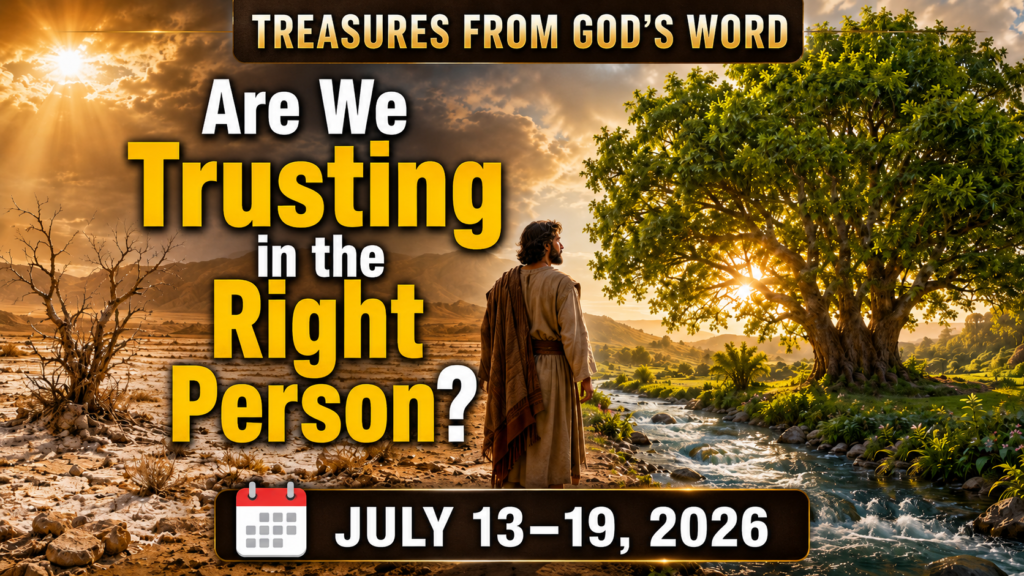
Theme: “Are We Trusting in the Right One?”
When a person is in danger, he looks for refuge. If a strong storm hits, he does not stay out in the middle of the street; he looks for a safe place. If he has an important decision ahead of him, he looks for guidance. The question is, where does he look for that security? Whom does he trust?
That question is very important for all of us: “Are we trusting in the right one?” Because not every source of help is safe, not every piece of advice is trustworthy, and not every solution that looks practical has Jehovah’s approval.
In Bible times, some of God’s people made the mistake of looking for protection in the wrong place. Instead of trusting in Jehovah, they sought human alliances. And Jehovah made it clear that this course of action did not please him.
The first point is this: those who trust only in mere humans displease Jehovah.
Let’s read Isaiah 30:1, 2: “‘Woe to the stubborn sons,’ declares Jehovah, ‘who carry out a plan, but not mine, and who make an alliance, but not by my spirit, in order to add sin upon sin. They are on their way down to Egypt without consulting me, seeking refuge in the protection of Pharaoh and seeking refuge in the shadow of Egypt.’”
Jehovah called his people “stubborn sons.” Why? Because they were carrying out plans, but they were not Jehovah’s plans. They were making alliances, but not by his spirit. They were going down to Egypt seeking Pharaoh’s protection, but they were not consulting Jehovah.
Egypt may have looked like a strong power, a logical ally, a practical solution. But the problem was not merely political; it was spiritual. Through their actions they were saying, “Jehovah is not enough. We need some other security.” And that added sin upon sin, because it showed a lack of faith and disobedience.
Jeremiah expressed the same idea in very direct words.
Let’s read Jeremiah 17:5: “This is what Jehovah says: ‘Cursed is the man who puts his trust in mere humans, who relies on human power, and whose heart turns away from Jehovah.’”
This text does not say that it is wrong to ask for help, to accept advice, or to value other people’s experience. The Bible itself shows that Jehovah’s servants can benefit from wise counsel. The problem lies in trusting in “mere humans” as though they were our main source of security, so that our heart turns away from Jehovah.
That’s the key phrase: “whose heart turns away from Jehovah.” A person can start out little by little. Maybe he has a problem, and the first thing he does is look for human solutions. He listens to opinions, watches what the majority is doing, lets himself be influenced by the world, or makes decisions based simply on what seems convenient. But he forgets to ask himself, “What does Jehovah think? What Bible principle applies here? Am I seeking his guidance first?”
This can happen in both big and small decisions—for example, when choosing a job, deciding whom to spend time with, looking for a marriage mate, facing family problems, or planning for the future. If we are guided only by human standards, such as money, comfort, prestige, or the opinion of others, we could end up relying on “human power.”
Jehovah does not want us to go through life distrusting everyone, but he does want us to understand that humans are limited. Even the most intelligent, powerful, or well-meaning person can make mistakes. Jehovah, on the other hand, sees the whole picture. He knows what is best for us now and also what will protect us in the long run.
That’s why, before we make important decisions, we do well to consult Jehovah through prayer, the Bible, our publications, and counsel based on Bible principles. The question should not simply be, “What is convenient for me?” but, “What will please Jehovah?”
The second point shows what happens when someone decides to turn away from Jehovah and to rely only on human solutions: he will have a difficult life.
Let’s read Jeremiah 17:6: “He will become like a solitary tree in the desert. He will not see any good come. He will reside in parched places in the wilderness, in a salty land where no one lives.”
What a sad picture! Jehovah compares the person who turns away from him to a solitary tree in the desert. It is not a tree by a river, strong and full of life. It is an isolated tree, on parched ground, in a salty land where no one lives.
This week’s material explains that the word used probably refers to a type of juniper, a shrub that grows in rocky desert areas and among crags. In addition, the Hebrew root related to that name conveys the idea of “bareness” or being “stripped.” That fits very well with the picture of a sad-looking, solitary shrub on dry ground.
That is what life is like for someone who turns away from Jehovah. Outwardly he may seem to be doing well. He may have goals, resources, or human support. But spiritually he is in a dry place. He lacks the guidance, the peace, and the protection that only Jehovah can give.
The text says, “He will not see any good come.” That is very serious. A person who trusts only in human judgment may have spiritual opportunities right in front of him and fail to appreciate them. He may hear good counsel and reject it. He may see how Jehovah cares for his people and still not recognize it. He may receive help but fail to value it because his heart is looking in another direction.
Consider someone who makes decisions based only on money. He may take a job that absorbs so much of his time that he starts missing meetings, preaches less and less, and drifts away from the brothers. At first he may think, “This gives me security.” But over time he may end up feeling spiritually dry, tired, and alone—not because Jehovah abandoned him, but because he himself drifted away from the source of true security.
Or consider someone who is swayed by the world’s advice about relationships, morals, or personal goals. The world may present that advice as modern or practical, but it often ends up leaving the person empty, hurt, or estranged from Jehovah.
The picture of the solitary tree reminds us that we were not created to live far from Jehovah. We need his direction. We need his Word. We need prayer. We need to stay close to his people. Without those things, life may look busy on the outside, but spiritually it becomes barren.
Now, Jehovah does not simply warn us of the danger. He also shows us the path that leads to a strong and fruitful life. The third point is this: those who trust in Jehovah will flourish.
Let’s read Jeremiah 17:7, 8: “Blessed is the man who puts his trust in Jehovah, whose confidence is in Jehovah. He will become like a tree planted by the waters, that sends out its roots by the stream. He will not fear when the heat comes, but his foliage will be luxuriant. In the year of drought he will not become anxious, nor will he stop producing fruit.”
What a beautiful contrast! First we saw a solitary tree in the desert. Now we see a tree planted by the waters. It has deep roots that reach the stream, and that is why it stays luxuriant even when the heat comes.
The material mentions that, along the banks of rivers and streams in Syria and Palestine, tall poplars used to grow. The Bible mentions them near watercourses or in torrent valleys. It was also common to find willows in places where there was plenty of water. These tall, leafy trees illustrate very well the point that the psalmist and Jeremiah wanted to highlight: The person who obeys God’s laws and trusts in him remains spiritually strong.
That does not mean that the one who trusts in Jehovah never has problems. The text speaks of heat and of drought. In other words, even faithful servants go through difficult times—sickness, financial problems, anxiety, opposition, discouragement, or losses. But the difference lies in where their roots are.
The one who trusts in Jehovah sends his roots out toward the stream. Those roots represent our relationship with him, our faith, our spiritual routine, and our confidence in his promises. If our roots are deep, the heat does not destroy us. The drought does not leave us without fruit.
For example, a brother may lose his job, but if he trusts in Jehovah, he does not make desperate decisions that endanger his spirituality. He prays, seeks counsel, keeps up his spiritual routine, and remains convinced that Jehovah will not abandon him. A sister may go through a family trial, but if her roots are in Jehovah, she does not respond with bitterness or isolate herself. She draws strength from prayer, from the meetings, and from the support of the brothers.
The question is, how do we make our roots reach the stream? It does not happen by chance. It takes consistency. Each time we pray sincerely, our roots grow deeper. Each time we study the Bible and meditate, we absorb spiritual water. Each time we attend the meetings, take part in the preaching work, and accept Jehovah’s counsel, we grow stronger.
It is also important to trust in Jehovah before the drought comes. A tree does not develop deep roots in a single day. In the same way, we cannot wait for a great trial to arrive before we start strengthening our faith. Now is the time to deepen our roots.
Trusting in Jehovah also means obeying him when his instructions do not match what the world recommends. The world may say, “Look for financial security first.” Jehovah teaches us to seek the Kingdom first. The world says, “Do what you feel like doing.” Jehovah teaches us to let Bible principles guide our heart. The world says, “Trust in yourself.” Jehovah teaches us to trust in him.
And the promise is precious: The one who trusts in Jehovah “will not stop producing fruit.” He can keep showing faith, love, patience, endurance, and joy even under difficult circumstances—not because he is strong on his own, but because he is connected to the best source of life: Jehovah.
So let’s go back to the question of our theme: “Are we trusting in the right one?”
If we trust only in mere humans, we may end up like a solitary tree in the desert—dry, isolated, and unable to see the good when it comes. But if we trust in Jehovah, we will be like a tree planted by the waters—firm, luxuriant, and able to produce fruit even in difficult times.
That’s why, before we make decisions, let’s seek Jehovah’s guidance. When we feel pressure, let’s not run to take refuge “in the shadow of Egypt,” that is, in human solutions that leave God out. And when the heat or the drought comes, let’s keep our roots close to Jehovah through prayer, the Bible, the meetings, and obedience.
Jehovah never fails. Humans can make mistakes, circumstances can change, and the securities of this world can vanish. But the one who trusts in Jehovah has the best protection, the best guidance, and the best hope. May our life always show that we are trusting in the right one: Jehovah.
Discover more from Comentarios para la Reunión TJ
Subscribe to get the latest posts sent to your email.
Receive new posts by email
Create a free account or choose the ad-free plan. During registration, you can choose to receive new posts by email.
Register


