










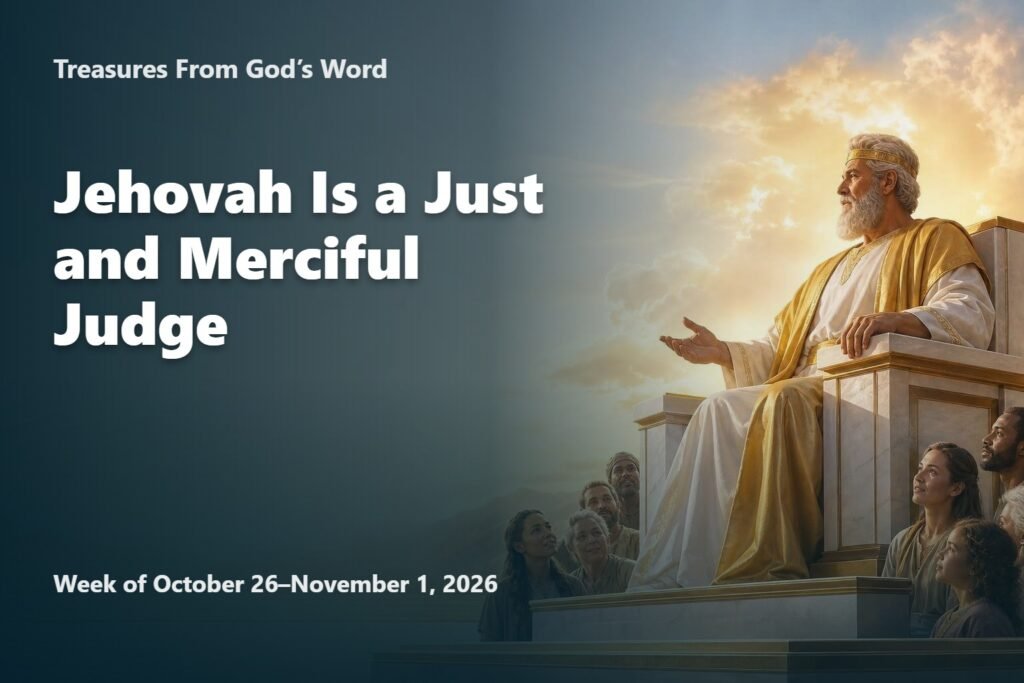
Theme: Jehovah Is a Just and Merciful Judge
When we see injustice, pride, or cruelty, we may wonder whether anyone will ever be called to account for so much harm. Jeremiah 48 gives us a reassuring answer. Jehovah carefully observes what nations and individuals do. His judgment is not impulsive or exaggerated. It is always just, and even when he has to execute punishment, his mercy remains evident.
The prophecy against Moab helps us to know Jehovah’s heart better. Moab was not judged without cause. It had shown opposition to and contempt for God’s people. Yet Jehovah did not take pleasure in its suffering, nor did he completely close the door to hope. Let us see how these three facets harmonize perfectly: justice, compassion, and mercy.
Moab had a long history of opposition to Israel. When Judah received discipline from Jehovah by means of the Babylonians, the Moabites did not recognize that Jehovah was acting or that Judah was his people. Instead, they mocked them. They seemed to enjoy seeing the humiliation of their neighbors. That attitude revealed a lack of respect both for Judah and for the God whom Judah served.
Jeremiah 48:27,29,42 — Was Israel not an object of ridicule to you? Was he found among thieves, So that you should shake your head and speak against him? “We have heard about the pride of Moab—he is very haughty— About his arrogance, his pride, his haughtiness, and the loftiness of his heart.” “‘And Moab will be annihilated from being a people, For it is against Jehovah that he has exalted himself.
These words make clear why the judgment was just. Moab had made Israel an object of ridicule and spoke contemptuously. In addition, Jehovah saw the pride in its heart. Moab trusted in its own importance, resources, and strength. But its most serious problem was that it had exalted itself against Jehovah. No one can adopt that attitude without facing the consequences.
Jehovah announced that he would use the Babylonians, led by Nebuchadnezzar, to call Moab to account. Many of its cities would become desolate. This was not a capricious reaction. Jehovah was responding to persistent conduct: pride, opposition, and ridicule directed against those who were his people. By executing that judgment, Moab would come to know who Jehovah is and that no one can arrogantly defy him.
This teaches us never to rejoice over the difficulties of others. Someone may be reaping the consequences of bad decisions, or perhaps may be undergoing painful discipline. It is not our place to speak against that person, shake our head in contempt, or feel superior. Jehovah sees the heart. He appreciates it when we treat those who suffer with dignity, even if they have made mistakes.
It is also good to ask ourselves whether pride may be influencing our way of thinking. At times it may appear when we place too much confidence in our abilities, possessions, or experience. Or it may be seen in the way we speak about others. The prophecy against Moab reminds us that Jehovah takes note of the haughtiness of the heart. Humility protects us and draws us closer to him.
Still, Jehovah’s justice does not make him a cold judge. He had sound reasons for punishing Moab, but he did not view its calamity with indifference. The following passage allows us to perceive Jehovah’s feelings and shows us that his judgment is always accompanied by deep compassion.
At times, humans may think that justice simply means punishing. Jehovah demonstrates something far higher. He upholds what is right and does not overlook wickedness, but he takes no pleasure in seeing others suffer. His reaction to Moab’s judgment was very different from the proud and cruel attitude that Moab had shown toward Judah.
Jeremiah 48:31,36 — That is why I will wail over Moab, For all Moab I will cry out And moan for the men of Kir-heres. That is why my heart will moan for Moab like a flute, And my heart will moan for the men of Kir-heres like a flute. For the wealth he has produced will perish.
Jehovah spoke of wailing, crying out, and moaning over Moab. Those expressions convey genuine sadness. Although Moab deserved to be called to account, the destruction of its cities and the loss of its wealth were not a cause for joy to Jehovah. He is not insensitive to the pain produced by judgment. His compassionate heart remains in perfect harmony with his just standards.
How comforting it is to know that. When Jehovah allows a person to face the consequences of his conduct, or when he disciplines those whom he loves, he never does so with unnecessary harshness. His objective is not to humiliate or crush. Jehovah knows that sin causes pain and that its results can be serious, but he cares deeply about people and wants them to benefit from his guidance.
We can imitate that attitude when dealing with those who have disappointed us. Perhaps a family member, a fellow Christian, or someone we have helped takes a wrong course. We do not minimize what is wrong or ignore Jehovah’s standards. But we avoid adopting a harsh tone or taking pleasure in seeing that person shamed. Christian justice must always be accompanied by compassion.
Jehovah’s compassion in the face of Moab’s calamity prepares the way for an even more moving truth. His judgment did not necessarily mean that there was no future for any Moabite. Jehovah is able to discipline firmly and at the same time leave open a possibility of restoration. That mercy is seen in the final words of the prophecy.
After describing the judgment against Moab, Jehovah added a promise that may surprise us. He did not erase from the prophecy the consequences of Moab’s arrogance, nor did he soften the seriousness of his judgment. But he showed that his purpose was not limited to punishing. Even after the discipline, Jehovah could offer the prospect of recovery.
Jeremiah 48:47 — But I will gather the captives of Moab in the final part of the days,’ declares Jehovah. ‘Down to this point is the judgment on Moab.’”
In time, Cyrus, the conqueror of Babylon, would allow the Moabite exiles to return to their land. Thus the promise that Jehovah would gather the captives of Moab was fulfilled. This detail reveals that Jehovah sees beyond a moment of judgment. He can show mercy to people who come from a nation that had been an enemy of his people.
This prophecy strengthens our confidence in Jehovah’s mercy. No one should conclude that he is too far from Jehovah or that his past eliminates all hope. Jehovah knows the complete situation of each person, and his desire is that people respond to his guidance. Therefore, while there is opportunity, we continue reflecting his patience and concern for those who do not yet serve Jehovah.
The possibility that Jehovah may show mercy even after the great tribulation begins helps us better understand why our preaching is so urgent. What we say now may remain engraved in someone’s mind. Even if that person does not respond today, he may remember the message when he sees the announced events taking place and decide to take his stand for Jehovah before it is too late.
Think of someone who once served Jehovah with his family but drifted away. Perhaps that person still has memories of what he learned and of the happiness he experienced while serving Jehovah. If he hears our respectful warnings and message of hope, those truths may touch his heart. We do not know what each person will do, but Jehovah sees inside and can help that person respond.
So the question for meditation is very practical: What does Jehovah’s mercy move us to do now? It moves us to continue giving warnings with tact, patience, and conviction. We do not preach to condemn people. We want them to have the opportunity to come to know Jehovah and take their stand for him. His mercy impels us not to give up easily on anyone.
The prophecy against Moab confirms that Jehovah is a just Judge. He does not overlook pride or mistreatment of his people. But it also confirms that he is deeply merciful: he does not take pleasure in suffering and can open a path of hope after discipline.
So let us maintain a humble attitude, avoid rejoicing over the difficulties of others, and treat everyone with compassion. And let us continue speaking about Jehovah’s message with a sense of urgency. By doing so, we will reflect the Judge who always does what is just and who never ceases to be merciful.
Discover more from Comentarios para la Reunión TJ
Subscribe to get the latest posts sent to your email.
Receive new posts by email
Create a free account or choose the ad-free plan. During registration, you can choose to receive new posts by email.
Register


