










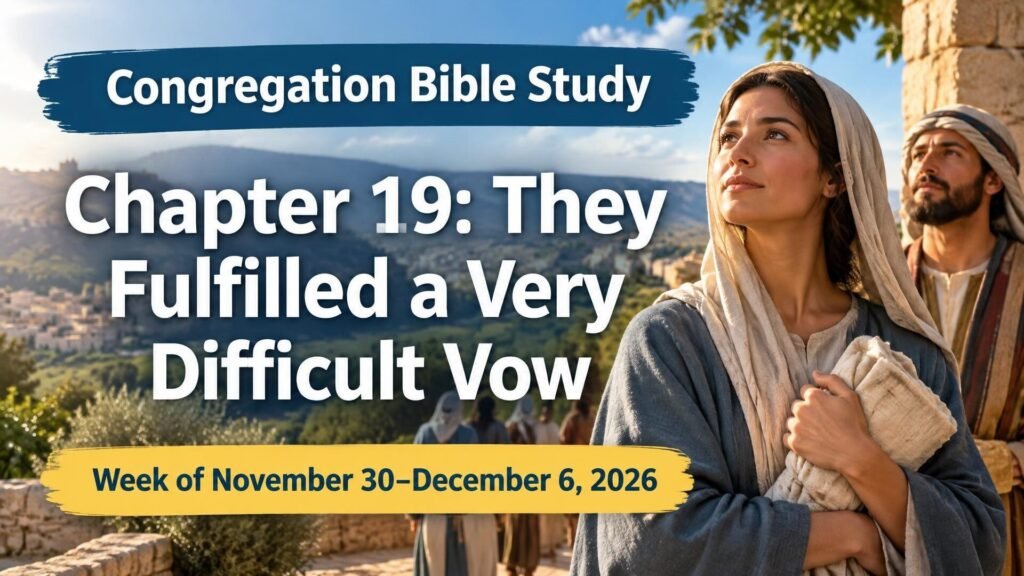
Chapter 19: They Fulfilled a Very Difficult Vow
In what ways did Jephthah and his daughter show courage?
Comment 1: Jephthah showed courage by accepting the responsibility to help the Israelites, even though they had previously treated him very badly. He did not allow resentment to prevent him from acting in favor of Jehovah’s people. Also, before going to battle, he tried to resolve the conflict by speaking with the king of Ammon. This teaches me that being courageous does not mean being aggressive. At times, it requires controlling our feelings, seeking peace, and being willing to help even those who have hurt us.
Comment 2: He also showed courage by leading the Israelites against the Ammonites. But he did not rely simply on his ability as a warrior. He knew what Jehovah had done for Israel and recognized that he needed Jehovah’s help to win. The account explains that Jehovah’s spirit came upon him and that Jehovah gave them the victory. So his courage was linked to faith. He was not trusting in himself but acting with the certainty that he needed God’s direction.
Comment 3: Jephthah’s daughter showed courage by accepting what her father’s vow meant. She knew that she would not marry or have children, and the account makes clear that this caused her pain. Even so, she supported her father so that he could fulfill his promise to Jehovah. I am impressed that her courage is not presented as an absence of sadness. She needed time to mourn with her companions, but her feelings did not cause her to abandon her decision to put Jehovah’s service first.
Comment 4: Jephthah’s daughter’s courage was not limited to the moment when she accepted the vow. She continued to be faithful to Jehovah as time passed. The chapter explains that there was immorality at the tabernacle, but she did not give in to that bad influence. This highlights another kind of courage: maintaining clean conduct even when others nearby do not. Her example reminds me that loyalty is shown both in a difficult decision and in the decisions we make every day.
1. What indicates that the Ammonites were fighting not only against the Israelites but also against true worship?
Comment 1: An important detail is when that attack was prepared. The Israelites had suffered oppression for years, but eventually they repented, removed their idols, and returned to serving Jehovah. After that change, the Ammonites gathered at Gilead for an all-out war. The explanation in Insight points out that true worship was at stake. This was not merely a conflict over land; God’s people, who had just returned to worshipping the true God, were being attacked.
1 Corinthians 10:20 — No; but I say that what the nations sacrifice, they sacrifice to demons and not to God; and I do not want you to become sharers with the demons.
Comment 2: This passage helps us understand what lay behind the worship of the pagan nations. Their sacrifices were made to demons, not to Jehovah. For that reason, the explanation in Insight identifies Satan as the one inciting those nations against Israel. The opposition had a spiritual dimension, even though it was expressed through warfare.
Comment 3: The contrast between the two sides is also significant. Israel was getting rid of the false gods, whereas the Ammonites remained attached to pagan worship. Psalm 96:5 shows the difference between those worthless gods and Jehovah, the Creator. Thus, the attack did not simply pit two peoples with different interests against each other. It threatened those who had decided to recognize Jehovah as their God and abandon idolatry. This context helps us understand why true worship was the central issue.
Comment 4: I am struck by the fact that returning to Jehovah did not immediately make the opposition disappear. The Israelites showed repentance by their actions, yet the Ammonites prepared to attack them. Therefore, that threat did not mean that they had done wrong by abandoning the idols. This helps us not to measure the value of a spiritual decision only by how easy things are afterward. What matters is that the decision agrees with what Jehovah wants, even when continuing to worship him involves difficulties.
2. Jacob also made a vow to Jehovah. In what way was Jephthah’s attitude like Jacob’s?
Comment 1: Both men wholeheartedly wanted Jehovah to direct them. Jacob needed protection during his journey, and Jephthah needed help when facing the Ammonites. Although their circumstances were different, neither considered that he could succeed solely by his own strength. Their vows expressed their dependence on Jehovah and their desire to acknowledge his help. That is the main similarity: they were not focused on proving their own ability but on receiving God’s direction and giving him credit for what they accomplished.
Comment 2: The grateful attitude of both men can be seen in what they were willing to offer. Jacob promised to give Jehovah a tenth of whatever he received. Jephthah also wanted to dedicate something valuable to him if he returned victorious. The details of their vows were not the same, but both recognized that their blessings would come from Jehovah. This is a good lesson for our prayers: besides asking for help, we can think about how to show gratitude for it and how to use what we have to serve him.
Judges 11:32-33 — So Jephthah went to fight against the Ammonites, and Jehovah gave them into his hand. He struck them down with a very great slaughter from Aroer all the way to Minnith—20 cities—and as far as Abel-keramim. Thus the Ammonites were subdued before the Israelites.
Comment 3: The account attributes the victory to Jehovah, not merely to Jephthah’s military skill. This fits the attitude he had expressed in his vow. Like Jacob, he recognized that any success would depend on divine help. Therefore, his trust in Jehovah was not just words; he acted while relying on Him.
Comment 4: It is also important to remember that Jephthah understood that Jehovah wanted them to fight against Ammon and that he already had the power of Jehovah’s spirit. His vow expressed a sincere desire to receive direction and honor Jehovah. The comparison with Jacob highlights that heartfelt attitude. To imitate it, we do not need to repeat their vows. We can recognize our limitations, seek Jehovah’s guidance before acting, and avoid taking all the credit when things turn out well. In this way, we show humble trust like theirs.
3. Why was fulfilling his vow such a sacrifice for Jephthah?
Comment 1: It was an enormous sacrifice because the young woman was his only daughter; Jephthah had no other children. By being devoted entirely to Jehovah’s service, she would not marry or have children. This meant that he would have no grandchildren and that no one would preserve the family name and inheritance. The vow deeply affected both of their futures.
Comment 2: Jephthah’s reaction shows how much it cost him to fulfill his promise. When his daughter came out to meet him, he ripped his garments and expressed his deep anguish. He was not indifferent to what she was going to lose or to what it meant for him. In addition, his daughter needed time to mourn the opportunity to marry and have children. This helps me understand that a person can feel great sadness and at the same time be completely determined to be loyal to Jehovah.
Comment 3: It is important to clarify that Jephthah was not going to take his daughter’s life. Jehovah prohibited and detested human sacrifice. The sacrifice consisted of her dedicating her life to Jehovah’s service and giving up marriage and motherhood. That is why the account speaks of her mourning her virginity. Understanding this allows us to appreciate their loyalty correctly: the father and daughter did not do something cruel to please God but accepted a very painful personal sacrifice in order to fulfill the vow.
Deuteronomy 23:21,23 — “If you make a vow to Jehovah your God, do not be slow about paying it. For Jehovah your God will surely require it of you; otherwise, it will be a sin on your part. The word of your lips you should keep, and you must carry out what your own mouth vowed as a voluntary offering to Jehovah your God.
Comment 4: This law helps us understand why Jephthah did not consider personal pain a reason to break his vow. He had made a voluntary promise to Jehovah and took it very seriously. His daughter shared that respect. For both of them, loyalty to Jehovah outweighed their personal desires.
4. The prophet Samuel was born around 1180 B.C.E. What indicates that he and Jephthah’s daughter may have served at the tabernacle at the same time?
Comment 1: The dates show that this was possible. Samuel was born around 1180 B.C.E., and Jephthah’s judgeship began approximately in 1173 B.C.E. Thus, Samuel would have been about seven years old when Jephthah began judging Israel. Since both belonged to the same period, Jephthah’s daughter may have served at the tabernacle while Samuel was a child.
Judges 12:7 — Jephthah judged Israel for six years, after which Jephthah the Gileadite died and was buried in his city in Gilead.
Comment 2: The six years of Jephthah’s judgeship fit with Samuel’s early years. Insight places that period probably during Eli’s judgeship. In addition, Jephthah’s reference to 300 years of Israelite occupation helps to date its beginning. Thus, the possible overlap is supported by chronological data, although the dates are approximate.
Comment 3: We can distinguish between what the dates allow and what the account confirms. The chronology makes it possible for Samuel and Jephthah’s daughter to have served there at the same time. But we do not know whether she took part in his education or personally influenced him. The chapter raises those questions without presenting the answer as certain. It is important to maintain the same caution: we can enjoy thinking about that possibility, but Jephthah’s daughter’s example of faithfulness does not depend on whether it happened.
What effect can it have on children to see their parents show courage like Jephthah?
Comment 1: It can help them understand that Jehovah deserves first place, even when obeying him is costly. Jephthah’s daughter saw that her father was not willing to undo his promise for personal convenience, and she showed the same loyalty. Children can learn much when they observe their parents maintaining a right decision even when it involves giving something up. They do not merely hear that serving Jehovah is important; they see that their parents truly believe it. That example can encourage them to develop their own convictions.
Comment 2: Parents’ example can also teach children to face pain without abandoning what is right. Jephthah did not hide that he was suffering, but neither did he use that suffering to justify breaking his vow. Thus, children can learn that being courageous does not mean never crying or having all the answers. It means remaining loyal to Jehovah even in a difficult situation. This can help them not to feel like failures when a right decision causes sadness or is very hard for them.
Comment 3: Another lesson children can learn is how to react when someone treats them badly. Jephthah had suffered an injustice, but he did not allow it to stop him from helping Jehovah’s people. When parents act in this way, they teach by their actions that resentment should not direct our decisions. Children can learn to seek peace, cooperate, and do good without becoming trapped by what others have done to them. This kind of courage is useful both in the family and in the congregation.
How can Christians imitate the young women who encouraged Jephthah’s daughter and helped her remain courageous?
Comment 1: We can imitate them by giving encouragement consistently, not only when someone makes a difficult decision. The young women of Israel went every year to commend Jephthah’s daughter. Their support was not limited to the beginning of her service. Similarly, someone who has made sacrifices to serve Jehovah more fully may continue to need affection long afterward. Taking an interest in how the person is doing, listening, and keeping in touch can help him feel that his brothers have not forgotten him or his efforts.
Comment 2: We can also give sincere, specific commendation. Those young women recognized Jephthah’s daughter’s courage and encouraged her. We could tell a brother what aspect of his faithfulness has strengthened us instead of limiting ourselves to a general compliment. This does not mean minimizing what is difficult about his situation. We can listen to his feelings while helping him see the good produced by his example. At times, well-chosen words arrive just when someone needs strength to continue.
Comment 3: The picture in the chapter shows a practical way to give such support. A sister who has moved to another country receives a package and speaks with her friends by video call. We can do something similar according to our circumstances: send a card, have a warm conversation, or help with a specific need. The gift does not have to be large. What matters is that the person senses our sincere concern. Thus, besides admiring his courage, we help him feel supported while he continues serving Jehovah.
In what ways can you imitate the courageous example of Jephthah and his daughter?
Comment 1: I can imitate Jephthah by not allowing a bad experience to prevent me from continuing to do good. He had reasons to feel hurt by the way his half brothers treated him, but he accepted the responsibility to help when the people needed him. If someone disappoints me, I can ask myself whether I am allowing that pain to determine how I treat others. His example encourages me to seek peace and continue cooperating. This does not erase what happened, but it prevents resentment from becoming the most important thing.
Comment 2: Jephthah’s daughter teaches me to maintain Jehovah’s standards even when other people do not respect them. She remained faithful despite the immorality at the tabernacle. Therefore, I do not want to justify a wrong decision by saying that others make the same one. My conduct must depend on my relationship with Jehovah, not on someone else’s bad example. Copying her courage means preserving my own convictions and acting in harmony with them, even when it would be easier to go along with the prevailing attitude.
Comment 3: I can also imitate them by taking my commitments to Jehovah seriously and accepting help when fulfilling them becomes difficult. Jephthah’s daughter was determined to be loyal, but that did not prevent her from spending time with her companions or receiving encouragement. At times, we might think that being strong means facing everything alone. Her example shows something different: we can maintain our decision while acknowledging that we need support. Speaking with spiritual friends and allowing ourselves to be encouraged can help us move forward without minimizing our feelings or giving up what is right.
What does this account teach me about Jehovah?
Comment 1: It teaches me that Jehovah is compassionate and takes sincere repentance into account. The Israelites had abandoned him, but later they acknowledged their sin and removed their false gods. Judges 10:15, 16 shows that Jehovah was moved when he saw them suffer. Their repentance was not merely words; they changed their conduct. This encourages me because I see that Jehovah is not indifferent when someone acknowledges his errors and returns to him. At the same time, it reminds me that repentance must be evident in what we do.
Comment 2: The account also helps me see that Jehovah does not approve of cruel practices. It would be wrong to think that Jephthah’s vow involved killing his daughter, because the Law expressly prohibited human sacrifice. She would dedicate her life to serving Jehovah. This detail is important for knowing our God well: his worship must not be confused with the detestable practices of the surrounding nations. When we read an expression that seems difficult, we need to understand it in the light of what Jehovah has clearly revealed about his standards.
Comment 3: I also learn that Jehovah values the faith of his servants. Long after those events, Jephthah was included among the examples of faith mentioned at Hebrews 11. His faithfulness was not forgotten. The account also preserves the example of his daughter, although it does not give her name. This helps me value loyalty more than personal recognition. What matters is not that everyone knows about our efforts but that we continue showing faith and love for Jehovah in the responsibilities we have.
How does this account relate to Jehovah’s purpose and the main theme of the Bible?
Comment 1: The account highlights the question of who deserves to receive worship. Israel had abandoned Jehovah to serve false gods, but afterward acknowledged its error and returned to him. This choice relates to the Bible’s theme of recognizing Jehovah as the true God and respecting his authority. The victory did not make Jephthah the focus of the account, because Jehovah made the deliverance possible. Thus, the difference is highlighted between the worthless gods of the nations and the God who could help his people.
Comment 2: We also see Satan’s opposition to true worship. The explanation in Insight points out that he incited the pagan nations against Israel. But Jephthah and his daughter did not abandon Jehovah in the face of that pressure or of the personal sacrifice they later had to make. Their example shows that humans can choose loyalty to God even when it is costly. Therefore, this account is not only about a military victory; it also highlights the faith of people who recognized that Jehovah deserved their obedience.
Comment 3: Another connection with Jehovah’s purpose is that he acted in favor of his people and true worship. The Ammonites could not prevent Jehovah from delivering Israel. At the same time, Jephthah and his daughter showed how to respond personally to that help—with gratitude and loyalty. It is valuable to link these two things. It is not enough to admire what Jehovah does to fulfill his purpose; each one of us can choose to support it by the way we live. They did so even when it meant giving up very important desires.
What would I like to ask Jephthah and his daughter when they are resurrected?
Comment 1: I would like to ask Jephthah what helped him not to be dominated by resentment when the elders of Gilead came to look for him. We know that he had suffered unjust treatment and yet accepted the responsibility to help. I would be interested to hear how he dealt with that decision and what aspects of his trust in Jehovah gave him strength. We do not know all the thoughts he had, but his conduct shows the result. It would be very enriching to hear from him how he managed to put the welfare of the people ahead of his personal wounds.
Comment 2: I would like to ask his daughter what words from her companions encouraged her most and what joys she found in dedicating her life to Jehovah’s service. The account tells us that she had to give up marriage and children, but also that she received commendation and encouragement every year. I would like to know more about that part of her life without imagining answers that we do not have now. Hearing her could help us appreciate even more how meaningful loving support can be to someone determined to remain faithful.
Comment 3: I would also ask her whether she came to know young Samuel and whether they spent time together at the tabernacle. The chronology allows for that possibility, but the chapter acknowledges that we do not know whether she had any influence on his education. It would be wonderful to clarify this by hearing about her own experience. Whatever the answer, I would like to thank her for her example. We do not need to know every detail of her life to admire her courage, clean conduct, and loyalty in supporting the fulfillment of the vow.
Enjoy every Premium feature
More convenient meeting preparation with full access to the site’s tools.
- Ad-free browsing
- My Recorder and live transcription
- Assignment Review
- Full Academy access
- Audio posts and reading magnifier
- Saved and synced comments
Monthly plan
€3 per monthRenews monthly. Cancel at any time.
Choose monthlyAnnual plan
€30 per yearOne payment for 12 months. No automatic renewal.
Choose annual


