










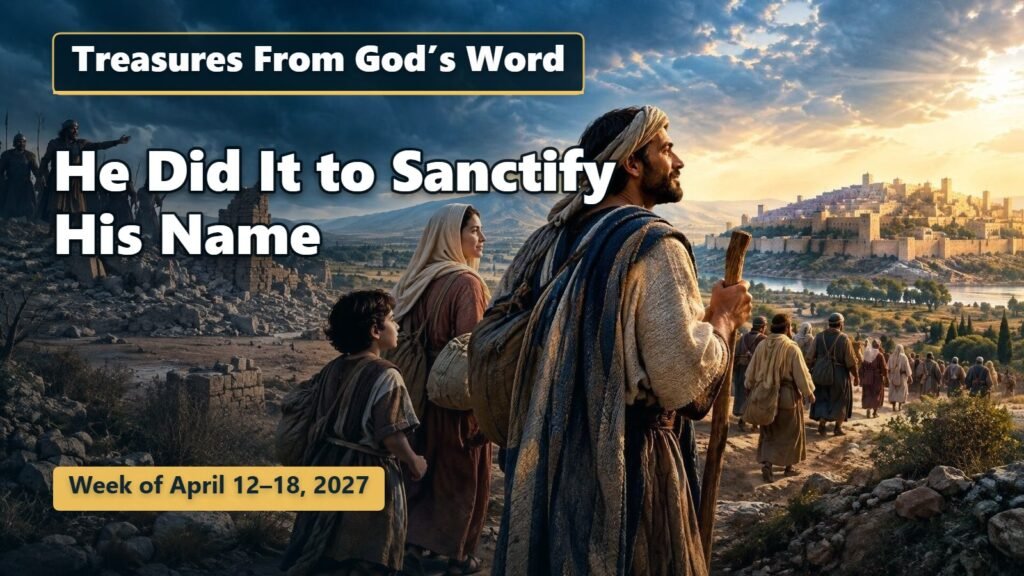
Theme: He Did It to Sanctify His Name
When someone speaks badly about a person we love, we want the truth to be known. We do not view that person’s name as just a word; we think of the person, his qualities, and his reputation. How much more, then, do we care about Jehovah’s name. Ezekiel chapters 35 and 36 show how he defended his holy name when others treated it with contempt.
Let us think about what happened when the Babylonians conquered Judah and Jerusalem in 607 B.C.E. The Edomites, enemies of Jehovah’s people, rejoiced over that tragedy. Their hatred moved them to incite the devastators and to hand over Judean fugitives to be executed. In addition, they took part in the plunder and wanted to take possession of the abandoned land. But their arrogance was directed not only against Israel. Let us listen to how Jehovah viewed their words. Let us read Ezekiel 35:12, 13.
Ezekiel 35:12-13 — You will then have to know that I myself, Jehovah, have heard all the insolent things you spoke against the mountains of Israel when you said, “They have been laid desolate and have been given to us to devour.” And you spoke arrogantly against me, and you multiplied your words against me. I heard it all.’
Jehovah had heard those insults. Although the Edomites spoke about the mountains of Israel, he made it clear that they were speaking against him personally. The nations did not understand that the desolation was punishment for Israel’s unfaithfulness. Instead of recognizing this, they reached the wrong conclusion that Jehovah was unable to protect his people. Thus, Israel’s tragedy became an opportunity for them to speak disrespectfully of the divine name.
That attitude did not go unnoticed by Jehovah. He announced that Edom’s joy would be short-lived and that it would have to answer for its conduct. This reminds us that the arrogance of those who despise Jehovah does not prove that they are right. Nor should we interpret their apparent advantage as a sign that he cannot act. Jehovah knew what was happening and would defend his name. However, his response would consist of more than just punishing the enemies.
The land that the enemies viewed as an available possession would once again receive Jehovah’s people. Where there had been desolation, there would be cultivated fields; where there had been ruins, there would be inhabited cities. The contrast is very beautiful: the enemies wanted to take advantage of the disaster, whereas Jehovah announced a restoration. And this was not a vague wish. His promise described concrete changes that would make life there possible for his people. Let us read Ezekiel 36:8-10.
Ezekiel 36:8-10 — But you, O mountains of Israel, will produce branches and bear your fruitage for my people Israel, for they will soon return. For I am with you, and I will turn toward you, and you will be cultivated and sown with seed. I will multiply your people—the whole house of Israel, all of it—and the cities will be inhabited and the ruins will be rebuilt.
Jehovah addresses the mountains of Israel and announces that they will produce fruitage for his people. Why? Because the Israelites would return. The land would be cultivated and sown, the population would increase, and the ruins would be rebuilt. Every detail supports the same promise: the desolation would not be permanent. The enemies had spoken as if the future of that land were in their hands, but Jehovah showed that he could bring his people back and make reconstruction possible.
How strengthening it is to focus on who made that promise. The ruins could be seen; the restoration could not yet be seen. However, what mattered was not what seemed possible at a glance, but what Jehovah had announced. We too need to give more weight to his promises than to appearances. This account strengthens our confidence in his ability to fulfill what he says. But an important question still remains: What was the main reason why he decided to restore Israel?
We might first think about the relief the Israelites would feel upon returning. Without a doubt, going back to their land would be a great blessing. But Jehovah explained that something else was more important than their well-being. To understand that restoration properly, we must view it from his standpoint, not only from the standpoint of those who benefited from it. Let us read Ezekiel 36:22-24.
Ezekiel 36:22-24 — “Therefore say to the house of Israel, ‘This is what the Sovereign Lord Jehovah says: “Not for your sakes am I acting, O house of Israel, but for my holy name, which you profaned among the nations where you have gone.”’ ‘I will certainly sanctify my great name, which was profaned among the nations, which you profaned among them; and the nations will have to know that I am Jehovah,’ declares the Sovereign Lord Jehovah, ‘when I am sanctified among you before their eyes. I will take you from the nations and gather you back from all the lands and bring you into your land.
The explanation is clear: Jehovah would act for the sake of his holy name. The Israelites had not honored the name they represented. Their disobedience had profaned it, and the punishment they received gave the nations an opportunity to despise it. Therefore, their return was not to be interpreted as a reward for exemplary conduct. By freeing and bringing back a remnant of Israel, Jehovah would clear his name of that reproach and demonstrate that the nations had been mistaken about him.
Sanctifying Jehovah’s name means recognizing it and treating it as holy. In this account we see why that was so necessary: both the conduct of his own people and the words of his enemies had dishonored that name. Jehovah intervened so that it would be known who he really is. This leads us to a very personal reflection: How can we help sanctify Jehovah’s name? Although we are imperfect, he allows us to contribute to something he considers so important.
One way is to speak about what Jehovah is really like. Jesus did not limit himself to using his Father’s name; he also taught about his qualities. To those who portrayed him as demanding, inflexible, or merciless, he helped people to learn about his patience, love, and compassion. We can follow that example. If someone thinks that God is cruel or indifferent, let us listen respectfully and take the opportunity to explain what we have learned about Jehovah’s goodness.
We also sanctify him by our conduct. If we speak about a patient God, let us strive to treat others patiently. If we explain that he is compassionate, let us show compassion when someone needs help. In the family, at work, and in the congregation, we can make those qualities visible through simple decisions. Remaining loyal even when it is difficult also honors his name. We can ask ourselves: “Do what I say and do help others to see what Jehovah is like, or could it give them a wrong impression of him?”
Jehovah heard the enemies’ insults, promised to restore the land of Israel, and brought his people back. The main reason was not the Israelites’ merit; he did it to sanctify his name. We too can give priority to that name. By speaking about Jehovah with affection, imitating his qualities, and maintaining our integrity, we help others to know him as he really is: a holy, just, good, and loving God.
More posts for this week


Enjoy every Premium feature
More convenient meeting preparation with full access to the site’s tools.
- Ad-free browsing
- My Recorder and live transcription
- Assignment Review
- Full Academy access
- Audio posts and reading magnifier
- Saved and synced comments
- Support the project and help keep it running
Monthly plan
€3 per monthRenews monthly. Cancel at any time.
Choose monthlyAnnual plan
€30 per yearOne payment for 12 months. No automatic renewal.
Choose annual


