










How to keep the right perspective in the face of difficulties?
1, 2. What should we do to withstand the difficulties?
Answer 1:
To endure the difficulties, we need to see them as Jehovah sees them. If we only focus on pain or injustice, we could lose spiritual clarity. But when we look at the situation with Jehovah’s perspective, we can make better decisions and continue to trust him.
Answer 2:
The article compares problems with obstacles along the way. If the windshield is dirty, we don’t see well and we can react badly. Similarly, if our point of view is clouded by discouragement, we need to clean it with the Bible to see the situation with balance.
Answer 3:
Holding doesn’t mean simply putting up with the problem as we can. It means learning to see it correctly, understanding why Jehovah allows certain things and seek his help. When we do that, we don’t let the difficulties stop us, but we move forward with faith.
THE CORRECT VIEW PUNTO
3. Why are we going to have problems in this system?
Answer 1:
We will have problems because we live in an imperfect world governed by Satan. As long as this system exists, there will be disease, injustices, disasters and suffering. Knowing this helps us not to think that Jehovah has abandoned us when we go through difficulties.
Answer 2:
The problems shouldn’t surprise us. The Bible had already warned that in recent days life would be complicated and that evil would increase. So, when we suffer, it does not mean that something goes wrong in our faith, but that we live in the system that Jehovah will soon eliminate.
Answer 3:
If Jehovah were to solve all the problems now, it might seem that he is supporting Satan’s government. That’s why it allows for the difficulties temporarily. But this does not mean that it is indifferent; rather, it is waiting for the right time to solve everything definitively.
4. What’s another reason we’re suffering?
Answer 1:
Another reason we suffer is that we are true Christians. Jesus warned that his disciples would be persecuted by his faith. Having this clearly helps us not to stagger when we receive opposition, because we understand that following Christ means enduring evidence.
Answer 2:
We suffer because we are on the Jehovah’s side in the question of sovereignty. Satan affirms that human beings serve God out of interest. But when we remain loyal despite the trials, we show that we truly love Jehovah and rejoice his heart.
Answer 3:
Persecution does not mean that Jehovah is unhappy with us. On the contrary, many times it confirms that we are on the right track. If we remain faithful, we give a clear answer to Satan and demonstrate that our worship is born of love.
5. What can we learn from Ecclesiastes 7:13, 14?
Answer 1:
We learn that we must be realistic: in this system we will have good days and bad days. When we enjoy quiet moments, we must thank Jehovah. And when difficulties come, we must not think it is a strange thing, because we are all exposed to unexpected problems.
Answer 2:
Ecclesiastes helps us maintain balance. Jehovah does not cause the bad things, but it allows them to happen for a while. Understanding this prevents us from blaming God when we suffer and help us to continue to trust that he can sustain us.
Answer 3:
We also learn that no one can fully control what will happen to him tomorrow. That is why we must not rely too much on our own security. Rather, every good day we must see it as a gift, and every day difficult as an opportunity to get closer to Jehovah.
6. What are some reasons why Jehovah allows us to go through evidence?
Answer 1:
Jehovah allows some tests because they can teach us to support us more in him and less on ourselves. When we go through difficult times, we realize our limitations and learn to depend on the strength, guidance and affection of Jehovah.
Answer 2:
Testing can also help us identify aspects of our personality that we need to improve. Jehovah does not cause suffering, but he can use what he allows us to refine ourselves. So it happened with Job, who learned important lessons and came out spiritually strengthened.
Answer 3:
Jehovah allows the trials, but does not allow them to cause us irreparable damage if we remain faithful. He accompanies us even in the valley of deep darkness. That comforts us, because we know that we don’t suffer alone and that he will give us the strength to hold on.
7. Why can we be happy when they chase us?
Answer 1:
We can be happy because persecution by our faith shows that we count on the approval of Jehovah. We are not happy to suffer, but we do know that we are on the right side and that Jehovah values our fidelity.
Answer 2:
Persecution can strengthen our joy if we see it as Jehovah sees it. The apostles felt happy because they had been considered worthy of suffering by the name of Jesus. That same perspective helps us not to lose self-esteem or peace.
Answer 3:
Moreover, our fidelity under persecution can give good testimony. Others can observe our conduct and come to glorify God. So even in a difficult situation, Jehovah can bless us and use our loyalty to help sincere people.
8. What other reason do we have to put up with the evidence?
Answer 1:
We have a very powerful reason: our problems have the days numbered. Job suffered greatly, but Jehovah blessed the end of his life more than his beginning. That reminds us that the current suffering is temporary, while the blessings of Jehovah will be eternal.
Answer 2:
We endure because we know that Jehovah will reward our faithfulness. Maybe now we’re living a very painful stage, but it won’t be the end of our history. Jehovah promises a future in which the difficulties will be left behind forever.
Answer 3:
This perspective helps us not to give up. The beginning of our life in this system may be full of problems, but the end that Jehovah promises will be much better. Thinking about eternal life gives us the strength to continue to endure to the end.
If you DO NOT TWE THE CORRECT POINT
9. How could we make things worse if we don’t have the right point of view?
Answer 1:
We could make things worse if we came to think that Jehovah caused us the problem. That idea can hurt us a lot, because it takes us emotionally away from those who want to help us most. Job and Naomi had the wrong thoughts, but Jehovah helped them correct them.
Answer 2:
When we don’t see difficulties like Jehovah, we could begin to justify our pain by blaming him. That would make the test weigh even more. That’s why we need to remember that Jehovah does not act cruelly or test anyone with bad things.
Answer 3:
We could also bitter or lose confidence in Jehovah. But the examples of Job and Naomi comfort us, because they show that Jehovah understands our feelings and can help us regain a correct perspective if we continue to approach him.
10. What is it possible for us to ask ourselves when we go through a difficulty?
Answer 1:
We might wonder if Jehovah has forgotten us. Even if we know he didn’t cause the problem, the pain can make us feel lonely. But David and Habakkk also had similar questions, and still kept praying.
Answer 2:
When we suffer, we may think, “Why does Jehovah not answer?” or does he not listen to me? Those thoughts can weaken us. But the key is not to stop talking to Jehovah, because he does listen and know exactly what we need.
Answer 3:
It is normal to be confused in a trial, but we must not allow the doubts to separate us from Jehovah. David and Habakkuk expressed their feelings sincerely, and Jehovah helped them. We too can open his heart and wait for his support.
11. What could happen if we don’t have the right view on the evidence?
Answer 1:
If we don’t have the right view, the evidence could take us by surprise. We might even think that these things shouldn’t happen to us. But the Bible warns us that we Christians suffer too, so we must prepare ourselves mentally and spiritually.
Answer 2:
It was hard for the disciples to accept that Jesus would have to suffer and die. Although he explained it to him, they didn’t get it right at first. That teaches us that we need to meditate on the Scriptures so as not to stumble when difficulties or persecution come.
Answer 3:
If we think serving Jehovah brings us out of trouble now, we could be discouraged when a test arrives. That is why it is so important to study what the Bible says about suffering. So we’ll be prepared and we won’t be confused.
12. What could we think if we don’t see things as Jehovah sees them?
Answer 1:
We might think we’re suffering an injustice when maybe it’s not. Sometimes our expectations can distort reality. The parable of the vineyard workers teaches that some complained not because they were treated badly, but because they expected more.
Answer 2:
If we don’t see things like Jehovah, we could exaggerate a situation or feel hurt by not receiving some responsibility. But we must ask ourselves whether an injustice was really committed or whether our expectations are causing us to lose peace.
Answer 3:
This question helps me examine my heart. When something doesn’t go as expected, I can be disappointed. But if I trust Jehovah and his organization, I will prevent a personal expectation from becoming resentment or discouragement.
WHAT CAN CAN DO NOTATE ADVERSITIES
13. What can happen when we face a difficulty?
Answer 1:
When the difficulty touches us personally, it can cost us to apply what we already know. Perhaps we have encouraged others with biblical texts, but when we suffer, feelings can cloud our vision. That’s why we need to make a special effort to think like Jehovah.
Answer 2:
We can begin to have thoughts that we did not have before, such as believing that Jehovah is punishing us or that he does not listen to our prayers. Those thoughts are not reality, but they can seem very strong when we are hurt. That’s why we need spiritual help.
Answer 3:
Evidence can affect not only our circumstances, but also our way of thinking. That is why it is not enough to endure physically; we have to protect our mind and our heart. If we keep the right perspective, it will be easier to continue to trust Jehovah.
14. What can we include in our prayers when we are suffering?
Answer 1:
We can tell Jehovah what we are going through and how we feel. We don’t need to hide pain, confusion or fear. Jehovah is our Father, and hews us to speak to him sincerely. That already helps us feel less lonely.
Answer 2:
We can also ask for specific things: strength, wisdom, patience and holy spirit. Maybe Jehovah won’t answer exactly as we hope, but he will always give us what’s necessary to hold on. Philippians 4:13 reminds us that with their help we can face any situation.
Answer 3:
Besides, we must be attentive to the way Jehovah responds. It can help us through the brothers, angels, a meeting, a publication or a biblical text. If we accept that help, we will see that Jehovah does not fall short by giving us strength.
15. What do we have to do when we go through tests?
Answer 1:
We have to continue to maintain a good spiritual program. We may not be able to do as much as we used to, but we can do what is in our power. Reading the Bible, praying, attending meetings and preaching helps us to keep the mind full of Jehovah’s thoughts.
Answer 2:
When we are going through anguish, it is precisely when we need the commandments of Jehovah. Psalm 119:143 shows that we can continue to love his guide even if we are suffering. Spiritual activities are not a burden; they are a protection for the heart.
Answer 3:
We must also resist the urge to isolate ourselves. When we suffer, sometimes we want to lock ourselves in, but we need the brothers. Meetings and spiritual companionship can give us encouragement, balance and strength to move on.
16. What questions can we have when we suffer a misfortune, and how can we solve them?
Answer 1:
We can doubt whether we continue to have the approval of Jehovah. To resolve this doubt, we can study examples such as that of the Apostle Paul. He suffered many adversities, but that did not mean that Jehovah was unhappy with him; on the contrary, he had his support.
Answer 2:
We might also doubt whether Jehovah has forgiven us mistakes of the past. In that case, we can make a list of texts that speak of Jehovah’s forgiveness, read them calmly and meditate on them. So we use biblical truth to tear down negative thoughts.
Answer 3:
Another doubt may be whether Jehovah really protects his servants. To solve it, we need to study what kind of protection Jehovah promises and read experiences of faithful brothers. That helps us to see that, even if it allows proof, it always protects our spirituality.
17. What should we do when we get a test?
Answer 1:
When we get a test, we must strive to keep the right point of view and continue to trust Jehovah. We will not always be able to control what is happening, but we can decide to support ourselves in it, pray, study and accept the help it gives us.
Answer 2:
If we are now enjoying a quiet period, we must thank it and take advantage of it to strengthen our faith. So, when a difficulty comes, you won’t find us unprepared. Good days can prepare us spiritually for the difficult days.
Answer 3:
Jehovah promises he will give us the way out so he can hold on. That doesn’t always mean it will eliminate the problem immediately, but it will give us strength, guidance and support. With that assurance, we can face the trials without losing hope.
ANALYSIS OF IMÁGENES
Pictured in paragraph 2: the driver with the dirty windscreen
Comment 1:
The image teaches that, if we don’t see the obstacle well, we can react late or wrong. The same is true of difficulties: if our mind is clouded by fear or sadness, we need to cleanse our vision with the Bible.
Comment 2:
The problem was not only the obstacle, but the driver could not see it clearly. This reminds me that many times the difficulty is already tough, but it becomes worse if we see it from the wrong perspective.
Comment 3:
The lesson is practical: before we react to a problem, we must make sure we see it as Jehovah sees it. That can help us decide whether we should act, wait, ask for help or just hold on patiently.
Pictured in paragraph 5: the garden with good days and bad days
Comment 1:
This image reminds us that in life there will be good days and difficult days. When all goes well, we must thank Jehovah. And when something goes wrong, we must not think that Jehovah has abandoned us.
Comment 2:
The same man enjoys a good harvest one day and another day sees that something has been spoiled. That’s the way this system is: not everything is under our control. That’s why we need to be realistic and depend on Jehovah.
Comment 3:
The image helps to accept that difficulties do not always mean that we have done something wrong. Sometimes we just live the effects of this imperfect system. Having that perspective protects us from discouragement and to blame Jehovah.
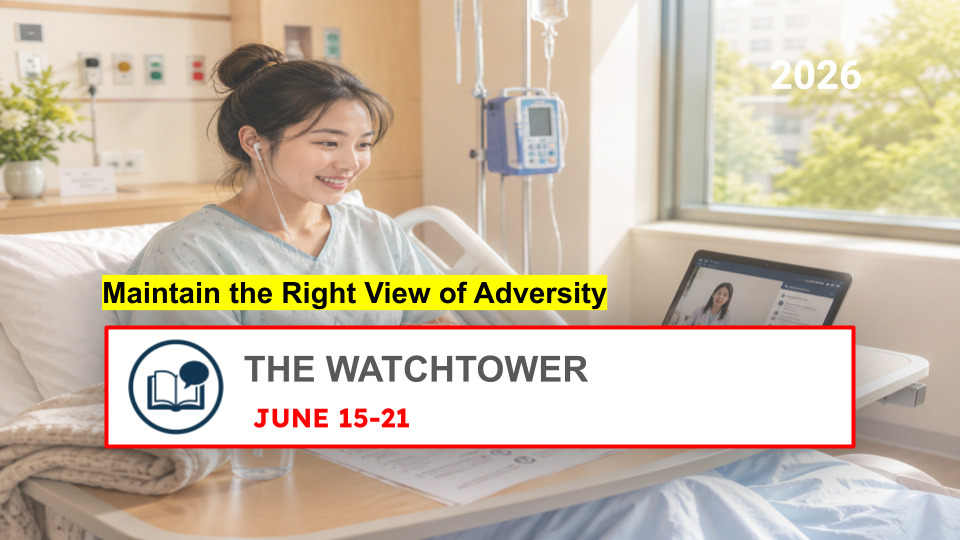
Pictured in paragraph 15: Brother in hospital connected to the meeting
Comment 1:
This image shows that, although a disease limits what we can do, we can still stay close to Jehovah. The brother cannot be physically in the Hall of the Kingdom, but he does his best to benefit from the meeting.
Comment 2:
It teaches me that Jehovah does not expect any more than we can give. If our circumstances change, we may have to adjust our spiritual program, but not abandon it. Doing what is in our power shows love and trust in Jehovah.
Comment 3:
It also reminds us that spiritual activities are a source of strength. In times of illness or anguish, connecting to meetings, reading the Bible and keeping our brothers close can help us not to lose perspective.
FINAL NOTE OF ARTICLE
Comments about the recommended experience
Comment 1:
The note mentions an experience of a family that suffered a tragedy and managed to stand spiritually. These kinds of stories help us because they show that Jehovah can hold his servants even in very painful blows.
Comment 2:
Reading experiences of faithful brothers can help us resolve doubts. When we see how others have endured with the help of Jehovah, we remember that we are not alone and that he continues to give strength to those who trust in him.
Comment 3:
These experiences do not eliminate our pain, but they do strengthen our hope. They teach us that, although a disgrace can change our lives, Jehovah can help us move forward and keep our friendship with him alive.
WHAT RESPONDER?
What can help us get the right view on difficulties?
Answer 1:
It helps us to remember that we live in Satan’s system and that, therefore, we all face problems. We must also remember that Jehovah does not cause bad things, but it can help us to learn, endure and come out spiritually strengthened.
Answer 2:
It helps us to study the Bible and see the difficulties as Jehovah sees them. If we understand that the trials are temporary and that Jehovah can sustain us, we will not let ourselves be dominated by fear, confusion or discouragement.
Answer 3:
It also helps us to think of examples such as Job, Joseph, the apostles and other faithful servants. They suffered, but Jehovah did not forsake them. Meditating on their experiences helps us to trust that Jehovah will also be with us.
What could happen if we don’t have the right point of view?
Answer 1:
We might come to think that Jehovah caused us the problem or that he has forgotten about us. Those thoughts can greatly weaken us and damage our friendship with him. That is why we must correct them with the help of the Bible.
Answer 2:
We could also feel the victims of injustice when perhaps our expectations are affecting us. If we do not see things as Jehovah, we could feed resentment or discouragement. The right perspective helps us keep the peace.
Answer 3:
If we don’t have the right view, the tests can take us by surprise and make us stumble. But if we meditate on what the Bible says about suffering, we will be better prepared to endure without losing faith.
What can we do in the face of adversity?
Answer 1:
We can pray with sincerity and ask Jehovah for strength, wisdom, and holy spirit. We must also be attentive to your response, because it can help us through the brothers, meetings, the Bible or some publication at the right time.
Answer 2:
We must maintain a good spiritual program, even if we have to adapt it to our circumstances. Reading the Bible, attending meetings, preaching and being with the brothers helps us keep the mind centered on Jehovah.
Answer 3:
We must also resolve our doubts using the Bible and publications. If negative thoughts appear, we shouldn’t let them grow. We can look for texts, meditate on them and remember the experiences of brothers who have verified the support of Jehovah.
More posts for this week



Enjoy every Premium feature
More convenient meeting preparation with full access to the site’s tools.
- Ad-free browsing
- My Recorder and live transcription
- Assignment Review
- Full Academy access
- Audio posts and reading magnifier
- Saved and synced comments
- Support the project and help keep it running
Monthly plan
€3 per monthRenews monthly. Cancel at any time.
Choose monthlyAnnual plan
€30 per yearOne payment for 12 months. No automatic renewal.
Choose annual


Good summary thanks torches Good work