










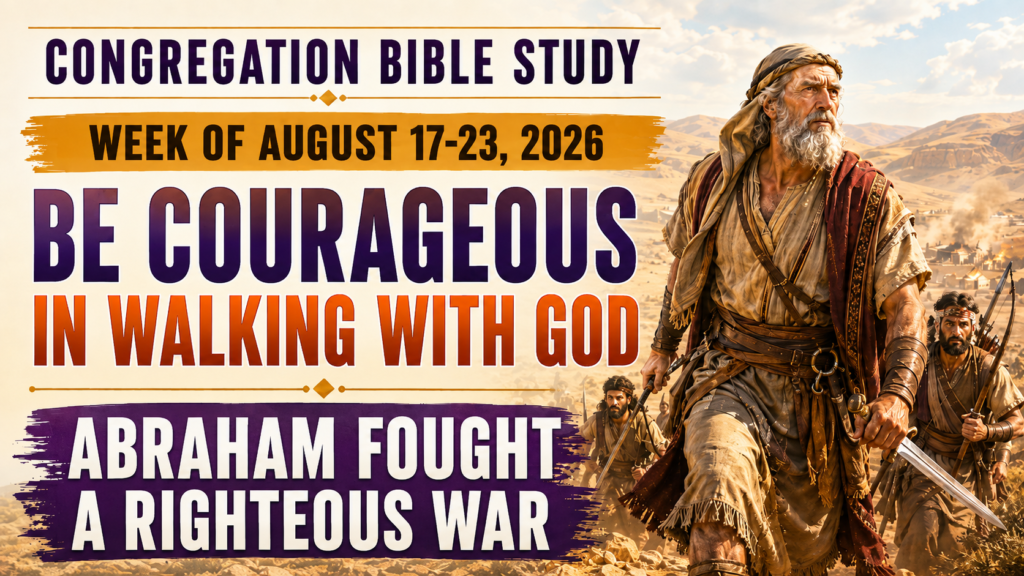
Lesson 4: Abraham, the First Man to Fight a Righteous War
In what ways did Abraham show courage during this stage of his life?
Comment 1:
Abraham showed courage when he decided to go and rescue Lot. He could have thought that his nephew had brought the trouble on himself by choosing to live near Sodom, but he did not react that way. Affection and loyalty were stronger than any fear of danger.
Comment 2:
He was also courageous because he confronted an alliance of four powerful kings. Abraham was not a professional soldier but a man who led a nomadic life and was mainly occupied with herding. From a human standpoint, that operation seemed very risky, but he trusted in Jehovah’s support.
Comment 3:
He gathered 318 trained men of his household and traveled a great distance to pursue the invaders. He did not become paralyzed by thinking only about everything that could go wrong. He analyzed the situation, acted decisively, and made good use of the resources he had available.
Comment 4:
His strategy during the attack also showed courage and good judgment. He divided his men during the night, attacked the enemy army, and when it fled, he kept pursuing it until he recovered Lot, his family, the other captives, and all their goods.
Comment 5:
After the victory, Abraham did not take all the credit for himself. He accepted Melchizedek’s blessing and gave him a tenth of the best things. In this way he showed that his courage was joined with humility and that he recognized that Jehovah was the One who had given him the victory.
1. How does archaeology confirm the accuracy of this account?
Comment 1:
For a long time some critics doubted that Elam had been powerful enough to exert influence over such distant regions. However, archaeological discoveries showed that the Elamites became a powerful warrior nation and exercised influence in Babylon.
Comment 2:
Ancient inscriptions have also been found with the names of Elamite rulers beginning with “Kudur,” a form similar to the first part of the name Chedorlaomer. In addition, an important Elamite deity was named Lagamar, which bears a resemblance to the second part of that name.
Comment 3:
Babylonian inscriptions are also known that contain names similar to those of several kings appearing in Genesis 14. For example, Tudhula has been linked with Tidal and Eri-aku with Arioch. These details show that the account fits well into the historical context of the period.
Comment 4:
Genesis does not describe a war in a vague way. It gives the names of kings, peoples, regions, alliances, and routes. It is interesting that later discoveries have helped us to understand that political world better and have shown that Elam could exert considerable influence beyond its own borders.
Comment 5:
All of this strengthens confidence in the historical accuracy of the account. The Bible mentions details that might have seemed strange when little was known about that period, but the growth of archaeological knowledge made it possible to understand better the setting that Genesis 14 presents.
2. According to the Bible’s description, where were Sodom and Gomorrah probably located? What evidence is there for this?
Comment 1:
Sodom and Gomorrah are generally thought to have been near the southern end of the Salt Sea, now known as the Dead Sea. Genesis links their kings with the Low Plain of Siddim, which later came to be identified with the Salt Sea.
Comment 2:
The Bible describes the region where Lot settled as a very well-watered area. This fits the southeastern zone of the Dead Sea, where even today there are areas with vegetation and where products such as wheat, barley, dates, and grapes can be cultivated.
Comment 3:
Another interesting detail is the presence of bitumen. Genesis 14 mentions the tar pits, or bitumen pits, of the Valley of Siddim, and it is precisely in the southern zone of the Dead Sea that significant quantities of bitumen and salt are found.
Comment 4:
That helps us understand why Lot was so impressed by the region. At first sight it offered excellent conditions for his flocks. However, the material prosperity of an area did not make up for the grave spiritual danger involved in living near Sodom.
Comment 5:
The combination of the geographic description in Genesis, the reference to the Salt Sea, the vegetation of its southeastern shore, and the presence of bitumen and salt makes that zone fit well with the details the Bible account provides.
3. Melchizedek was priest and king of Salem. Where was Salem located?
Comment 1:
The Biblical evidence points to Salem being ancient Jerusalem. The very name “Salem” is contained in “Jerusalem,” and its meaning is related to peace. There Melchizedek served at the same time as king and priest of the Most High God.
Comment 2:
Abraham met Melchizedek and the king of Sodom in what is called the Low Plain of the King. Centuries later, Absalom set up a monument in an area with that same name near Jerusalem, which supports identifying Salem with that city.
Comment 3:
Psalm 76 also links Salem with Zion. Since Zion came to be part of Jerusalem, this detail adds another Biblical reason to conclude that the city where Melchizedek reigned was located at the site that would later be Jerusalem.
Comment 4:
It is significant that Melchizedek was king and priest precisely there. In time Jerusalem became the city from which the kings of the line of David ruled and where the priesthood connected with Jehovah’s temple functioned.
Comment 5:
Furthermore, Jerusalem would have a special importance connected with Jesus. There he offered up his life in sacrifice, and Jesus would become King and High Priest “in the manner of Melchizedek.” For that reason, the location of Salem fits very well with the later outworking of Jehovah’s purpose.
4. How did Melchizedek represent Jesus?
Comment 1:
Melchizedek combined two functions that were normally separate: he was king and also priest of the Most High God. In a far greater way, Jesus Christ also carries out both functions, for Jehovah has appointed him as heavenly King and High Priest.
Comment 2:
Melchizedek did not receive his priesthood by belonging to the family of Aaron. In a similar way, Jesus was not from the priestly tribe of Levi but from Judah. His priesthood comes directly from Jehovah’s appointment, just as in the pattern of Melchizedek.
Comment 3:
The Bible does not record Melchizedek’s priestly genealogy nor mention any predecessor or successor of his. That allowed him to serve as a fitting representation of the permanent priesthood of Jesus, who after being resurrected received an indestructible life.
Comment 4:
Abraham recognized the authority that Jehovah had granted to Melchizedek: he received his blessing and gave him a tenth of the spoils. Hebrews uses that fact to show the greatness of the priesthood that Melchizedek represented and, by extension, the superiority of Christ’s priesthood.
Comment 5:
Jesus perfectly fulfills what Melchizedek represented. As King he can rule with justice, and as High Priest he can help humans to draw close to Jehovah. That is why his role combines authority, mercy, and the ability to provide complete salvation.
Abraham let Lot keep the best part of the land. How can we imitate Abraham when we deal with our family, with the brothers, and with other people?
Comment 1:
We can imitate him by avoiding always insisting on our rights. Abraham was older and could have chosen first, but he allowed Lot to take the area that seemed best. Sometimes keeping peace is far more valuable than obtaining what we personally prefer.
Comment 2:
Within the family we can show that attitude in simple matters: giving up a preference, listening before deciding, or thinking about what will benefit the other person. Abraham’s generosity avoided a quarrel and helped to preserve a good relationship with Lot.
Comment 3:
In the congregation we can do something similar when we give up a seat, a preference, or a certain comfort to someone who needs it more. These small acts show that for us people are worth more than always getting the best option.
Comment 4:
Abraham could be generous because he trusted in Jehovah. He did not think that losing the best part of the land meant losing the divine blessing. We too can be less competitive when we remember that our happiness does not depend on gaining an advantage over others.
Comment 5:
His example also teaches us to look for solutions that reduce conflicts. If a difference arises with a brother or a family member, asking ourselves “What can I yield?” can be far more useful than concentrating only on proving that we are right.
What do we learn from the fact that Abraham was willing to take such a great risk to rescue his nephew?
Comment 1:
We learn that true love is shown by actions. Abraham did not merely lament what had happened to Lot. When he learned that he was a captive, he immediately organized a rescue, even though that meant confronting far more powerful enemies.
Comment 2:
We also learn not to think, “He brought it on himself.” Lot had decided to live near Sodom, but Abraham did not use that bad decision as an excuse to abandon him. When someone we love needs help, compassion can move us to look beyond their mistakes.
Comment 3:
His example shows that loyalty may require sacrifices. Helping a family member or a brother may demand time, energy, money, or stepping out of our comfort zone. Christian love is willing to bear a reasonable cost for the well-being of others.
Comment 4:
Abraham did not confuse courage with recklessness. He prepared trained men, had allies, and used a strategy during the night. Therefore, helping someone courageously does not mean acting impulsively but combining love with good judgment and preparation.
Comment 5:
Finally, we learn that a relationship can be more important than old differences. Abraham and Lot had already had to separate because of problems between their herdsmen, but Abraham held no resentment. When Lot was in danger, he acted as a true friend and relative.
In what other ways can you copy Abraham’s example of courage?
Comment 1:
I can copy it by making decisions based on my trust in Jehovah and not only on what seems safest from a human point of view. Abraham saw a very dangerous situation, but he did not let fear keep him from doing what was right.
Comment 2:
I can also prepare myself to act with courage. His 318 men were trained before the emergency arose. In the same way, the study of the Bible, prayer, and a good spiritual routine can prepare me before an unexpected test appears.
Comment 3:
I can imitate his humility after achieving good results. Abraham did not present himself as a great military hero but recognized Jehovah’s role. When an assignment goes well for me, I want to avoid pride and remember where my abilities and blessings really come from.
Comment 4:
Another way is not to let attachment to comforts determine my decisions. Abraham could have thought about someday returning to Ur and avoiding a confrontation with the king of Shinar, but he did not let that possibility condition his loyalty to Jehovah and to Lot.
Comment 5:
In addition, I can learn to distinguish between human wars and our spiritual fight. Christians do not take part in physical wars, but we do need courage to resist temptations, defend our faith, and remain faithful in a world that opposes Jehovah’s principles.
What does this account teach me about Jehovah?
Comment 1:
It teaches me that Jehovah is able to give strength to his servants to face situations that seem impossible. Abraham had a much smaller group than the enemy army, but Jehovah allowed him to gain a complete victory and free the captives.
Comment 2:
Jehovah also deeply values loyalty. Abraham took a risk to rescue Lot, and afterward Melchizedek blessed him in God’s name. This shows that Jehovah takes note when we make an effort to help and protect those we love.
Comment 3:
We learn that Jehovah can protect his purpose even when Satan tries to frustrate it. Abraham’s family had a special role within the promise related to the offspring. No alliance of kings could prevent God from carrying forward what he had decided.
Comment 4:
We also see that Jehovah deserves the credit for the blessings we receive. Melchizedek acknowledged that the Most High God had delivered the enemies into Abraham’s hands, and the patriarch responded humbly by giving him a tenth of the spoils.
Comment 5:
Jehovah does not support just any human conflict. The account distinguishes a war that was related to his purpose from the common wars of men. Later Jesus taught his followers not to take part in physical wars but in a spiritual fight.
How does this account relate to Jehovah’s purpose and the main theme of the Bible?
Comment 1:
Jehovah had promised to make Abraham into a great nation, and from that nation would come the offspring foretold at Genesis 3:15. For that reason, protecting Abraham and his family was directly related to the fulfillment of one of the central promises of the Bible.
Comment 2:
Satan had reason to try to harm Abraham’s family, for he knew that from that line would come the one who would finally put an end to his rule. Abraham’s victory shows that Satan’s opposition cannot stop Jehovah’s purpose.
Comment 3:
The appearance of Melchizedek adds another very important connection. As king and priest, he represented Jesus Christ, who would become the King-Priest appointed by Jehovah. Thus, an event in Abraham’s life pointed forward to a fundamental part of the Messianic Kingdom.
Comment 4:
In time, Jehovah stopped using the physical nation of Israel as his special people and began to bless a spiritual nation under Christ. This shows how the divine purpose kept moving forward until it centered on the rule of the Messiah.
Comment 5:
The account also helps us understand the nature of the Christian fight today. Jesus forbade his disciples to resort to weapons but did prepare them for a spiritual war. Abraham’s courage thus encourages us to be firm in a different fight, but one also related to Jehovah’s sovereignty.
What would I like to ask Abraham and Lot when they are resurrected?
Comment 1:
I would like to ask Abraham what he felt when he received the news that Lot had been captured. It would be interesting to know whether he was afraid when he thought about those four kings and what thoughts about Jehovah gave him the courage to act immediately.
Comment 2:
I would also ask him how he prepared the rescue operation. Genesis mentions the 318 trained men and the night attack, but surely there was much planning. Knowing those details would help us better understand the combination of faith, prudence, and courage that he showed.
Comment 3:
I would ask Lot how he felt when he saw his uncle appear after he had been taken captive. Perhaps that experience made him appreciate in a new way Abraham’s affection and realize the dangers that choosing to live so near Sodom had involved.
Comment 4:
I would like to ask them what their conversation was like after the rescue. Abraham could have reproached Lot for his earlier choice, but the account does not highlight any attitude of that kind. It would be nice to know how that experience affected their family relationship.
Comment 5:
And I would ask Abraham what he felt when Melchizedek came out to meet him and blessed him. After the danger and the effort, hearing that Jehovah acknowledged the victory must have further confirmed his confidence that God would always fulfill all his promises.
More posts for this week



Enjoy every Premium feature
More convenient meeting preparation with full access to the site’s tools.
- Ad-free browsing
- My Recorder and live transcription
- Assignment Review
- Full Academy access
- Audio posts and reading magnifier
- Saved and synced comments
- Support the project and help keep it running
Monthly plan
€3 per monthRenews monthly. Cancel at any time.
Choose monthlyAnnual plan
€30 per yearOne payment for 12 months. No automatic renewal.
Choose annual


