









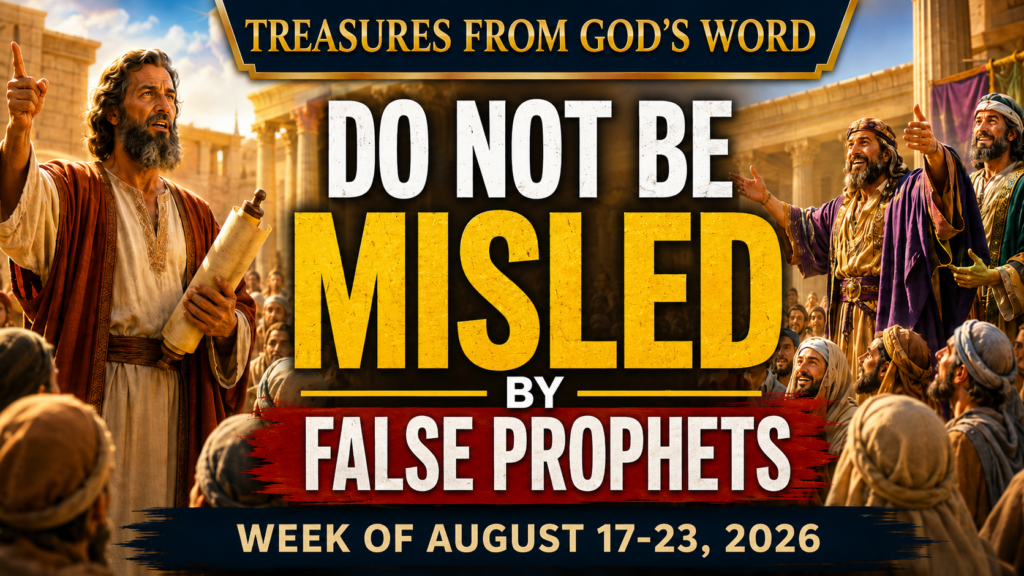
Theme: Do not be deceived by false prophets
Imagine that you receive an urgent message on your phone. It looks genuine, uses familiar expressions, and claims to contain important instructions. Would you share it immediately? The wise thing would be to check who sent it and whether it agrees with what we already know to be true.
In Jeremiah’s day, the people received two opposing messages. Jeremiah conveyed Jehovah’s words, although they were not pleasant to hear. The false prophets said what the people wanted to hear. The lives of those listening depended on being able to distinguish truth from lies.
Jeremiah, God’s prophet, gave the people instructions that could save their lives.
Jeremiah 26:2-6
“This is what Jehovah says: ‘Stand in the courtyard of the house of Jehovah and speak to all the people of the cities of Judah who come to worship at the house of Jehovah. Tell them everything that I command you; do not leave out a single word. Perhaps they will listen and each one will turn back from his evil way, and I will change my mind concerning the calamity I intend to bring on them because of their evil deeds. Say to them: “This is what Jehovah says: ‘If you will not listen to me and follow my law that I placed before you, and if you will not listen to the words of my servants the prophets, whom I am sending to you again and again but whom you have not listened to, then I will make this house like Shiloh, and I will make this city an object of cursing to all the nations of the earth.’”’”
Jehovah told Jeremiah: “Do not leave out a single word.” He was not to soften the message or remove the parts that might make people uncomfortable. He had to deliver it in full because the warning could save lives.
Jehovah’s purpose was not to destroy the people without giving them an opportunity. He said: “Perhaps they will listen and each one will turn back from his evil way.” If they repented and corrected their conduct, they could avoid the calamity. Although the message was firm, it showed Jehovah’s mercy.
Accepting those instructions required humility. The Jews had to acknowledge that they had moved away from Jehovah and submit to a situation they did not like. The truth does not always agree with what we want to hear. At times it corrects us or requires us to change. But an instruction does not stop being good simply because it is uncomfortable.
Then a danger appeared: The false prophets contradicted Jeremiah.
Jeremiah 27:14, 15
“Do not listen to the words of the prophets who are saying to you, ‘You will not serve the king of Babylon,’ because they are prophesying lies to you. ‘For I have not sent them,’ declares Jehovah, ‘but they are prophesying lies in my name, with the result that I will disperse you and you will perish, you and the prophets who are prophesying to you.’”
The false message seemed more appealing. The false prophets assured the people that they would not have to serve the king of Babylon. It was as though they were saying: “Everything will work out; there is no need to accept Jeremiah’s warning.” That message brought relief, but it was a lie.
The fact that we like a message does not prove that it is true, and the fact that an instruction is difficult does not prove that it is false. What matters is its source and whether it agrees with what Jehovah has already revealed.
Furthermore, those men spoke in Jehovah’s name. They did not present themselves as deceivers. They used religious language and appeared to have authority. A lie disguised as truth can be far more convincing than an obvious lie.
Something similar can happen today. A post, an audio recording, or a video may use Bible verses, images from our publications, and familiar expressions. It may even claim to contain instructions from responsible brothers. But its appearance does not prove that it comes from Jehovah’s organization.
How can we protect ourselves? By holding firmly to the pattern Jehovah has already given us.
2 Timothy 1:13
“Keep holding to the pattern of wholesome words that you heard from me with the faith and love that result from union with Christ Jesus.”
The “pattern of wholesome words” is the Bible’s Christian teachings, the foundation of our beliefs. Jehovah’s organization has taught us to follow that pattern closely. So when faced with surprising information, let us ask ourselves: “Is it in harmony with the Bible and with what Jehovah has taught us? Can I verify where it came from?”
In the first century, some spread the rumor that Jehovah’s day had already arrived. Apparently, a letter attributed to Paul was circulating. Some Thessalonians believed it and repeated the information without checking it. Paul reminded them of what he had already taught them and ended his second letter with a greeting written in his own hand as a sign of authenticity.
The lesson is clear: We should not believe or share something just because it seems urgent or convincing. Before forwarding a news item, a video, or a supposed instruction, let us check the source. We can see whether the information appears on jw.org or whether it has come through the official channels used by the congregation.
In the former Soviet Union, enemies circulated a letter that appeared to come from world headquarters and encouraged some brothers to form an independent organization. Faithful brothers did not fall into the trap because its contents did not fit the truths they had learned. Today technology can produce even more convincing fake messages, images, and videos, but the protection remains the same: Compare everything with the pattern of wholesome words and verify its source.
Let us also think about the effect the information is trying to produce. God’s enemies want to create distrust and division. Jehovah’s direction, on the other hand, is in harmony with the Bible and strengthens faith and unity. That does not mean that every instruction will be easy. Jeremiah’s instructions were difficult, but they came from Jehovah.
Therefore, if something clearly contradicts the Bible, the teachings we have received, or official communications, we should not spread it. Nor do we need to spend hours investigating every accusation that appears online. Sometimes the wisest course is to close the content and not give it any more room in our mind.
We can remember three questions: “Is it in harmony with the Bible?” “Can I verify that it comes from an official source?” and “Do I want to share it only because it caused an emotional reaction in me?” These questions can prevent us from unintentionally helping to spread a lie.
Jeremiah told the truth even though it was unpopular. The false prophets offered a more comfortable message, but it led those who believed it toward calamity. The difference was not who spoke with greater confidence or which message seemed more pleasant. It was who had been sent by Jehovah.
If we know the Bible well, follow the guidance of Jehovah’s organization, and verify the source of what we receive, we will be able to distinguish truth from lies.
So let us not believe everything we see or hear. Let us not allow a convincing appearance to replace verification. Let us hold firmly to the pattern of wholesome words. In that way, we will recognize the instructions that come from Jehovah and will not be deceived by false prophets.
More posts for this week




Enjoy every Premium feature
More convenient meeting preparation with full access to the site’s tools.
- Ad-free browsing
- My Recorder and live transcription
- Assignment Review
- Full Academy access
- Audio posts and reading magnifier
- Saved and synced comments
- Support the project and help keep it running
Monthly plan
€3 per monthRenews monthly. Cancel at any time.
Choose monthlyAnnual plan
€30 per yearOne payment for 12 months. No automatic renewal.
Choose annual


