










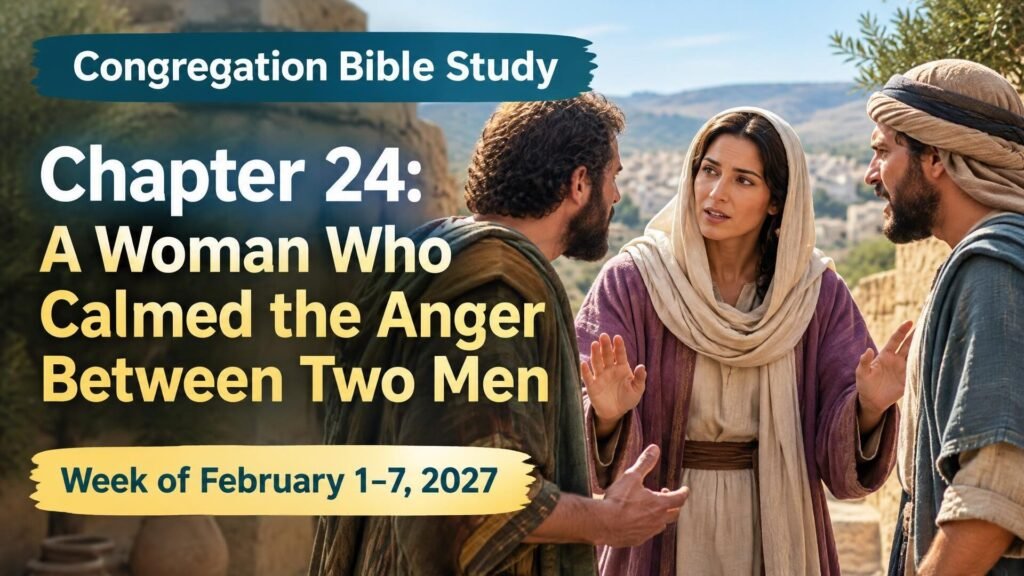
Chapter 24: A Woman Who Calmed the Anger Between Two Men
In what ways did Abigail show courage?
Comment 1: Abigail showed courage by taking action as soon as she learned that her household was in danger. She did not merely lament what Nabal had done. She listened to the servant, gathered abundant provisions, and went to meet David. She knew that her husband would probably try to prevent her from doing what was right, but that did not paralyze her. Her courage was accompanied by good sense: first she dealt with the need for food, and then she personally went to try to stop the attack. She thought about protecting others, not just about avoiding trouble for herself.
Comment 2: She also showed great courage by approaching David when he was coming with 400 armed men and was furious. She had no military force with which to face them. She got off the donkey, bowed down before David, and asked him to listen to her. Her humility was not a sign of weakness; it was the sensible way to approach a dangerous situation. This teaches us that courage is not always shown by speaking loudly or asserting ourselves. Sometimes it takes more courage to approach someone respectfully and seek peace.
Comment 3: Abigail had the courage to tell David something he needed to hear: taking revenge could make him guilty of bloodshed and leave him with deep regret. She did not justify Nabal’s conduct, but neither did she approve of David’s reaction. She reminded him of his relationship with Jehovah and of the future God had promised him. So she did not simply ask for help for her family; she also tried to prevent David from making a serious mistake. She knew how to combine a clear warning with kind and respectful words.
1. Why might Abigail have married Nabal? (ia 77 par. 6)
Comment 1: We do not know exactly why Abigail married Nabal. The reference explains that in those days the parents’ opinion carried great weight and that many arranged their children’s marriages. So that is one possibility, but we cannot state it as a fact in her case. This detail helps us avoid judging Abigail because of her marriage or assuming that Nabal’s character reflected what she valued. Rather, the account highlights her own good sense.
Comment 2: Another possibility is that her parents pressured her, even though they had not arranged the marriage. Perhaps they were impressed by Nabal’s wealth and position, or perhaps they were experiencing financial difficulties. The publication presents these explanations as possibilities, not as established facts. What it does make clear is that Nabal’s money did not make him a good husband. He could have many possessions and still be harsh and senseless. Material prosperity did not compensate for a lack of good qualities.
Comment 3: The practical lesson is that wealth and social position are not enough to make a wise choice of a marriage mate. Nabal had a great deal of money, but he was not a good choice. Without attributing motives to Abigail that we do not know, her situation reminds us of the importance of focusing on a person’s character and on how he treats others.
2. When David asked Nabal for food, it was the time of sheepshearing. What characterized that time? (w97 7/1 14 par. 4) A
Comment 1: Sheepshearing was a festive occasion, similar to harvesttime for a farmer. It was not merely a time to do work; it was also a time of joy. Picture A helps us visualize that atmosphere: the owner of the flock appears happy and gives a gift to one of the shearers. This setting helps us understand why David chose that time to ask for food. His request came at a time when it was customary to celebrate and share.
Comment 2: In addition to joy, that time was characterized by generosity. Sheep owners customarily rewarded those who had worked for them. Thus, the reference explains that David was not being presumptuous by asking for food. He and his men had rendered a valuable service by protecting Nabal’s shepherds and flocks. Giving them food would have been an appropriate way to acknowledge that help. It was not a request unrelated to what they had done for him.
1 Samuel 25:4-9 — David heard in the wilderness that Nabal was shearing his sheep. So David sent ten young men to him, and David told the young men: “Go up to Carmel, and when you come to Nabal, ask him in my name about his welfare. Then say, ‘May you live long and may you be well and may your household be well and may all that you have be well. Now I hear that you are doing your shearing. When your shepherds were with us, we did not harm them, and they found nothing missing the whole time they were in Carmel. Ask your young men, and they will tell you. May my young men find favor in your eyes, because we have come at a joyous time. Please give to your servants and to your son David whatever you can spare.’” So David’s young men went and told all of this to Nabal in David’s name. When they finished,
Comment 3: At 1 Samuel 25:4-9, we can see that David took both the occasion and the way of making the request into account. He sent respectful greetings, mentioned that they had treated the shepherds well, and allowed Nabal to decide what he could give them. He also pointed out that they had arrived at a joyful time. He made no threats and demanded no specific amount. All of this confirms that his request was reasonable and courteous. Nabal’s insulting response stood in sharp contrast with the generous spirit that characterized sheepshearing.
Comment 4: This makes me think that a joyful occasion can also be an opportunity to show gratitude. Nabal had reasons to celebrate, but he did not want to share with those who had helped protect his property. We can avoid that attitude by remembering, when we enjoy something good, the help we have received. Showing gratitude involves more than feeling happy about what we have; it also means acknowledging those who have supported us and, when possible, doing something concrete for them.
3. Why should Nabal have been grateful for the help of David’s soldiers? (ia 77, 78 pars. 9, 10) B
1 Samuel 25:15-16 — Those men were very good to us. They never harmed us, and we did not miss a single thing the whole time we were together with them in the fields. They were like a protective wall around us, both by night and by day, the whole time we were with them shepherding the flock.
Comment 1: According to 1 Samuel 25:15, 16, Nabal’s own servants could confirm how well David’s men had treated them. They did not bother them or take anything from them. In addition, they protected them day and night while they were tending the flocks. Therefore, Nabal had verifiable reasons to be grateful; it was not merely a matter of what David claimed to have done. His workers had personally experienced that help. Before responding with insults, he could have listened to them and acknowledged the value of the protection they had received.
Comment 2: The protection was especially valuable because of the dangers in that region. There were wild animals, and because they were near Israel’s southern border, attacks by foreign raiders were frequent. David’s men helped protect both the shepherds and the flocks. Nabal benefited not only by keeping his animals; his servants were also safer. When we think about those risks, we see that asking for some food was very little compared with the help they had provided.
Comment 3: There is a contrast that makes the soldiers’ conduct even more commendable. Nabal was very rich, whereas David and his men were struggling to survive in regions of ravines and caves, living on what they hunted. Although they were armed men and could have taken some sheep for themselves, they did not. Instead of taking advantage of the shepherds, they protected them. Nabal should have been grateful both for their help and for their honesty. Their need did not lead them to take what belonged to someone else.
Comment 4: This detail reminds me that I should not take the help I receive for granted. Nabal kept his flocks, but it seems that he did not value the effort of those who helped protect them. Sometimes help is so constant that we stop noticing it. We can show a different attitude by pausing to think about what others do for us, listening to them, and expressing our gratitude. In this case, the absence of losses was precisely a reason to be thankful, not to think that no one had done anything.
4. What did Abigail mean when she said that Jehovah would have David’s life “securely wrapped in the bag of life”? (1 Sam. 25:29; it “Life” par. 45)
1 Samuel 25:29 — When someone rises up to pursue you and seeks your life, the life of my lord will be wrapped securely in the bag of life with Jehovah your God, but the lives of your enemies he will hurl away like stones from a sling.
Comment 1: Abigail used a comparison involving something valuable that a person wraps up and stores for protection. With that image, she assured David that his life was in Jehovah’s hands. Even if his enemies tried to kill him, he was not abandoned and did not depend solely on his own strength. Jehovah could preserve his life. The comparison was very fitting because David was about to act out of anger. Abigail directed his attention toward God’s protection instead of letting him remain focused on Nabal’s offense.
Comment 2: The explanation in Insight emphasizes that David had to wait on Jehovah and not try to obtain salvation by his own means. Thus, Abigail’s words were not a guarantee of protection regardless of what he did. They encouraged him to trust in God and not take revenge. That was the decision before him: go ahead with the attack or leave the matter in Jehovah’s hands. By listening to Abigail, he showed that he was willing to correct his course and act in harmony with that trust.
Comment 3: The verse also establishes a contrast between David and his enemies. While Jehovah could preserve David’s life as something valuable, he could cast his enemies away like a stone hurled from a sling. The point was that David did not need to resolve that offense by shedding blood. Jehovah was able to protect him and deal with those who opposed him. Abigail helped him look beyond the anger of the moment and remember who truly had control of his future.
Comment 4: The application I see is that trusting in Jehovah should influence how we react when someone offends us. David may have felt humiliated by Nabal, but revenge would not strengthen his relationship with God. Abigail reminded him that his life was valuable to Jehovah and that he did not need to defend his honor by doing something wrong. We too can pause before responding out of pride. Refraining from retaliation does not mean approving of the offense; it means not allowing that offense to lead us to disobey Jehovah.
David followed Abigail’s suggestion. What can husbands learn from what David did? C
Comment 1: Husbands can learn that listening to good advice does not make them less worthy of respect. David was a warrior and would become king, but he recognized that Abigail was right. He did not reject her words because they came from a woman or because they pointed out a mistake. A husband can imitate that humility by listening carefully to his wife, especially when she perceives a danger he does not see. What matters is not always defending the first decision, but being willing to do what pleases Jehovah.
Comment 2: David did more than listen: he changed what he was going to do. This is important because someone might let his wife speak and then go ahead exactly as before. Picture C presents a very clear application: a brother is angry with another driver and his wife tries to calm him down. In such a situation, accepting her help could prevent words or actions he would later regret. David’s example encourages husbands to stop and correct their course, even when they are upset and even when other people are watching.
Comment 3: David also expressed gratitude and praised Abigail for her good sense. He did not make her feel bad for correcting him. A husband can learn to sincerely thank his wife when she helps him avoid a mistake. In this way he shows that he values her good judgment and does not view her observations as competition, but as help.
What can sisters who are married to someone who does not serve Jehovah learn from Abigail?
Comment 1: They can learn that their own faithfulness to Jehovah continues to be very valuable, even if their husband does not share their faith. Abigail lived with a harsh and senseless man, but she did not adopt those same attitudes. She continued to be sensible and acted with what Jehovah considered right in mind. This can encourage a sister not to measure her spirituality by her husband’s conduct. Not all unbelieving husbands are like Nabal; the lesson is that each one can cultivate her own qualities and relationship with Jehovah.
Comment 2: Abigail also showed good judgment in choosing when to speak. When she returned home, Nabal was completely drunk, and she waited until the next morning to tell him what had happened. This was not a lack of courage; she was taking the circumstances into account. A sister can learn to look for an appropriate time to discuss a delicate matter instead of insisting when conditions are not suitable for conversation. The account shows the value of prudence, without implying that she could control her husband’s reaction.
Comment 3: Another lesson is that being peaceable does not mean supporting a bad decision. Abigail did not imitate Nabal’s insults or allow his stubbornness to make her disregard the danger. She sought a respectful solution that protected those in her household and prevented bloodshed. Her example encourages us to combine kindness with firmness in doing what is right. The goal is not to win an argument, but to act sensibly and remain faithful to Jehovah even when family circumstances are difficult.
In what ways can you imitate Abigail’s example of courage?
Comment 1: I can imitate her by not remaining passive when I have an opportunity to contribute to peace. Abigail listened to what was happening and took concrete steps. In my case, perhaps I can clear up a misunderstanding or speak calmly before a difference becomes a greater conflict. Her example reminds me that it is not enough to wish for things to improve. Sometimes I need to take the first step, even when it is uncomfortable, and think about what practical help I can offer without increasing the tension.
Comment 2: I can also imitate the way she spoke. Abigail did not humiliate David or deny that he had reasons to feel offended. She recognized his good qualities and helped him think about the consequences of what he was about to do. If I need to warn someone about a possible mistake, I can try to maintain that same balance: speak clearly, but with respect and love. Being courageous does not require being harsh. Advice is more likely to help when the person senses that we are seeking his good and not trying to expose him.
Comment 3: I would like to imitate her ability to remain calm without delaying what was necessary. Abigail acted quickly in the face of danger, but she waited to speak with Nabal until he was sober. She did not respond in the same way to every situation. This teaches me that courage must be accompanied by discernment. Before acting, I can ask myself whether I need to intervene immediately or whether it would be better to wait for a more suitable time. What matters is that my decision be guided by what is right, not simply by the impulse of the moment.
What does this account teach me about Jehovah?
Comment 1: It teaches me that Jehovah can help us through the sensible advice of another person. David recognized Jehovah’s intervention when Abigail stopped him, and he thanked Him for sending her to meet him. The help did not consist in giving him more strength to attack, but in preventing him from making a serious mistake. This encourages me to value timely warnings. If someone helps me see that I am reacting wrongly, I do not want to reject him out of pride; his advice may help me maintain a good relationship with Jehovah.
Comment 2: The account also shows that Jehovah does not approve of his servants taking justice into their own hands. Nabal had acted very wrongly, but that did not justify David’s shedding blood without cause. Jehovah helped David avoid doing so and later dealt with Nabal Himself. This reminds me that God sees both the offense we receive and our reaction to it. We can trust in his justice without thinking that a provocation gives us permission to do harm or set aside his standards.
Comment 3: I am moved by the fact that Jehovah did not overlook Abigail’s situation. The chapter explains that he blessed her by delivering her from Nabal and that she later received further blessings. Her courage and good sense were not insignificant in God’s eyes. This does not mean that every difficult situation will be resolved in the same way or within the same time. But it does allow us to appreciate that Jehovah sees what his servants face and values their efforts to do what is right under painful circumstances.
How does this account relate to Jehovah’s purpose and the main theme of the Bible?
Comment 1: The account relates to Jehovah’s purpose because David was not simply a man trying to defend his honor. Jehovah had chosen him to be Israel’s next king, and Abigail knew that. So she reminded him that God would give him authority. Her words helped David look beyond that personal offense and think about his future responsibility. We see that recognizing Jehovah’s authority involves respecting his decisions and not acting as if everything depends on our own strength.
Comment 2: Abigail also spoke of David’s house becoming enduring. Thus, the conversation was not only about saving Nabal’s family; it kept in mind what Jehovah had arranged for David. Later, as the chapter relates, David became king over Judah and afterward over all Israel. The connection between what was announced and what occurred highlights that Jehovah fulfills his purpose. The opposition and offenses of other people do not force him to abandon what he has decided to do.
Comment 3: In connection with the theme of Jehovah’s authority, I think it is important that David had to let himself be guided by God’s standards. Being the future king did not give him the right to take revenge or kill without cause. Abigail helped him remember that he had to reach that responsibility without the regret of having shed innocent blood. The account shows that the authority Jehovah grants is not separate from obedience to him. Anyone who represents him must respect his view of what is just.
What would I like to ask Abigail when she is resurrected?
Comment 1: I would like to ask her how she managed to organize her thoughts so quickly when the servant told her what was happening. We know that she gathered provisions and went to meet David, but we do not know all the thoughts she had as she prepared. I would be interested in hearing what helped her focus on what she could do to protect others. I would not want to assume what she felt, but to hear it from her and learn more about how she faced a decision that required so much good sense and courage.
Comment 2: I would ask her what she had learned about Jehovah that helped her speak so confidently about David’s future. The account makes clear that she knew God had chosen him to be king and trusted that He could protect him. I would like to know more about how she cultivated that faith while living with Nabal. It would be very interesting to hear her personal experience and understand what helped her maintain such good judgment and firm trust in Jehovah in such a difficult family environment.
Comment 3: I would like to ask her how she felt when David accepted her advice and decided not to attack. She had gone to ask him to prevent a tragedy, and he was willing to listen to her. The account tells us David’s response, but it does not describe everything she felt at that moment. It would be wonderful to hear how she experienced that important change.
More posts for this week





Enjoy every Premium feature
More convenient meeting preparation with full access to the site’s tools.
- Ad-free browsing
- My Recorder and live transcription
- Assignment Review
- Full Academy access
- Audio posts and reading magnifier
- Saved and synced comments
- Support the project and help keep it running
Monthly plan
€3 per monthRenews monthly. Cancel at any time.
Choose monthlyAnnual plan
€30 per yearOne payment for 12 months. No automatic renewal.
Choose annual


