










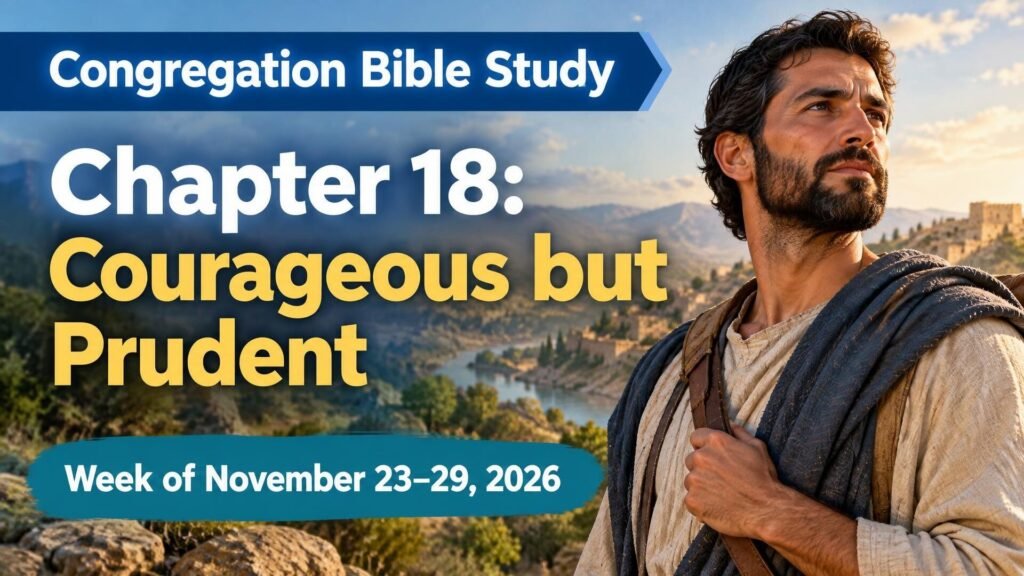
Chapter 18: Courageous but Prudent
In what ways did Gideon show courage?
Comment 1: Gideon showed courage even before leading the army. While the Midianites were oppressing Israel, he continued threshing grain to feed the people. But he did not do it in a way that unnecessarily exposed him: he worked inside a winepress, almost in hiding. I think this is a good combination of courage and prudence. He did not let fear paralyze him, but neither did he think that being courageous meant calling attention to himself in front of the enemies.
Comment 2: He was also courageous when Jehovah commanded him to pull down his father’s altar of Baal and cut down the sacred pole. Gideon knew that this would provoke opposition in his own city. In fact, the chapter explains that he felt afraid and therefore acted at night. Even so, he obeyed completely. This teaches us that feeling afraid does not mean that we lack courage. What matters is not allowing that fear to prevent us from doing what Jehovah asks of us.
Comment 3: His courage became very clear when he agreed to fight with only 300 men against an army of 135,000. He had started with 32,000, but he obeyed Jehovah’s instructions even though each reduction left him at a greater disadvantage from a human standpoint. In addition, he entered the enemy camp at night and then led the attack. He did not merely ask others to be courageous; he himself acted while trusting in Jehovah’s support.
1. In his dream, the soldier saw “a round loaf of barley bread.” Why might this be a fitting symbol of Gideon’s army? (Judg. 7:13; it “Barley” par. 7).
Judges 7:13 — Gideon now came, and there was a man relating a dream to his companion, and he said: “This is the dream I had. There was a round loaf of barley bread rolling into the camp of Midian. It came to a tent and struck it so hard that it collapsed. Yes, it turned the tent upside down, and the tent fell fl at.”
Comment 1: Barley was a common and inexpensive food. For that reason, the reference explains that some commentators connect that loaf with Gideon’s humble army. Something that looked insignificant represented the group that would defeat Midian.
Comment 2: The contrast in the dream is very expressive: a simple barley loaf overturned a tent. Something similar was about to happen with the two armies. Gideon’s men were very few compared with the enemy forces, so they did not seem capable of winning that victory. The symbol fit that difference. The explanation in Insight is presented as a possibility, not as an absolute statement about every detail of the dream.
Comment 3: The explanation given by the other soldier is also important. He connected the dream with Gideon and understood that God would give Midian into his hand. So Gideon did not merely hear about a loaf that overturned a tent; he heard an enemy acknowledge what was going to happen. According to the chapter, this strengthened his confidence in Jehovah. The size of his army had not changed, but he had another proof of God’s support.
2. Why did the sound of 300 horns confuse and frighten the Midianites? (it “Horn” par. 3).
Comment 1: Normally, one person blew the horn to give signals in battle. So hearing 300 horns would not necessarily make them think of 300 soldiers, but of an army of considerable size. This customary use of the instrument explains the Midianites’ reaction. It was not just a very loud noise: the sound could indicate that a force much larger than the one actually present was attacking their camp.
2 Samuel 2:28 — Joab now blew the horn, and his men stopped chasing after Israel, and the fighting ceased.
Comment 2: This example shows that the horn transmitted military orders; on that occasion, its sound caused the pursuit to end. The reference explains that it was also used to gather forces and direct other maneuvers. This helps us better understand the Midianites’ fear. Hearing so many signal instruments at once could make them believe that they were facing an enormous army, not a small group of Israelites.
Comment 3: The darkness, the breaking jars, the torches, and the shouts were added to the sound of the horns. Everything happened suddenly and around the camp. That combination contributed to the enemies’ confusion and fear. But the chapter does not attribute the victory solely to a good strategy; it explains that Jehovah caused the enemy soldiers to fight one another. Gideon and his men acted, but the decisive power came from Jehovah.
3. What did Gideon and his army have to do to defeat the Midianites? (w04 10/15 16 pars. 9, 10).
Comment 1: First, they had to follow the strategy that Gideon gave them. They positioned themselves around the camp and, at the signal, blew the horns, smashed the jars, and shouted. Each man had to do his part in coordination with the others. This required courage and obedience, because there were only 300 of them facing a very numerous enemy. They could not base their confidence on military superiority; they had to act convinced that Jehovah was supporting them.
Comment 2: The victory was not completed with the night attack. Gideon had to pursue the enemies who escaped. The reference explains that he kept advancing until he crossed the Jordan and continued through places such as Succoth and Penuel, toward the area of Jogbehah. In all, the pursuit and fighting covered about 80 kilometers. This detail helps us see the effort they made: it was not a feat lasting a few minutes, but a task requiring great endurance.
Comment 3: They had to continue even though they were tired. When they reached the Jordan, Gideon and his 300 men had still not completed their mission, so they crossed and continued pursuing the enemy. The tiredness was real, but it did not make them give up. Their example shows that courage is also demonstrated by persevering when the effort continues for a long time.
Comment 4: In addition to tiredness, they faced the refusal of some to help them. Gideon asked for food for his men in Succoth and Penuel, but he did not receive the support he requested. Even so, he continued the pursuit until he captured the Midianite kings. This detail helps us appreciate his perseverance. He did not continue because everything was easy or because everyone cooperated, but because he was determined to complete the mission Jehovah had given him.
Comment 5: The reference connects this victory with what Hebrews says about men of faith, including Gideon. The strength they showed did not mean that they never felt weak. They trusted in Jehovah and acted courageously despite their limitations. Thus, when we think about that long pursuit, we see more than physical endurance. We see faith that moved them to keep obeying when obstacles still remained and enemies still had to be defeated.
Galatians 6:9 — So let us not give up in doing what is fine, for in due time we will reap if we do not tire out.
Comment 6: This exhortation helps us apply Gideon’s perseverance to our Christian life. We do not take part in that fight, but we too may become tired while doing God’s will. The example encourages us not to give up doing what is fine. This does not mean ignoring our physical limitations, but maintaining the desire to serve Jehovah and moving forward faithfully within our capabilities.
4. What details confirm the accuracy of this Bible account? (w05 4/15 32).
Judges 6:33 — All Midian and Amalek and the Easterners joined forces; and they crossed over into the Valley of Jezreel and camped.
Comment 1: The account places the invading forces in a specific location: the Valley of Jezreel. It then identifies other points connected with the battle and the pursuit. The events are not presented in an undefined setting. Those locations make it possible to follow the campaign’s development and compare the account with the geography of the region, as the reference suggests.
Comment 2: It does not mention only place-names. The reference highlights the relationship between the terrain, the movements of the armies, and the actions of the participants. The campaign passes through the area of Harod and Moreh, continues toward the Jordan Valley, and proceeds to the other side of the river. This connection between geography and events is significant. The details of the terrain help us understand how the pursuit developed rather than being mere decorations in the account.
Comment 3: The authors of Battles of the Bible, quoted in the reference, highlighted the precision of the tactical movements and their relationship to the features of the terrain. When comparing Gideon’s campaign with descriptions of other ancient battles, they found a notable difference in the degree of geographical detail. Their observation supports the truthfulness of the military account. This does not mean that every point has been identified, but it does allow us to appreciate the coherence of the details that can be studied.
Comment 4: We can better appreciate this accuracy by using the maps in the atlas See “the Good Land.” The reference recommends observing both the main locations and the topography, as well as the territories of the tribes. This enables us to relate what we read to a real setting. In addition, the other reference acknowledges that the location of all the places is not known. This precision in distinguishing what is known from what still cannot be determined prevents us from drawing exaggerated conclusions.
Gideon led God’s people to victory. Yet he remained humble and worked to maintain peace when speaking with others (Judg. 8:1-3). How can family heads and elders imitate Gideon when someone becomes upset with them?
Judges 8:1-3 — Then the men of Ephraim said to him: “What have you done to us? Why did you not call us when you went to fight against Midian?” And they quarreled bitterly with him. But he said to them: “What have I done compared with you? Are not the gleanings of Ephraim better than the grape harvest of Abi-ezer? It was into your hand that God gave Midian’s princes Oreb and Zeeb, and what have I done compared with you?” When he spoke this way, they calmed down.
Comment 1: Gideon did not respond to the reproaches by listing his own achievements. Rather, he highlighted what the men of Ephraim had accomplished and acknowledged that God had used them. That response calmed them. A family head or an elder can imitate him by sincerely recognizing the good that the other person does. When someone is upset, showing that we value his contribution may help much more than insisting on everything we have done.
Comment 2: I am struck by the fact that the men of Ephraim spoke very harshly, but Gideon did not imitate their tone. He had led a great victory, yet he did not use his position to humiliate them. Elders can remember this example if they receive a complaint expressed in an unkind way. Instead of focusing only on the manner in which the complaint is made, they can listen to what is troubling the brother and respond calmly. Humility helps prevent tension from becoming a confrontation.
Comment 3: In the family, this example can help when someone feels that his effort has not been taken into account. The family head does not have to turn the conversation into a defense of his authority. He can listen, acknowledge what the others contribute, and choose words that promote peace. Gideon did not lose courage by speaking humbly. Likewise, treating one’s wife or children with consideration does not weaken authority; it allows it to be exercised peacefully.
In what situations might we need to be both courageous and prudent?
Comment 1: At school, we may need courage to reject peer pressure. The illustration shows a sister who respectfully refuses to put on a bracelet promoting something contrary to her beliefs. Prudence is seen in how she responds: she can stand firm without mocking anyone or treating those who think differently badly. Being courageous does not require arguing. Sometimes it means expressing a decision respectfully, even when others do not understand it.
Comment 2: We also need both qualities if a relative opposes our obeying Jehovah. Gideon carried out the order involving Baal’s altar, but he chose to do it at night. He did not abandon his responsibility or seek an unnecessary confrontation. Similarly, we can stand firm in our convictions while carefully choosing when to speak and how to explain ourselves. Prudence does not mean giving in regarding what is right, but avoiding difficulties that do not need to be provoked.
Comment 3: When someone speaks to us angrily, we may need courage to address the problem and prudence not to make it worse. Gideon showed both qualities when responding to the men of Ephraim. He did not answer aggressively or turn the conversation into a competition to see who had done more. We can imitate him at home or in the congregation: deal with the matter, but use respectful words and do not let pride control us. The goal would not be to impose ourselves, but to help restore peace.
In what ways can you imitate Gideon’s example of courage?
Comment 1: I can remember that I do not need to wait for all fear to disappear before obeying Jehovah. Gideon was afraid when he had to act against Baal worship, but he still carried out the command. If I find it difficult to explain a conviction or make a decision that will not please everyone, I can ask myself what Jehovah expects of me. Then I can look for a prudent way to do it instead of allowing fear to decide for me.
Comment 2: Another way to imitate him is to let evidence of Jehovah’s support strengthen my confidence. Gideon paid attention to the answers he received and then acted. In my case, I would not expect miraculous signs like those involving the fleece. I can carefully study what Jehovah has left in his Word, including this account, and meditate on it. Thus, when a difficulty arises, I will have reasons to trust in him and not just in what I am capable of doing.
Comment 3: I can copy his courage by remaining steadfast after taking the first step. Gideon did not stop after the initial attack; he continued even though he was tired and did not always receive help. This reminds me that a decision faithful to Jehovah may require perseverance for some time. If others do not support me as I expected, I should not abandon what I know is right. I would try to continue fulfilling my responsibilities, trusting in Jehovah and recognizing my limitations.
What does this account teach me about Jehovah?
Comment 1: It teaches me that Jehovah is patient with his servants. Gideon asked for confirmation that he had Jehovah’s support, and Jehovah responded to both tests involving the fleece. Later, he also allowed him to hear the dream of the enemy soldier. The chapter shows that these tests strengthened Gideon. I am encouraged to see that Jehovah did not overlook his need for reassurance. His patience helped a fearful man to act courageously.
Comment 2: Jehovah does not depend on great human resources to accomplish what he purposes. Gideon had 32,000 men, and God reduced that army until only 300 remained. From a human perspective, the situation seemed increasingly difficult. Nevertheless, Jehovah gave them the victory. This teaches me not to measure the likelihood of his support by the number of people, the means available, or the strength of the opposers. What mattered was that Jehovah was with them.
Comment 3: I also see that Jehovah is just and merciful. He allowed the Israelites to suffer the consequences of turning their back on him, and he sent a prophet to explain why they had lost his protection. But when they repented and asked for help, he did not abandon them without hope. He commissioned Gideon to deliver them. The account helps me understand that Jehovah takes unfaithfulness seriously, but he also listens to those who repent and seek his help.
How does this account relate to Jehovah’s purpose and the Bible’s main theme?
Comment 1: The clearest connection is seen in Gideon’s response when the people wanted to make him king. He rejected the idea that either he or his descendants should occupy that position and acknowledged that Jehovah should rule them. In this way, he directed attention to Israel’s true Ruler, not to the person who had led the victory. This relates to the Bible’s theme because it highlights Jehovah’s right to rule and the importance of recognizing his authority.
Comment 2: The account also shows that Jehovah can deliver his people from oppression that seems impossible to overcome. The Israelites lived in fear, and the enemy forces were vastly greater than Gideon’s army. Yet Jehovah changed the situation and, during the time Gideon served as judge, there was peace. This harmonizes with Jehovah’s purpose for his servants to enjoy peace under his rule. He does not merely ask for obedience; he has the power to protect and deliver.
Comment 3: Another connection is the importance of true worship. Before fighting Midian, Gideon had to pull down Baal’s altar and build an altar to Jehovah. Israel’s problem was not only the oppression of an enemy; the people had turned away from God. Thus, the account is not merely about a military victory. It also reminds us that recognizing Jehovah’s rulership involves worshipping and obeying him rather than following false gods.
What would I like to ask Gideon when he is resurrected?
Comment 1: I would like to ask him what he thought when he saw that only 300 men remained out of the 32,000. The account explains what he did and shows that he obeyed, but it would be very interesting to hear him describe how he experienced that moment. I would also ask what helped him most to maintain his confidence in Jehovah as the army grew smaller. We do not know all those details now, but his answer could help us appreciate even more the faith he showed in such an unequal situation.
Comment 2: I would ask him how he experienced that night when he entered the enemy camp and heard the soldier’s dream. We know that this increased his confidence in Jehovah, but I would like to hear him explain that moment in his own words. I would also ask him what it was like to return to his men and prepare them to act. It would be an opportunity to learn more about an experience showing how much a servant of God can be strengthened by having evidence of his support.
Comment 3: I would like to ask him how he remembers the pursuit when he and his men were already tired. The account allows us to know the distance and some of the difficulties, but not all the details of that experience. I would also ask what he valued most about the period of peace that followed. I would be interested in hearing him because his story did not end with the danger of battle: Jehovah allowed him to enjoy a long life and peace in Israel.
Enjoy every Premium feature
More convenient meeting preparation with full access to the site’s tools.
- Ad-free browsing
- My Recorder and live transcription
- Assignment Review
- Full Academy access
- Audio posts and reading magnifier
- Saved and synced comments
Monthly plan
€3 per monthRenews monthly. Cancel at any time.
Choose monthlyAnnual plan
€30 per yearOne payment for 12 months. No automatic renewal.
Choose annual


