










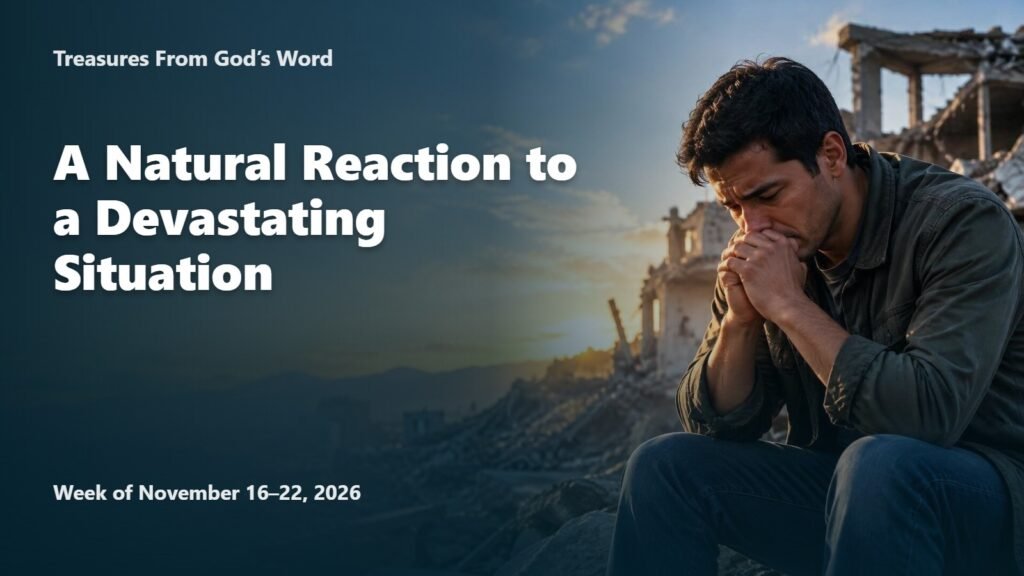
Theme: A Natural Reaction to a Devastating Situation
Seeing someone we love suffer can cause us tremendous pain. And when that suffering is related to the person’s own decisions, sadness, concern, and even feelings of guilt may become mixed together. We know that we cannot change what happened, but we cannot simply stop feeling pain either. The book of Lamentations helps us understand that reaction. It shows us that feeling devastated does not prevent us from turning to Jehovah or from maintaining the hope that someone may change.
Lamentations contains expressions of deep sorrow, but also expressions of hope. That combination is important. When we are going through a painful situation, it is not always easy to see beyond what is happening. This book allows us to draw close to Jeremiah’s suffering and, at the same time, see where he directed his attention in the midst of his anguish. To set the stage, let us watch the video “Information About Lamentations.”
Sorrow and hope do not have to exclude each other. A person can cry over what has happened and still wish for those who have drifted away from Jehovah to return to him. With that thought in mind, let us consider Jeremiah. He did not observe his people’s suffering as a distant onlooker. He loved those people, and that is why he was so deeply affected by the consequences of their having stopped serving Jehovah.
Knowing why someone is suffering does not make our love for that person disappear. Jeremiah understood that the people had made bad decisions. However, that did not make him insensitive. His pain was real, intense, and affected his entire being. As we read his words, let us notice both how he describes his anguish and the people whose suffering he mentions in particular. Let us read Lamentations 2:11.
Lamentations 2:11 — My eyes are worn out from shedding tears. My insides are churning. My liver has been poured out on the ground, because of the downfall of the daughter of my people, Because of the children and infants fainting away in the public squares of the town.
Jeremiah describes the exhaustion caused by his weeping and expresses his anguish with very intense physical imagery. This was not a passing concern. The downfall of his people caused him deep pain, especially seeing children and infants fainting away. These words allow us to sense his compassion. He was not focused only on pointing out what the people had done wrong. He also saw the suffering around him and felt it deep within.
This can help us if someone we love stops serving Jehovah. We may understand that the person’s decisions are wrong and that they will have painful consequences. Even so, we can cry. Feeling sad does not mean that we approve of what the person has done. Those are different things. Jeremiah did not justify the people’s disobedience, but neither did he stop loving them. Similarly, we can continue to respect Jehovah’s standards without expecting ourselves to immediately stop feeling love and concern.
It also helps us to be understanding toward those who are going through this situation. Think of parents who are suffering because their child has drifted away from Jehovah. We would not help them by minimizing their sadness or expecting them to recover right away. We can listen to them patiently, without hastening to judge their tears. Jeremiah’s pain reminds us how much someone who loves can suffer. But his reaction did not end with weeping; he also wanted the people to return to Jehovah.
Jeremiah hoped that those people would come to their senses, humbly pray to Jehovah, and repent. He could not make that decision for them. But he could direct their attention to Jehovah and urge them to turn to him. Rather than presenting suffering as a reason to remain silent, he encouraged them to express what they were feeling. Let us listen to that invitation at Lamentations 2:19.
Lamentations 2:19 — Rise up! Cry out during the night, at the start of the watches. Pour out your heart like water before the face of Jehovah. Raise your hands to him for the lives of your children, Who are fainting away at every street corner because of famine.
The invitation to open their heart to Jehovah conveys sincerity and urgency. It was not enough to lament what was happening; they needed to turn to him. Jeremiah pointed out whom they could approach in the midst of that devastating situation. His exhortation supported the hope that they would respond with humility. This teaches us to distinguish between feeling pain over the consequences of a bad decision and taking steps to regain friendship with Jehovah. Repentance involves more than being sad.
The supporting material reminds us that Jehovah is not permissive and does not tolerate sin. His standards remain just, and we must respect them. But he also wants people to repent. So when the Israelites were disobedient, he did not simply wait for them to return. He took the initiative to help them, even before they showed signs of repentance. His compassion did not mean approving their conduct; it meant offering them help so that they could change and return to him.
The elders strive to imitate that compassion. They sincerely want anyone who has stopped being part of the congregation to repent and return to Jehovah’s organization, and they do not want to make it difficult for that person to take that step. They try to help patiently, although not everyone accepts their help. Keeping this in mind can comfort us when we suffer over someone we love. Their situation pains us, but we know that Jehovah wants them to repent and that the elders strive to help them return.
Now, in addition to sadness, we may perhaps feel guilty. The question for meditation this week touches precisely on that point: What can help us if we feel responsible for other people’s bad decisions? Let us remember a fundamental truth: We cannot decide for others or always protect them from the consequences of their choices. We can give counsel, teach, and strive to set a good example. But the decision to serve Jehovah belongs to each person, not to us.
Let us think again about the parents whose child leaves the truth. They may go over and over what they did and wonder what they could have done better. Jehovah knows that they are not perfect; he wants them to strive to be good parents. If a child decides to leave him, that decision is the child’s responsibility. Parents who take all the blame upon themselves impose a burden that Jehovah does not expect them to carry. Deeply loving someone does not make us responsible for all of that person’s choices.
What if they continue dwelling on specific mistakes from the past? They can tell Jehovah how they feel and ask him for forgiveness. He knows that no one can go back and change what happened. Nor does he expect parents to spare their child the consequences of his or her actions. So they can open their own heart to him without carrying the burden of someone else’s decision. And they can hold on to this comforting hope: If their child strives to return to Jehovah, he will welcome that one with open arms.
When faced with a devastating situation, crying is a natural reaction. Jeremiah helps us see that we can feel pain without justifying wrong decisions and maintain hope without deciding for others. If we are suffering, let us open our heart to Jehovah. Let us respect his standards, trust in his compassion, and remember that he does not ask us to carry the burden of others’ decisions. Our pain does not have to extinguish the hope that someone will return to him.
Enjoy every Premium feature
More convenient meeting preparation with full access to the site’s tools.
- Ad-free browsing
- My Recorder and live transcription
- Assignment Review
- Full Academy access
- Audio posts and reading magnifier
- Saved and synced comments
Monthly plan
€3 per monthRenews monthly. Cancel at any time.
Choose monthlyAnnual plan
€30 per yearOne payment for 12 months. No automatic renewal.
Choose annual


