










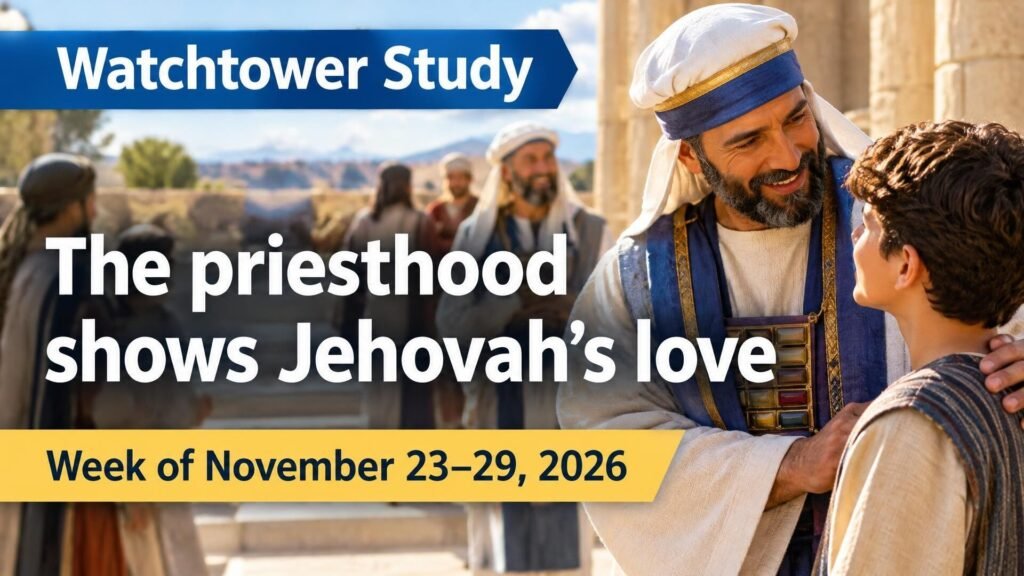
The priesthood shows Jehovah’s love
1. Why are all humans in a desperate situation?
Answer 1: We are in this desperate situation because we all inherited sin from Adam and Eve. Sin has separated us from Jehovah, and none of us can solve the problem on our own. We need help to restore a good relationship with God. Recognizing this helps us appreciate even more what Jehovah has done for us.
Ephesians 2:12 — At that time you were without Christ, alienated from the state of Israel, strangers to the covenants of the promise; you had no hope and were without God in the world.
Answer 2: Ephesians 2:12 shows how sad it is to be without God and without hope. Without Jehovah’s help, our situation would be desperate. We cannot overcome the consequences of sin on our own. Our hope depends, not on human ability, but on what our Father has arranged to draw us close to him.
Answer 3: The paragraph compares sin to an abyss that separates us from Jehovah. Even if someone wants to draw close to him, that person cannot cross the abyss alone. This comparison helps us to be humble: we all need God’s help. It also gives us reason to be grateful because Jehovah has not left us without a way out.
2. What will we learn in this article?
Answer 1: We will see how the priesthood has helped imperfect humans draw close to Jehovah. The article explains its benefits in Bible times, what it does for us today, and what it will accomplish in the future. This shows that the subject is not merely Bible history; it has much to do with our friendship with Jehovah and our hope.
Answer 2: The article emphasizes that the priesthood is a gift from Jehovah. It first benefited the Israelites and later Christians, including us. As we examine it, we can focus not only on what the priests did but also on why Jehovah appointed them: he wanted to help sinful people draw close to him.
Answer 3: Above all, we will see what the priesthood reveals about Jehovah’s immense love. This study invites us to focus on everything our Father has done to help us. Meditating on his loving arrangements can strengthen our trust in him and make us want an ever-closer friendship with him.
3. According to Hebrews 5:1, how did the priesthood help those who wanted to worship Jehovah? (See also the picture.)
Hebrews 5:1 — For every high priest taken from among men is appointed in their behalf over the things relating to God, so that he may offer gifts and sacrifices for sins.
Answer 1: Hebrews 5:1 explains that the high priest served in behalf of people in their relationship with God. He presented gifts and sacrifices for their sins. In this way, Jehovah provided the help they needed to draw close to him. The priesthood showed that he wanted to receive the worship of his servants, even though they were imperfect.
Answer 2: The picture shows a bridge over an abyss. The bridge allows a man to pass from a dark, barren place to a green, luxuriant one. Similarly, the priesthood helped the Israelites overcome the separation caused by sin. The illustration emphasizes that God made it possible for them to draw close to him.
Answer 3: Jehovah established the priesthood because he wanted to help those who desired to worship him. The high priest and the other priests were not there merely to perform ceremonies; their work benefited the people’s relationship with God. Jehovah does not merely point out that we are sinners; he provides the help needed for us to draw close to him.
4. In what sense were the priests God’s representatives to humans?
Malachi 2:7 — For the lips of a priest should safeguard knowledge, and people should seek the law from his mouth, because he is the messenger of Jehovah of armies.
Answer 1: Malachi 2:7 shows that a priest was to convey knowledge of Jehovah. He represented God by teaching His Law, not his own ideas. Through that teaching, the people could learn what Jehovah expected of them. This reminds us how important it is to understand God’s standards in order to worship him as he wishes.
Answer 2: The priests helped the people understand and apply the Mosaic Law. Their work did not end with communicating a command; they also helped the Israelites understand how to put it into practice. Thus, they represented Jehovah before the people. Knowing his instructions better enabled the Israelites to make decisions that pleased him and draw closer to him.
Answer 3: Ezra’s example shows the value of that teaching. In Nehemiah’s day, 13 Levites worked with him to explain the meaning of what was read in the Law. The people not only heard it but were able to understand and apply Jehovah’s standards. We too need to seek understanding rather than remain with reading alone.
5. In what sense were the priests representatives of humans before God, and what does this teach us about Jehovah?
Answer 1: The priests represented the Israelites before Jehovah by offering sacrifices in their behalf. The people knew that they sinned and needed his forgiveness. Through the priesthood, Jehovah gave them a way to seek that forgiveness. This shows that he was not indifferent to their suffering or guilt; he cared about their welfare and salvation.
Psalms 51:9 — Turn your face away from my sins, And wipe away all my errors.
Answer 2: Psalm 51:9 expresses how much a servant of God needs his sins to be forgiven. The priests helped the Israelites in this regard by presenting sacrifices for them. Thinking about the relief they felt when forgiven helps us appreciate Jehovah’s compassion. He wanted his servants to continue worshipping him with a good relationship with him.
Answer 3: This arrangement reveals that Jehovah cares about how we feel when we fail. The priesthood gave the Israelites reason to trust in his mercy. It helps us view forgiveness as an expression of Jehovah’s love. Rather than thinking that he notices only our faults, we can remember how much he wants to help us draw close to him.
6. Why does the Bible mention priests even before the priesthood was established in Israel?
Answer 1: Before the priesthood was established in Israel, family heads usually offered sacrifices for themselves and their households. Thus, they performed priestly functions. The priests mentioned at Exodus 19:22 were those family heads. This shows that Jehovah has always wanted a good relationship with his obedient servants.
Genesis 8:20 — Then Noah built an altar to Jehovah and took some of all the clean animals and of all the clean flying creatures and offered burnt offerings on the altar.
Answer 2: Genesis 8:20 describes Noah offering sacrifices long before Israel was formed. After leaving the ark, he wanted to thank Jehovah for saving them. His example confirms that offering sacrifices did not begin with Aaron. Family heads could already express their gratitude to God and their desire to maintain a good relationship with him in this way.
Answer 3: Job is another example. He regularly offered sacrifices for his children because he was concerned that they might have sinned. Abraham also built altars to offer sacrifices to Jehovah. These examples show that family heads cared for matters of worship before the Israelite priesthood. Jehovah already allowed his servants to draw close to him.
7. Who was Melchizedek, and in what way would the Messiah be like him?
Genesis 14:18 — And Melchizedek king of Salem brought out bread and wine; he was priest of the Most High God.
Answer 1: Genesis 14:18 identifies Melchizedek as king of Salem and priest of the Most High God. He is the first person whom the Bible specifically calls a priest. The Messiah would resemble him because he too would have both functions: he would be king and priest. Melchizedek therefore helps us understand an important aspect of the work Jehovah would assign to Jesus.
Answer 2: What distinguishes Melchizedek is that he was not only a priest but also a king. Jehovah promised that the Messiah would be like him in this respect. This combination helps us appreciate Jesus: in addition to ruling, he performs priestly work in behalf of humans. Our hope is therefore connected with both functions, not merely with his authority as King.
Answer 3: The resemblance was that both would be kings and priests, but the Messiah’s reign would bring eternal benefits. This is not merely a historical similarity. Jehovah’s promise directs our attention to the lasting good Jesus will do for mankind. Meditating on this strengthens our confidence in all that Jehovah will accomplish through him.
8. Who were the priests in Israel, and what was their work?
Exodus 40:12-15 — “Then bring Aaron and his sons near to the entrance of the tent of meeting, and wash them with water. And you are to clothe Aaron with the holy garments and anoint him and sanctify him, and he will serve as priest to me. After that bring his sons near, and clothe them with robes. You are to anoint them just as you anointed their father, so that they will serve as priests to me, and their anointing will serve continually for them as a lasting priesthood during their generations.”
Answer 1: Jehovah chose Aaron and his descendants to offer sacrifices for the Israelites.
Answer 2: The priests were Aaron and his descendants. Their main task was to present sacrifices for the people, some for the entire nation and others for individuals. Jehovah also assigned the Levites to support them. This shows that worship involved defined responsibilities and that Jehovah organized the help the Israelites needed to draw close to him.
Answer 3: Their work had to be carried out according to Jehovah’s instructions. The Law indicated which sacrifices to offer, their purpose, and how to present them. The priests did not decide for themselves how to worship God. Moreover, that priesthood foreshadowed something better and helped explain why mankind needed the superior sacrifice Jesus would later offer.
9, 10. Who will serve as priests with Jesus during the Thousand Year Reign?
1 Peter 2:9 — But you are “a chosen people, a royal priesthood, a holy nation, a people for special possession, that you should declare abroad the excellencies” of the One who called you out of darkness into his wonderful light.
Answer 1: The 144,000 will be kings and priests with Jesus, our High Priest. First Peter 2:9 identifies anointed Christians as a royal priesthood. During the Thousand Year Reign, they will work with Christ to help obedient humans attain perfection. Their service will be another expression of Jehovah’s love for mankind.
Answer 2: They will be the 144,000, and their work will be based on Jesus’ perfect sacrifice. Unlike animal sacrifices, his sacrifice can completely cleanse sins. The future priesthood will therefore accomplish what the Israelite priesthood could not: help obedient humans become free from sin and attain perfection. This gives us an extraordinary hope.
Answer 3: Jesus and the 144,000 will serve as priests until humans reach perfection. Then the separation caused by sin will no longer exist, and a priesthood serving as a bridge will no longer be needed. Jehovah intends to solve the problem completely, not merely help us endure imperfection now.
11. What is the first thing the priesthood shows us about Jehovah?
2 Corinthians 5:18 — But all things are from God, who reconciled us to himself through Christ and gave us the ministry of the reconciliation,
Answer 1: Second Corinthians 5:18 shows that reconciliation through Christ comes from God. Jehovah wants our friendship and took the initiative to make it possible. He does not want sin to keep us away from him forever. Thinking about his efforts to draw us close gives us confidence to seek his approval and strengthen our relationship with him.
Answer 2: The first thing it shows is that Jehovah wants us to be his close friends. The priesthood is not a cold or impersonal arrangement; it reflects his desire that we draw close to him and please him. He also wants to free us from sin and death. This gives us more reason to love him and trust his feelings toward us.
Answer 3: I am comforted that Jehovah knows we did not choose to be imperfect but inherited this condition. That does not remove our responsibility, but it helps us understand his mercy. He knows our situation and has done what is necessary for us to please him. We can value the opportunity he lovingly offers us to be his friends.
12. Why are we comforted that Jesus, our High Priest, speaks in our behalf before Jehovah? (Hebrews 7:25; see also the picture.)
Hebrews 7:25 — So he is able also to save completely those who are approaching God through him, because he is always alive to plead for them.
Answer 1: Hebrews 7:25 assures us that Jesus continues interceding for those who approach God through him. His help did not end when he gave his life. This comforts us because, when we fail, we have a High Priest who wants to help us preserve our friendship with Jehovah. Our Father assigned him this work in our behalf.
Answer 2: Jesus knows much more than our mistakes. He may take into account how our upbringing, experiences, or physical and emotional health have affected us. He also knows our qualities and efforts to do what is right. We can trust that he understands our situation and wants to help us.
Answer 3: The picture reminds us that Jesus values the good things we do—preaching, resisting temptation, helping others, or continuing to pray despite limitations. He knows our motives and requests for forgiveness. This encourages us not to think that our mistakes sum up our entire life. Jehovah is willing to forgive, and Jesus keeps our faithful efforts in mind.
13. According to Hebrews 4:16, what else is possible because of the work of our High Priest, and how does this benefit us?
Hebrews 4:16 — Let us, then, approach the throne of undeserved kindness with freeness of speech, so that we may receive mercy and find undeserved kindness to help us at the right time.
Answer 1: Through Jesus we can approach Jehovah in prayer with confidence. Hebrews 4:16 connects this approach with receiving mercy and help when needed. We do not have to hide our concerns from him. We can speak freely, sure that he wants to listen and that his undeserved kindness sustains us during difficult times.
Answer 2: The work of our High Priest makes it possible to pour out our heart to Jehovah. Our Father likes to hear our prayers because they show that we trust him and seek his support. We do not have to carry our worries alone. We can tell him about them and strengthen our friendship with him when we most need help.
Answer 3: At times, anxiety makes it hard to express what we feel or what to ask for. But this does not prevent Jehovah from hearing and understanding us. We do not need perfect words to approach him. Remembering this can help us keep praying even on the most difficult days, confident that our Father understands our heart.
14. How do we know that Jehovah wants us to live forever?
1 John 4:10 — The love is in this respect, not that we have loved God, but that he loved us and sent his Son as a propitiatory sacrifice for our sins.
Answer 1: First John 4:10 shows that Jehovah took the initiative to send his Son as a sacrifice for our sins. This is concrete proof of his love. He not only wants us to live; he provided the means for us to receive complete forgiveness and live forever. Meditating on this gift strengthens our gratitude to him.
Answer 2: We know this because Jehovah provided a sacrifice capable of accomplishing what animal sacrifices could not. Those sacrifices helped the Israelites recognize their need for something better, but they did not completely remove sins. Jesus’ perfect human life makes complete forgiveness possible. Jehovah did what was necessary to save us.
Answer 3: The priesthood helps us see that Jehovah does not intend to leave us indefinitely under the burden of sin. He wants us to receive forgiveness and live forever. That is why he gave his Son, the sacrifice we truly needed. When we wonder how much he cares about our future, we can think about what he was willing to do to give us this hope.
15. Why do we say that those whom Jehovah chooses to be priests are proof of how much he loves us?
Philippians 2:8 — More than that, when he came as a man, he humbled himself and became obedient to the point of death, yes, death on a torture stake.
Answer 1: Philippians 2:8 highlights that Jesus was obedient to the point of death. The anointed must also remain faithful to the end. Jehovah has therefore chosen for this work people whose loyalty will have been fully demonstrated. We can trust that those who help us attain perfection will be loyal and loving priests who act according to Jehovah’s will.
Answer 2: Jehovah shows how much he loves us by choosing priests whom we can trust. The anointed must prove faithful to death, as Jesus did. They will not receive this responsibility without having demonstrated their loyalty. This helps us look to the future calmly because those applying the ransom’s benefits will be completely devoted to Jehovah.
Answer 3: Jehovah’s love is also seen in the purpose of this choice. Jesus and the 144,000 will help humans leave sin behind and become perfect. They will continue until the earth is a paradise filled with perfect people. Jehovah has not only promised blessings; he has also chosen those who will help make them a reality.
16. How does Hebrews 4:15 show that Jesus is the best High Priest we could have?
Hebrews 4:15 — For we do not have a high priest who cannot sympathize with our weaknesses, but we have one who has been tested in all respects as we have, but without sin.
Answer 1: Hebrews 4:15 shows that Jesus can understand our weaknesses because he too was tested, although he never sinned. His perfection does not make him insensitive to our difficulties. Rather, his experience as a human enables him to treat us compassionately. We can trust that he knows what we face and how to give us needed help.
Answer 2: Jesus knows by experience what fatigue, hunger, and thirst mean. When physical limitations make us feel weak, we can remember that our High Priest understands. He does not view us as someone detached from human life. What he experienced assures us that he will care for us with understanding.
Answer 3: He also suffered ridicule and opposition and felt the pain of losing a loved one, his friend Lazarus. Thus he understands both physical and emotional suffering. If rejection because of our beliefs or the death of someone we love hurts us, we can feel understood. Jehovah has given us a High Priest who knows these human experiences firsthand.
17. Why are we convinced that the anointed will be understanding priests?
Answer 1: During their life on earth, the anointed were also imperfect and sinful. They know what it feels like to make a mistake and feel guilty. When they work with Jesus to help mankind attain perfection, they will understand the difficulties caused by sin. They will help from personal experience, not ignorance.
Answer 2: The anointed have also faced physical and emotional problems. They will understand that difficulties are not always visible and can affect us deeply. This makes Jehovah’s choice very comforting. Those who work with Jesus know human limitations and will be able to empathize with the people they help.
Answer 3: Among the 144,000 are men and women from different eras, cultures, races, and circumstances. Whatever our personal situation, some of them will be able to relate to us. Jehovah has not overlooked the diversity of human experience. This strengthens our confidence that the priesthood will treat people with understanding.
18. What does the priesthood teach us about Jehovah’s personality, and how does this make you feel?
Answer 1: It teaches me that Jehovah is very merciful and compassionate. He knows our imperfection, yet he has done much so that we can have his friendship and approval. Thinking about this helps me not to view him as distant or interested only in our mistakes. It makes me feel more secure in his love and awakens in me the desire to draw closer to him.
Revelation 12:10 — I heard a loud voice in heaven say: “Now have come to pass the salvation and the power and the Kingdom of our God and the authority of his Christ, because the accuser of our brothers has been hurled down, who accuses them day and night before our God!
Answer 2: Revelation 12:10 presents Satan as the accuser of the brothers. Jehovah is completely different: he established the priesthood to help us draw close to him. This contrast reminds me not to confuse accusations with our Father’s feelings. He loves us and wants to help us.
Answer 3: I am impressed that Jehovah not only says he loves us but proves it through concrete arrangements. The priesthood, Jesus’ help, and the possibility of receiving forgiveness reveal what our Father is like. Meditating on this helps me trust his willingness to forgive and love him even more.
19. How does Jehovah view us when we feel bad because of imperfection?
1 John 3:20 — regarding whatever our hearts may condemn us in, because God is greater than our hearts and knows all things.
Answer 1: First John 3:20 reminds us that our heart’s evaluation does not always reflect everything Jehovah knows about us. When we see only our faults, he also knows our qualities and efforts. We should not treat guilt as the final word about our relationship with him. Jehovah understands us better than we understand ourselves.
Answer 2: Jehovah remembers how we are made and understands our limitations. He does not expect us to stop being imperfect by our own strength. When we feel unworthy of his love, we can remember that he knows the condition we inherited. His understanding does not minimize our mistakes, but assures us that he treats us mercifully.
Answer 3: Our Father sees beyond what we have done wrong. He also notices our virtues and what we can become. This perspective can help when we find it difficult to see anything good in ourselves. We can remember how Jehovah views us and keep striving to please him, trusting in his love and understanding.
20. Why are we grateful for the priesthood, and how can we show it?
Hebrews 4:16 — Let us, then, approach the throne of undeserved kindness with freeness of speech, so that we may receive mercy and find undeserved kindness to help us at the right time.
Answer 1: We are grateful because the priesthood allows us to draw close to Jehovah despite being sinners. Hebrews 4:16 teaches us how to show it: confidently seeking his mercy and help. Therefore, when we need support, we should not stop praying. Approaching our Father shows that we value what he has given us through Jesus.
Answer 2: We appreciate that Jehovah has not allowed sin to prevent us from worshipping him. The priesthood expresses his desire to close the separation between him and humans. We can show gratitude by using this help—speaking to him sincerely and turning to him when we fail or feel weak.
Answer 3: This gift assures us that Jehovah wants us near. We should not let guilt make us draw away from him. When we most need help, we can approach our Father. Doing so does not minimize sin; it shows trust in the loving arrangement he established to help us worship him.
Why did Jehovah give humans the gift of the priesthood?
Hebrews 5:1 — For every high priest taken from among men is appointed in their behalf over the things relating to God, so that he may offer gifts and sacrifices for sins.
Answer 1: He gave it to help us draw close to him despite sin. Hebrews 5:1 explains that the high priest acted in behalf of people in matters relating to God and offered sacrifices for their sins. This shows that Jehovah did not want to keep humans at a distance; he provided help so they could worship him.
Answer 2: The priesthood met two important needs. The priests taught the Law and helped people understand and apply it. They also offered sacrifices in behalf of the Israelites. Thus, they represented God to the people and the people to God. Both functions helped the Israelites know Jehovah better and maintain a good relationship with him.
Answer 3: Jehovah gave us this gift out of love and compassion. He knew that humans could not overcome the separation caused by sin on their own. The priesthood would be like a bridge allowing us to draw close to him. Its purpose shows that our Father cares about both our salvation and the relief of knowing we can receive his forgiveness.
How has Jehovah used priests throughout history?
Answer 1: Before Israel existed, family heads offered sacrifices, as Noah, Abraham, and Job did. Melchizedek was both king and priest. Later, Jehovah appointed Aaron and his descendants as priests to serve the Israelites. Through these stages, we see Jehovah’s continuing concern that his servants draw close to him and maintain a good relationship with him.
Hebrews 9:24 — For Christ did not enter into a holy place made with hands, which is a copy of the reality, but into heaven itself, so that he now appears before God on our behalf.
Answer 2: Hebrews 9:24 explains that Jesus appears before God in our behalf. He offered his perfect human life, a sacrifice superior to animal sacrifices, and continues helping us as High Priest. The priesthood therefore does not belong only to the past. Today we benefit from Jesus’ work in preserving our friendship with Jehovah.
Answer 3: During the Thousand Year Reign, Jesus and the 144,000 will help obedient humans attain perfection. Once that is accomplished, a priesthood serving as a bridge will no longer be needed because sin will no longer separate them from Jehovah. The history of the priesthood shows how our Father prepared a complete and lasting solution.
Why does the priesthood help us love Jehovah more?
1 John 4:10 — The love is in this respect, not that we have loved God, but that he loved us and sent his Son as a propitiatory sacrifice for our sins.
Answer 1: First John 4:10 reminds us that Jehovah expressed his love by sending his Son for our sins. The priesthood helps us understand the extent of that gift: we can receive forgiveness, have friendship with God, and hope for everlasting life. The more we meditate on what our Father has done, the more reasons we find to love him.
Answer 2: It helps us love him more because it reveals his understanding. Jehovah has given us a High Priest who lived as a human and knows our difficulties. The 144,000 will also have experienced imperfection. Knowing that he chose priests able to understand us makes us feel his care. Our Father has kept our needs and feelings in mind.
Answer 3: The priesthood convinces us that Jehovah wants our friendship and does not focus only on our mistakes. Through Jesus we can open our heart to him, ask for forgiveness, and seek help confidently. We also know that he wants to eliminate completely the separation caused by sin. All of this moves us to draw closer to him and show through our prayers that we value his love.
Enjoy every Premium feature
More convenient meeting preparation with full access to the site’s tools.
- Ad-free browsing
- My Recorder and live transcription
- Assignment Review
- Full Academy access
- Audio posts and reading magnifier
- Saved and synced comments
Monthly plan
€3 per monthRenews monthly. Cancel at any time.
Choose monthlyAnnual plan
€30 per yearOne payment for 12 months. No automatic renewal.
Choose annual


