









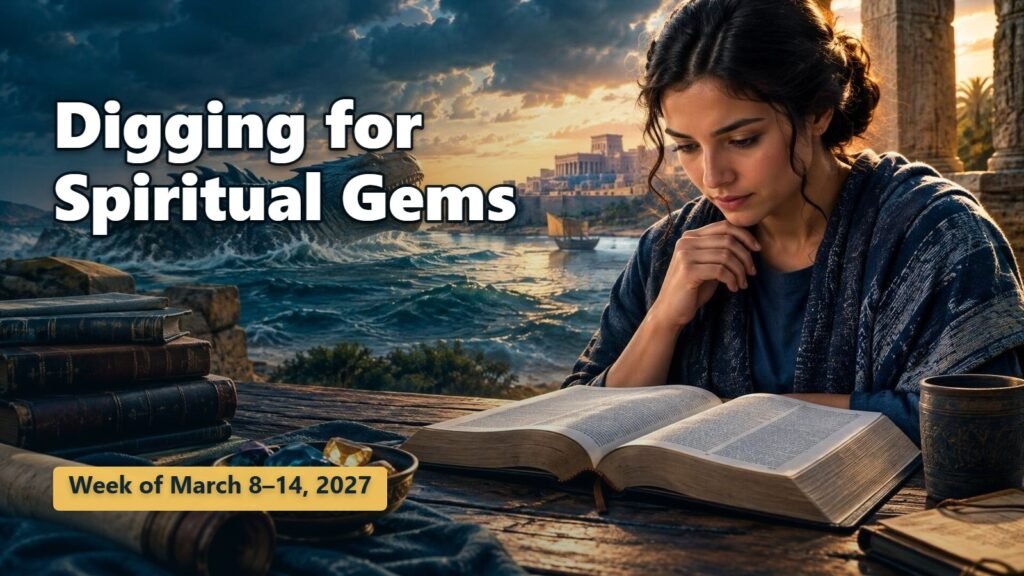
Ezekiel 29:3, 4. Why was it appropriate for Jehovah to compare Pharaoh to a “great sea monster”? (it “Hook, Fishhook, and Harpoon” par. 5)
Answer 1: The comparison was appropriate because it evoked a Nile crocodile, an animal the Egyptians knew well. Pharaoh was portrayed as a huge monster lying among the channels of that river. Thus, Jehovah used an image from Egypt’s surroundings to describe its ruler. In addition, the method of taking the animal out of the water corresponded to a method the Egyptians used to capture crocodiles.
Answer 2: A detail that made the comparison especially appropriate was the use of hooks. According to the historian Herodotus, the Egyptians used large hooks to catch crocodiles and pull them out of the river. So when Jehovah announced that he would put hooks in Pharaoh’s jaws and pull him out of the Nile, he described a recognizable scene. The ruler, although he might have seemed powerful, could not prevent Jehovah from acting against him, just as a crocodile could be captured.
Answer 3: The image also fit Pharaoh’s arrogant attitude. Ezekiel 29:3 presents him as claiming ownership of, and even credit for creating, the Nile. He appeared as a great monster settled in its waters, confident of his control. But Jehovah announced that he would pull him out with hooks. The contrast was very expressive: Pharaoh boasted that he controlled the river, but he would not even be able to remain in it when Jehovah intervened.
Answer 4: The comparison highlighted not only the animal’s size or strength but also its vulnerability when it was pulled out of the river. Jehovah announced that he would remove the monster from the Nile and abandon it in the open field. In this way, he described the defeat and humiliation awaiting Pharaoh. The image of a captured crocodile was very fitting: it showed that this ruler was not beyond Jehovah’s reach, no matter how powerful he might have seemed within his territory.
Answer 5: The comparison was also appropriate because of the context: Israel had unwisely sought military support from Egypt against Babylon. Pharaoh might have seemed like a formidable protector, like a great animal of the Nile. However, Jehovah described him as a monster that would be captured and pulled out of its waters. That image made clear that he could not provide the security Israel expected. In fact, Egypt had proved to be as unreliable as a reed used for support.
What spiritual gems from this week’s Bible reading have you enjoyed?
Spiritual Gems for EZEKIEL 29
Ezekiel 29:2 — “Son of man, turn your face toward Pharaoh king of Egypt, and prophesy against him and against all Egypt.
Comment 1: Ezekiel 29:2 shows that Jehovah assigned his prophet to deliver a message against a powerful ruler. The importance of the recipient did not change what he had to say. This encourages me not to be intimidated in the ministry by a person’s position. I can speak respectfully while remaining faithful to the Bible’s message.
Ezekiel 29:3 — Speak these words: ‘This is what the Sovereign Lord Jehovah says: “Here I am against you, Pharaoh king of Egypt, The great sea monster lying among the streams of his Nile, Who has said, ‘My Nile River belongs to me. I made it for myself.’
Comment 2: At Ezekiel 29:3, Pharaoh took credit for something he had not created—the Nile. His attitude makes me think about how I speak of my abilities and accomplishments. Even if I have worked hard to achieve something, it would not be reasonable to forget all that I have received. Gratefully acknowledging what Jehovah gives us helps us remain humble and avoid speaking as though everything depended exclusively on us.
Ezekiel 29:4 — But I will put hooks in your jaws and cause the fish of your Nile to cling to your scales. I will bring you up out of your Nile along with all the fish of the Nile that cling to your scales.
Comment 3: Ezekiel 29:4 presents Pharaoh as an animal that Jehovah could pull out of the river with hooks. What seemed impossible to others was completely within his power. This image helps me put human threats in perspective. It does not mean that we will never experience difficulties, but no person, regardless of how influential, is above Jehovah. Remembering this can help us remain calm when we feel under pressure.
Ezekiel 29:6 — Then all the inhabitants of Egypt will have to know that I am Jehovah, For they were no more support to the house of Israel than a piece of straw.
Comment 4: Ezekiel 29:6 connects the recognition of Jehovah with the demonstration that Egypt was not a reliable support. It was not enough for that nation to appear strong; its actions had shown otherwise. This reminds me that knowing Jehovah involves recognizing his authority and taking seriously what he says. In my personal study, I want to pay attention not only to events but also to what they reveal about him and about the trust he deserves.
Ezekiel 29:7 — When they grasped your hand, you were crushed, And you caused them to tear their shoulder. When they supported themselves on you, you were broken, And you caused their legs to wobble.”
Comment 5: The image in Ezekiel 29:7 is very graphic: the support not only broke but also injured those who leaned on it. Misplaced trust can cause more harm than simply leaving us disappointed. Before following important advice, it is wise to ask whether it agrees with Bible principles. Someone’s speaking with great confidence does not guarantee that his guidance is good or that it will help us spiritually.
Ezekiel 29:12 — I will make the land of Egypt the most desolate of lands, and its cities will be the most desolate of cities for 40 years; and I will scatter the Egyptians among the nations and disperse them among the lands.”
Comment 6: At Ezekiel 29:12, Jehovah did not give a vague warning. He announced desolation, dispersion, and a specific period of 40 years. This shows that Egypt’s situation did not escape his knowledge or authority. I am encouraged to read prophecies with attention to details. Rather than adding my own ideas or looking for meanings the text does not explain, I want to carefully distinguish what Jehovah actually announced.
Ezekiel 29:13 — “‘For this is what the Sovereign Lord Jehovah says: “After 40 years I will gather back the Egyptians from the peoples where they were scattered;
Comment 7: Ezekiel 29:13 shows that Jehovah had also set a limit to the dispersion of the Egyptians. After 40 years, he would gather them back. The announcement contained not only punishment; it also explained what would happen afterward. This helps me avoid forming an idea of Jehovah based on only one part of an account. To know his way of acting well, I need to consider everything he says, including the limits he sets.
Ezekiel 29:15 — Egypt will become lower than the other kingdoms and will no longer dominate the other nations, and I will make them so small that they will not be able to subdue other nations.
Comment 8: Ezekiel 29:15 indicated that Egypt would cease dominating other nations. Its former position of power did not guarantee that it could keep it. This helps me not to be overly impressed by prestige or influence. It is also useful within the congregation: a person’s value is not measured by social position or ability to impose himself. Therefore, I want to treat everyone considerately, without showing favoritism toward those who seem more important.
Ezekiel 29:16 — It will never again be a source of confidence for the house of Israel, but it will only remind them of their error in turning to the Egyptians for help. And they will have to know that I am the Sovereign Lord Jehovah.”’”
Comment 9: According to Ezekiel 29:16, Egypt would remind the Israelites of the error of having sought support there. That memory could help them avoid repeating the same decision. At times, we too remember a mistake and feel ashamed. But we can use that memory constructively: identify what led us to err and what Bible principle we should apply. In this way, a bad experience can help us make wiser decisions in the future.
Spiritual Gems for EZEKIEL 30
Ezekiel 30:2 — “Son of man, prophesy and say, ‘This is what the Sovereign Lord Jehovah says: “Wail, ‘Alas, the day is coming!’
Comment 1: At Ezekiel 30:2, the announcement of judgment is accompanied by an expression of mourning. This reminds me that a serious message should not be delivered with satisfaction over the suffering of others. When we speak about Bible warnings, we want to do so with respect and sensitivity. Our tone should show that we care about the people listening to us.
Ezekiel 30:3 — For the day is near, yes, a day of Jehovah is near. It will be a day of clouds, an appointed time of nations.
Comment 2: Ezekiel 30:3 presents the judgment against those nations as something that had an appointed time. Jehovah did not depend on the calendar or on human expectations in order to act. This helps me cultivate patience. At times I might want an unjust situation to be resolved immediately, but my impatience does not determine when Jehovah should intervene. I can concentrate on fulfilling my responsibilities and avoid drawing hasty conclusions simply because I do not yet see a solution.
Ezekiel 30:4 — A sword will come against Egypt, and panic will overtake Ethiopia when the slain fall in Egypt; Its wealth is taken and its foundations are torn down.
Comment 3: Ezekiel 30:4 shows that Egypt’s riches would not prevent its fall; in fact, they would be taken. This reminds me that material possessions can be useful, but they do not offer absolute security. It is reasonable to manage what we have well without making it the center of our life. One question I can ask myself is: When I think about my future, do I give as much attention to my friendship with Jehovah as I do to my financial situation?
Ezekiel 30:6 — This is what Jehovah says: ‘The supporters of Egypt will also fall, And its arrogant power will be brought down.’ “‘From Migdol to Syene they will fall by the sword in the land,’ declares the Sovereign Lord Jehovah.
Comment 4: Ezekiel 30:6 indicates that those supporting Egypt would also suffer the consequences of its fall. Being on the side of an arrogant power would not keep them safe. Without directly transferring that judgment to our personal relationships, we can draw a useful warning: We should not support wrong conduct out of loyalty to someone. If we care about a person, we help him best by defending what is right rather than justifying his decisions simply because he is close to us.
Ezekiel 30:9 — In that day I will send messengers in ships to make self-confident Ethiopia tremble; panic will seize them in the day that is coming upon Egypt, for it will surely come.’
Comment 5: At Ezekiel 30:9, Ethiopia is described as a nation confident in itself, but that calm would turn into panic. Feeling secure does not always mean that one is truly safe. Personally, this encourages me not to think that I am immune to a weakness or a bad influence. It is wiser to recognize my limits, listen to Bible counsel, and take precautions than to rely too much on my own strength.
Ezekiel 30:10 — “This is what the Sovereign Lord Jehovah says: ‘I will bring an end to Egypt’s hordes by the hand of King Nebuchadnezzar of Babylon.
Comment 6: At Ezekiel 30:10, Jehovah identified by name the king he would use against Egypt: Nebuchadnezzar. The announcement did not speak merely of an undefined disaster. This detail encourages me to explain the Bible accurately in the ministry. If the text identifies a person or describes a specific action, it is good to highlight it. In this way, we help the listener understand what the passage actually says instead of offering only a general impression.
Ezekiel 30:12 — I will turn the canals of the Nile into dry ground and will sell the land into the hand of wicked men. I will make the land and everything in it desolate by the hand of foreigners. I myself, Jehovah, have spoken.’
Comment 7: Ezekiel 30:12 says that the land would be handed over to wicked men. That detail is important: Jehovah’s using those men to execute a judgment did not mean that he approved of their wickedness. The account itself distinguishes between the two things. This helps me read Bible events with balance and not attribute Jehovah’s approval to everything a nation did simply because he used it for a specific task.
Ezekiel 30:13 — “This is what the Sovereign Lord Jehovah says: ‘I will also destroy the disgusting idols and bring an end to the worthless gods of Noph. There will no longer be a prince from the land of Egypt, and I will put fear in the land of Egypt.
Comment 8: Ezekiel 30:13 shows that Egypt’s idols could not protect its inhabitants. Jehovah presents them as useless gods, incapable of preventing the judgment. This highlights the difference between an object to which religious power is attributed and the living God who can act. In the ministry, we can help people respectfully examine the basis for their trust, directing attention to Jehovah rather than to objects of devotion.
Ezekiel 30:16 — I will set a fire in Egypt; and Sin will be seized with terror and No will be broken through and Noph will face attack in broad daylight!
Comment 9: Ezekiel 30:16 describes terror, defenses breached, and a city attacked in broad daylight. Behind those expressions was human suffering, not merely changes on a map. When reading accounts of judgment, I want to avoid becoming insensitive simply because I already know the outcome. Meditating on what people experienced can help me speak about these passages seriously and show greater compassion toward those who suffer the consequences of violence today.
More posts for this week



Enjoy every Premium feature
More convenient meeting preparation with full access to the site’s tools.
- Ad-free browsing
- My Recorder and live transcription
- Assignment Review
- Full Academy access
- Audio posts and reading magnifier
- Saved and synced comments
- Support the project and help keep it running
Monthly plan
€3 per monthRenews monthly. Cancel at any time.
Choose monthlyAnnual plan
€30 per yearOne payment for 12 months. No automatic renewal.
Choose annual


