









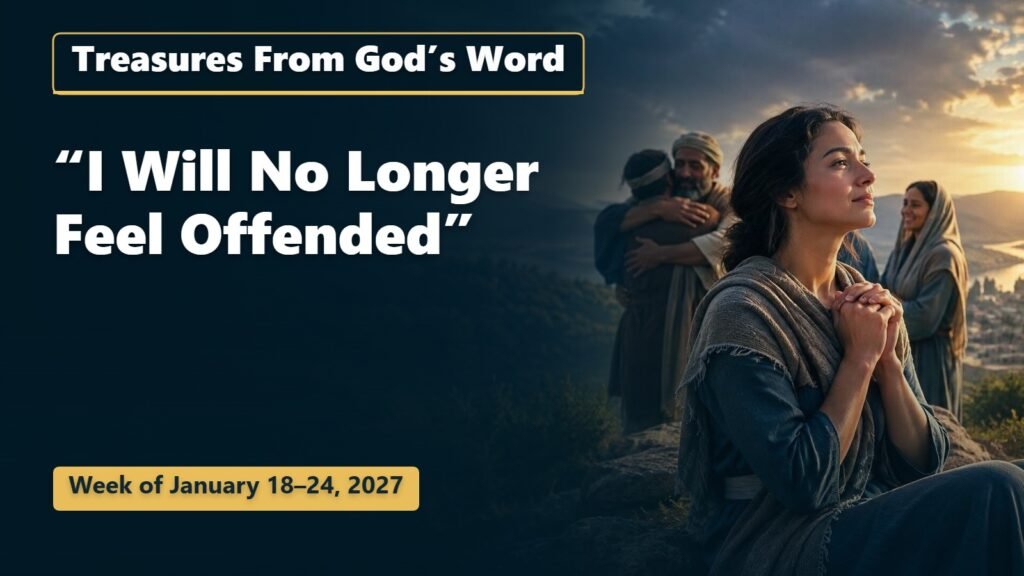
Theme: “I Will No Longer Feel Offended”
When someone hurts us, it can be very difficult to regain our calm. And if the offense is repeated, we may find it even harder to put the anger behind us. That is why it helps us to know how Jehovah reacted when his people deeply offended him. Ezekiel chapter 16 allows us to see both the seriousness of that offense and Jehovah’s desire to open the way to forgiveness.
To appreciate Jehovah’s forgiveness, we must first understand what had happened. This was not a difference of opinion or an insignificant mistake. Israel had rebelled against him. When describing Jerusalem’s conduct, Jehovah used a very strong comparison that highlighted his people’s unfaithfulness. Let us listen to what Ezekiel 16:26 says.
Ezekiel 16:26 — You prostituted yourself to the sons of Egypt, your lustful neighbors, and you offended me with your countless acts of prostitution.
The comparison to prostitution shows that the people had betrayed their relationship with Jehovah. Their ties with Egypt were not innocent: they were part of their unfaithfulness. In addition, the text makes clear that this had not been an isolated incident. The conduct had been repeated again and again. Therefore, Jehovah had more than enough reason to feel deeply offended by what had happened.
This helps us avoid a mistaken idea about Jehovah’s forgiveness. His willingness to forgive does not mean that he is indifferent to what we do. Unfaithfulness matters to him, very much so. We must not confuse his mercy with permissiveness. To understand how valuable the forgiveness he would offer was, we first need to recognize how serious his people’s rebellion had been.
We can draw a personal application. When making decisions, it is not enough to ask ourselves whether something benefits us or whether other people accept it. We should also think: What effect will this have on my relationship with Jehovah? Does it show that I value his friendship? Remembering that our conduct can please or offend him helps us take loyalty seriously, even in decisions that others may consider small.
We also learn something that will help us when thinking about our own hurts. Jehovah did not deny that there were reasons to be angry. He acknowledged the offense and acted on it. So imitating his willingness to forgive does not require us to pretend that nothing happened. But an important question arises: After so much unfaithfulness, would Jehovah want to maintain the distance between himself and his people forever?
Jehovah announced that Jerusalem would suffer the consequences of its conduct. The same idolatrous allies in whom it had trusted would eventually destroy it and take away its valuable things. The punishment would be severe. However, to understand Jehovah’s way of acting, we cannot focus only on the punishment; we must pay attention to his objective. Let us read how he expressed it at Ezekiel 16:42.
Ezekiel 16:42 — I will satisfy my rage against you, and my indignation will turn away from you; and I will be calm and no longer feel offended.’
These words show that Jehovah did not want to prolong his anger indefinitely. His purpose was not to exterminate his people but to put an end to their unfaithfulness. In the long term, he wanted to restore pure worship after the exile. Therefore, the discipline did not close off every possibility of recovery. Although there were reasons for indignation, Jehovah looked beyond the offense and the punishment it deserved.
Why would he act that way? Because he would remember the covenant he had made with his people. Unlike the Israelites, Jehovah would prove to be completely loyal. His reaction was not governed by a desire to make them suffer endlessly. He continued to keep his purpose and the relationship he had established with them in mind. How reassuring it is to know that his anger does not cause him to forget his loyalty.
We do not have Jehovah’s authority or perfect knowledge to judge. But we can imitate his desire not to remain angry. For example, if a brother has spoken harshly to us and then tries to make things right, we might ask ourselves: Do I want to restore peace, or do I want him to continue feeling bad? That question may reveal what we are really seeking by our reaction.
Regaining our calm may take time; the pain does not always disappear right away. Even so, we can decide not to keep feeding resentment. Jehovah shows us that having reasons to feel offended does not oblige us to hold on to anger forever. And his example goes even further: He not only expressed that he would cease being indignant, but he also made it possible for his people to draw close to him again.
Here we see the depth of Jehovah’s mercy. He did not merely announce that the punishment would end. He offered the prospect of reconciliation. The people had seriously damaged their relationship with him and needed his help to restore it. What would Jehovah do, and how would that affect those who received his forgiveness? Let us listen to the promise found at Ezekiel 16:62, 63.
Ezekiel 16:62-63 — “‘And I myself will establish my covenant with you; and you will have to know that I am Jehovah. Then you will remember and be too ashamed to open your mouth because of your humiliation, when I make an atonement for you despite all that you have done,’ declares the Sovereign Lord Jehovah.”
Jehovah announced that he would make atonement for them. Atonement is the arrangement he established so that sinful humans could again have a good relationship with him. Thus, this promise was not simply an invitation to forget the past. Jehovah would provide a basis for forgiveness. He himself would make it possible for the people to recover something they had damaged by their conduct.
In the time of the Israelites, that arrangement was temporary. Each year, on the Day of Atonement, the high priest offered animal sacrifices in behalf of the people. Those sacrifices could not completely remove their sins, since animals are inferior to humans. Nevertheless, Jehovah was willing to forgive them if they repented and offered the sacrifices he requested.
The sacrifices also reminded them that they were sinners and needed a permanent solution. And, according to the passage we read, receiving mercy would not cause them to feel proud or justify their past. They would remember their conduct with shame and humility. That is an important difference: Jehovah’s forgiveness did not make rebellion acceptable; it gave them reason to acknowledge it and change.
As we think about all of this, let us ask ourselves: What can I do to forgive those who have hurt me? A first step is to examine whether I am willing to promote peace. I can ask Jehovah to help me avoid feeding resentment and to recognize the other person’s sincere efforts to correct what he did, instead of automatically dismissing them.
For example, if someone sincerely apologizes for a hurtful comment, we can listen to him without taking advantage of the opportunity to humiliate him. And once the matter has been forgiven, we can strive not to use it as a weapon in future conversations. This does not mean denying the pain, but rather preventing it from continuing to control the way we treat the person. Let us think of one specific action we can take to move toward that forgiving attitude.
Israel had deeply offended Jehovah. However, he did not want to remain angry forever and provided the means for his people to regain his friendship. That example teaches us that forgiveness does not mean minimizing wrongdoing. It means not making anger our permanent response. Let us be grateful for Jehovah’s mercy and strive to reflect it in the way we treat others.
More posts for this week





Enjoy every Premium feature
More convenient meeting preparation with full access to the site’s tools.
- Ad-free browsing
- My Recorder and live transcription
- Assignment Review
- Full Academy access
- Audio posts and reading magnifier
- Saved and synced comments
- Support the project and help keep it running
Monthly plan
€3 per monthRenews monthly. Cancel at any time.
Choose monthlyAnnual plan
€30 per yearOne payment for 12 months. No automatic renewal.
Choose annual


