










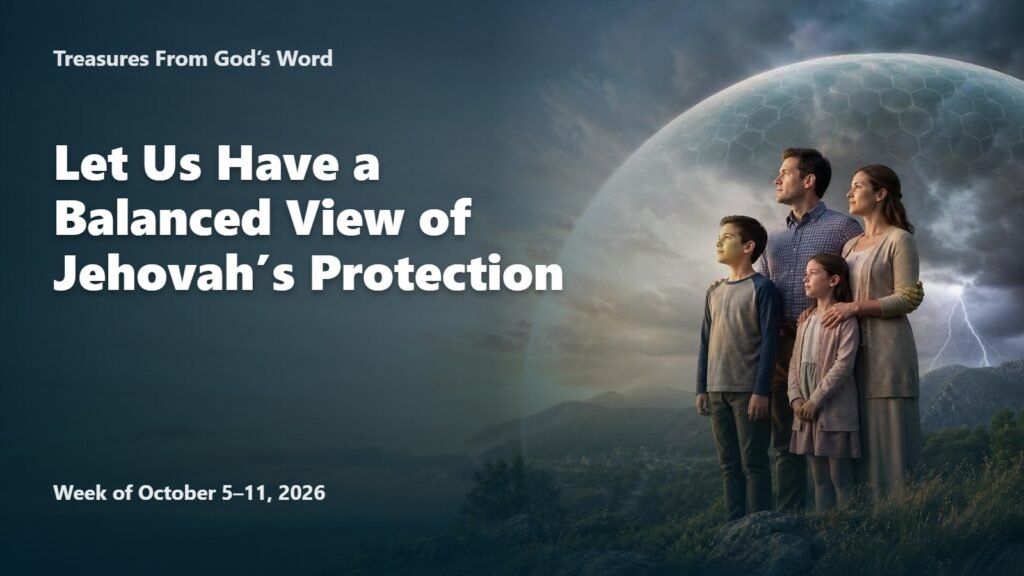
Theme: Let Us Have a Balanced View of Jehovah’s Protection
When we suffer a difficulty, it is natural to ask Jehovah to protect us. We fully trust that he has the power to help us and that he truly cares about us. But that trust needs to be accompanied by balance. Jehovah can deliver his servants from danger, but he has not promised to eliminate every problem in our present life. The events recorded in Jeremiah chapters 40 and 41 help us to understand this reality clearly.
In those chapters, we see two very different experiences. Jeremiah was protected after the destruction of Jerusalem. By contrast, Gedaliah, a God-fearing man, died violently. Does that mean that Jehovah protected Jeremiah but did not care about Gedaliah? Not at all. As we consider these accounts, we will see why we can feel secure under Jehovah’s care without expecting him to miraculously deliver us from every trial.
Jeremiah had faithfully served Jehovah during a very dangerous time. For years he delivered messages that many did not want to hear. He was rejected, threatened, and mistreated. However, after the fall of Jerusalem, the chief of the Babylonian guard released him and gave him the opportunity to choose where to live. Notice how he acknowledged that the calamity had occurred just as Jehovah had said and the freedom he offered Jeremiah.
Jeremiah 40:2-4 — Then the chief of the guard took Jeremiah and said to him: “Jehovah your God foretold this calamity against this place, and Jehovah has brought it about just as he said, because you people sinned against Jehovah and did not obey his voice. That is why this has happened to you. Now I am releasing you today from the handcuffs that were on your hands. If it seems good to you to come with me to Babylon, come, and I will look after you. But if you do not want to come with me to Babylon, do not come. See! The entire land is before you. Go wherever you choose.”
Jehovah protected Jeremiah, although He did not prevent him from going through painful situations before that time. Divine protection did not always consist of keeping him from all opposition. Rather, Jehovah sustained his prophet and, when the time came, made it possible for him to be released. This outcome confirms that Jehovah never loses sight of those who serve him loyally, even when their circumstances seem very uncertain.
We also learn from the sensible way Jeremiah acted when facing danger. He was not a fanatic, nor did he seek unnecessary confrontations. When the false prophet Hananiah reacted furiously and broke the yoke that Jeremiah was wearing, Jeremiah went on his way. Later he returned with the message Jehovah had commanded him to deliver. His trust in Jehovah did not lead him to be reckless; it helped him know when to withdraw and when to speak courageously.
We can imitate that balance. We pray for protection, but we also avoid unnecessary risks and exercise good judgment. Perhaps a conversation is becoming hostile, or perhaps we sense a situation that could put us in physical or spiritual danger. We would not demonstrate greater faith by ignoring warning signs. Humbly, we can take reasonable precautions and continue trusting that Jehovah sees our efforts to do what is right.
Now, the fact that Jehovah protected Jeremiah does not mean that he always prevents his servants from suffering. Consider Gedaliah. After the destruction of Jerusalem, the king of Babylon appointed him governor over the Jews who remained in Judah. Gedaliah lived in Mizpah, where Jeremiah also took up residence. He encouraged the people to live peacefully, serve the king of Babylon, and gather the produce of the land.
Gedaliah feared God, but he faced a conspiracy. Johanan and other military chiefs warned him that Ishmael planned to assassinate him. They even offered to intervene to thwart the plot. But Gedaliah thought that the accusations were false and took no precautions. When Ishmael arrived with ten men, Gedaliah welcomed them to eat. The account shows the tragic result of that misplaced trust.
Jeremiah 41:1-2 — In the seventh month Ishmael son of Nethaniah son of Elishama, who was of the royal line and one of the principal men of the king, came with ten other men to Gedaliah the son of Ahikam at Mizpah. As they were eating a meal together in Mizpah, Ishmael the son of Nethaniah and the ten men who were with him rose up and struck down Gedaliah the son of Ahikam the son of Shaphan with the sword. So he put to death the one whom the king of Babylon had appointed over the land.
Gedaliah’s death does not indicate that Jehovah had stopped loving him or that He lacked the power to save him. We live in a world where bad decisions, violence, and imperfection cause much pain. Jehovah has not promised to miraculously prevent all such consequences. This account also reminds us that trusting in Jehovah does not mean disregarding prudent advice or ignoring serious information that can help us protect ourselves.
This reality can touch us deeply. A faithful servant may become sick, lose a loved one, face poverty, or suffer the consequences of a war. It is normal for us to feel pain and to beg Jehovah for help. But we should not conclude that we have lost his favor if the trial does not disappear. Jehovah remains close to his servants and can give them the strength, guidance, and support needed to remain faithful during the most difficult circumstances.
Jehovah has the power to perform miracles, and in Bible times he sometimes did so. However, he has not committed himself to giving us a life without problems in this system. If he always miraculously eliminated every difficulty, it might seem that we served him only to receive protection. We serve him because we love him and recognize that his way of ruling is just. Therefore, mature faith trusts Jehovah both when he delivers us and when he allows us to endure a trial.
Even so, Jehovah protects us today in very real ways. One way is through the wisdom he gives us in his Word. That wisdom can protect us from decisions that would bring painful consequences. It helps us choose good friends, avoid dangerous conduct, and respond calmly when we are under pressure. Let us read the counsel in Proverbs about the protective value of acquiring wisdom and understanding.
Proverbs 4:5-6 — Acquire wisdom, acquire understanding. Do not forget, and do not turn aside from what I say. Do not forsake it, and it will protect you. Love it, and it will safeguard you.
To receive this protection, it is not enough to know what the Bible says. We must love wisdom and not abandon it. That means allowing Jehovah’s principles to influence our daily decisions. For example, a Bible principle may seem simple to us, but following it can save us much anguish. When we turn to Jehovah in prayer, study his Word, and accept spiritual guidance, we show that we value the protection he provides.
Jehovah also protects us through the congregation. In times of sickness, sadness, or weakness, the brothers can become a very tangible source of help. A visit, a meal, words of encouragement, or practical assistance can lighten a heavy burden. These are not merely kind gestures. Jehovah can use the love of the congregation to sustain us when our own strength seems exhausted. So all of us can ask ourselves how we can help those who are going through a trial.
The congregation not only brings comfort to those who are depressed or suffering. It can also protect us when we receive a kind warning because we are taking an imprudent step. For that help to work, the one giving the counsel needs love, and the one receiving it needs humility. Notice the broad and balanced exhortation that the apostle Paul gave the brothers.
1 Thessalonians 5:14 — On the other hand, we
These words invite us to look beyond our own needs. Perhaps someone needs a respectful warning; another, comfort; and another, patient support. When we provide such help, we cooperate with Jehovah in protecting our brothers. And when we are the ones who need help, we do not have to isolate ourselves. We can gratefully accept the affection and support of the congregation, convinced that Jehovah knows how to care for each one of us.
So let us maintain a balanced view of Jehovah’s protection. He can deliver us, as he did Jeremiah; but he does not always prevent problems, as the case of Gedaliah shows. Regardless of what happens, Jehovah protects us through his wisdom and through the congregation. Let us seek that wisdom, take sensible precautions, and support one another. In this way, we will feel the faithful care of our heavenly Father each day.
Discover more from Comentarios para la Reunión TJ
Subscribe to get the latest posts sent to your email.
Receive new posts by email
Create a free account or choose the ad-free plan. During registration, you can choose to receive new posts by email.
Register


