










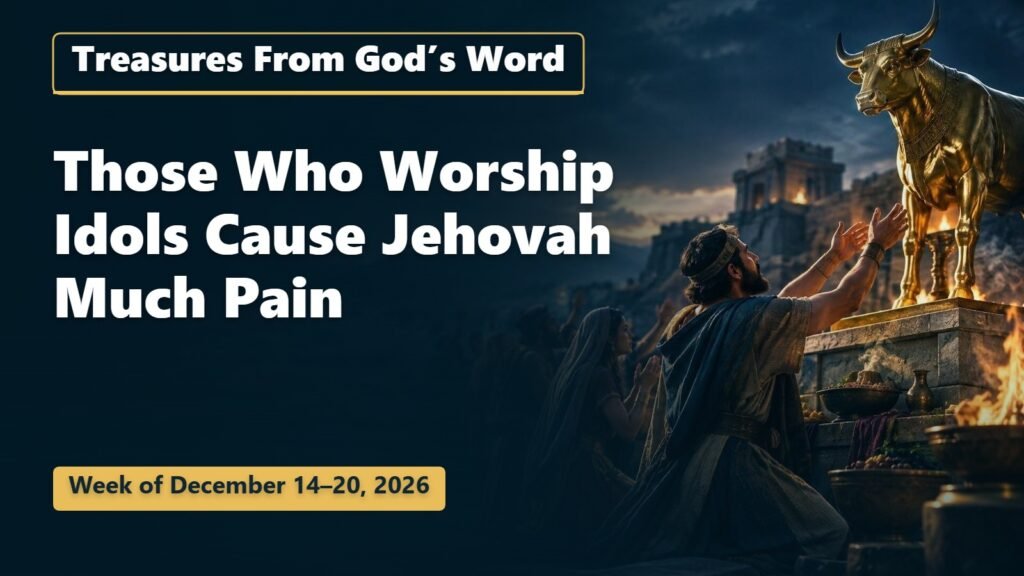
Theme: Those Who Worship Idols Cause Jehovah Much Pain
When we truly love someone, we care about how that person feels. We are not satisfied with merely avoiding an obvious offense; we want to care for the relationship and show loyalty. Now think about our relationship with Jehovah. Do we stop to consider how our decisions affect him? Ezekiel’s account helps us understand that idolatry is not simply a wrong way of worshipping. It is unfaithfulness that causes our God deep pain.
The Israelites were well aware of what Jehovah expected of them. They had agreed to become part of the Law covenant and had committed themselves to giving him exclusive devotion. This meant that Jehovah had to be the only recipient of their worship. They could not mix true worship with false worship and remain faithful to that commitment. Yet, in time, that is exactly what they did. Let us listen to how Jehovah described that situation. Let us read Ezekiel 5:11.
Ezekiel 5:11 — “‘Therefore as surely as I am alive,’ declares the Sovereign Lord Jehovah, ‘because it was my sanctuary that you defiled with all your disgusting idols and with all your detestable practices, I will also reject you; my eye will not feel sorry, and I will show no compassion.
Notice where they had introduced their idols: into Jehovah’s sanctuary. The place intended for his worship had been contaminated by images and practices that he detested. Therefore, this was not simply a matter of personal preference or different tastes. They were dishonoring the One to whom they had promised faithfulness. Belonging to Jehovah’s people did not make their conduct acceptable or protect them from the consequences of their unfaithfulness.
Jehovah’s response was firm. He was not going to accept contaminated worship simply because it was practiced in his sanctuary. This teaches us something fundamental: We are not the ones who decide what kind of worship pleases God. He is the one who establishes what is clean in a spiritual sense. If we want to worship him, we need to respect his standards, even if a religious practice is popular, has a long tradition, or is very attractive to the people around us.
We might ask ourselves: Am I content to think that I belong to Jehovah’s people, or do I make sure that my decisions reflect exclusive devotion? The lesson is not for us to look down on those Israelites. Their example invites us to examine ourselves humbly. A relationship with Jehovah is not maintained simply by what we said in the past; it requires faithfulness in the present. But the account reveals more than the seriousness of a broken standard: It also allows us to learn about Jehovah’s feelings.
When hearing the sentence against idolatry, we might focus only on the punishment. However, Jehovah also explained what that conduct had meant to him. He was not an indifferent observer of his people’s decisions. The Israelites’ unfaithfulness affected a relationship that should have been based on love and loyalty. Let us see what those who survived would come to recognize. Let us read Ezekiel 6:9.
Ezekiel 6:9 — And those who escape will remember me among the nations where they are taken captive. They will realize that I was brokenhearted over their unfaithful heart that turned away from me and at their eyes that are lusting after their disgusting idols. They will be ashamed of and loathe all the evil and detestable things they have done.
Jehovah pointed out that the problem was in the heart. His people had turned away from him and directed their desires toward the idols. Acts of false worship expressed inner unfaithfulness. That is why they caused him so much pain. Those Israelites would eventually feel ashamed of and hate what they had done. They would understand that their decisions had not only brought painful consequences on themselves but had also hurt the feelings of the God they should have loved.
This passage helps us to know Jehovah better. He is not an impersonal force, incapable of feeling. He is a spirit person, the living God. Therefore, our actions matter to him, and our conduct can cause him pain. Knowing this changes the way we view obedience. It is not merely a matter of fulfilling requirements to avoid consequences. It is a matter of caring for a real relationship with someone we love and whose feelings we want to keep firmly in mind.
Think about the difference between asking, “What might happen to me if I do this?” and asking, “How will Jehovah feel if I do it?” The first question focuses on us; the second takes our relationship with him into account. Both consequences deserve attention, but love moves us to look beyond our own well-being. The more we value Jehovah as a person, the less we will want to make room for anything that displaces our devotion. How can we protect it in daily life?
Ezekiel’s warning also applies to us as Christians. It would be a mistake to think that idolatry was a danger only to the Israelites or that it has to do only with bowing down before an image. We need to take a determined stand against every form of idolatry. The inspired command is brief and direct. Let us read 1 Corinthians 10:14.
1 Corinthians 10:14 — Therefore, my beloved ones, flee from idolatry.
To flee means to move away from danger, not to look for a way to remain close to it. Perhaps we are very sure that we would never use images or symbols to worship Jehovah. That is important, but it does not exhaust the scope of the command. Idolatry can also consist of allowing something to occupy first place in our life and replace the exclusive devotion we owe God. Therefore, in addition to examining our religious practices, we must examine our priorities.
Material possessions, money, sex, or entertainment can come to occupy that place. The danger lies in allowing them to govern our desires and decisions above Jehovah. Think, for example, about money. Working to care for our needs is not the same as worshipping it. But if, in order to get more, we are willing to set aside what Jehovah asks, we need to stop and review our priorities. The question is not only how much we have, but what place it occupies in our heart.
Something similar can happen with entertainment. Resting and enjoying an activity does not in itself mean that we have made it an idol. But imagine that the activity absorbs more and more of our attention and that we begin to relegate Jehovah’s worship so as not to give it up. That would be a sign we should not ignore. Instead of justifying ourselves because others do the same, we do well to ask ourselves honestly whether we are still giving Jehovah the first place that belongs to him.
We can review what dominates our thoughts, how we distribute our time, and what we are willing to sacrifice. If we detect that something is displacing Jehovah, fleeing from idolatry will require us to make specific changes: set limits, reorganize our activities, or give up what competes with our worship. We will not do so merely because we are afraid of making a mistake. We will do so because we remember what Ezekiel teaches: Our loyalty matters to Jehovah, and we do not want to cause him pain with a divided heart.
The idolatry of Jehovah’s people contaminated their worship and caused him much pain. That warning moves us to protect our own relationship with him. We do not want merely to avoid religious images; we want to give him a loyal heart, without rivals. When deciding how we will use our time, energy, and resources, let us remember whom we love. Jehovah deserves our exclusive devotion. Let us show him every day that he occupies the first place in our life.
More posts for this week





Enjoy every Premium feature
More convenient meeting preparation with full access to the site’s tools.
- Ad-free browsing
- My Recorder and live transcription
- Assignment Review
- Full Academy access
- Audio posts and reading magnifier
- Saved and synced comments
- Support the project and help keep it running
Monthly plan
€3 per monthRenews monthly. Cancel at any time.
Choose monthlyAnnual plan
€30 per yearOne payment for 12 months. No automatic renewal.
Choose annual


