









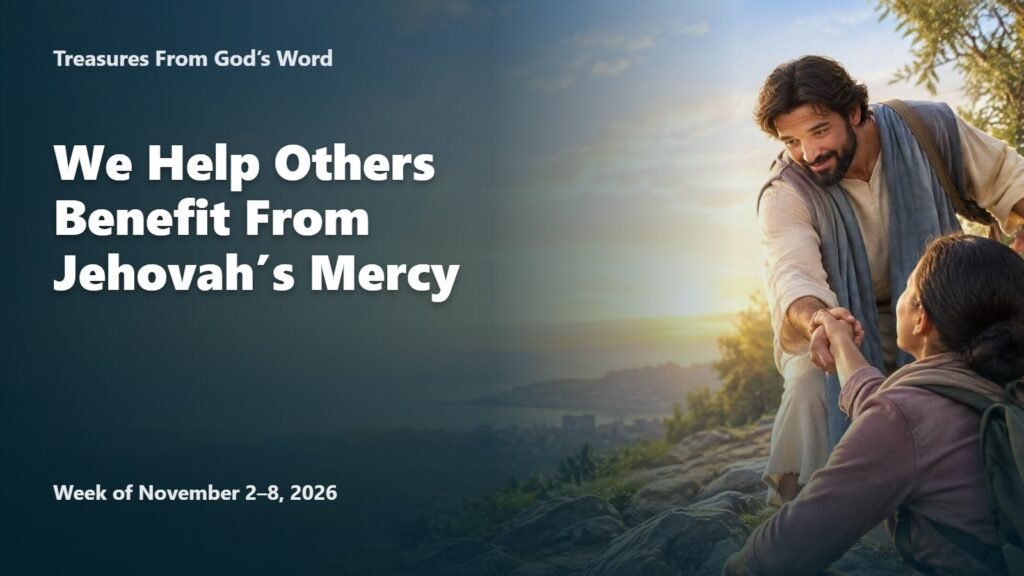
Theme: We Help Others Benefit From Jehovah’s Mercy
When someone has made serious mistakes, he may think that he no longer has the opportunity to draw close to God. Others, when they see so much wickedness, wonder why God does not put an end to it. Jeremiah 50 helps us understand how Jehovah responds to both situations. He does not overlook wickedness, but neither does he reject someone who repents. Understanding that balance moves us to help others benefit from his mercy.
First, let us consider Babylon. Its condemnation was not an arbitrary reaction on Jehovah’s part. That power had committed serious sins and had acted arrogantly against him. The prophecy clearly explains why it would have to give an account. Let us read Jeremiah 50:14, 29, and 31.
Jeremiah 50:14,29,31 — Come against Babylon in battle formation on every side, All you who are bending the bow. Shoot at her, spare no arrow, For it is against Jehovah that she has sinned. Summon archers against Babylon, All who are bending the bow. Camp all around her; let no one escape. Repay her according to her activity. Do to her just as she has done. For she has acted arrogantly against Jehovah, Against the Holy One of Israel. “Look! I am against you, O defiant one,” declares the Sovereign Lord, Jehovah of armies, “For your day must come, the time that I will call you to account.
Do we notice the reasons Jehovah gives? Babylon had sinned against him, had acted arrogantly, and was defiant. This was not an isolated mistake. Its conduct showed an attitude of defiance. Moreover, the punishment was related to what it itself had done. Jehovah knew its actions and would not allow it to continue causing harm indefinitely. Therefore, the sentence against Babylon was an expression of justice, not a lack of mercy.
This helps us when we speak with someone who finds it difficult to understand God’s judgments. We can listen to his concern and show him that Jehovah does not act out of prejudice or allow himself to be deceived by appearances. In Babylon’s case, he explained the reasons for its condemnation. His mercy does not mean indifference toward the suffering caused by wickedness. We can trust that his decisions are always just.
There is also a lesson for us. Instead of feeling superior to those who do not yet know Jehovah, we want to cultivate humility. Arrogance leads a person to reject divine guidance; humility allows him to accept it and change. And here an important question arises: What would happen to the Israelites who had also sinned but were willing to repent? The answer shows that Jehovah does not treat defiance and repentance alike.
The sins of Israel and Judah were real. However, Jehovah did not consider all his people to be beyond hope. He offered repentant Israelites something they deeply needed: his forgiveness. Let us listen to the promise recorded at Jeremiah 50:20.
Jeremiah 50:20 — “In those days and at that time,” declares Jehovah, “Israel’s guilt will be searched for, But there will be none, And the sins of Judah will not be found, For I will forgive those whom I let remain.”
The picture is very comforting. Guilt would be searched for, but it would not be found. Why? Not because those Israelites had never sinned, but because Jehovah would have forgiven them. His forgiveness would be complete. He would not offer them a partial reconciliation. What a contrast with the sentence against arrogant Babylon! The same God who judges justly is willing to show mercy to those who repent and want to return to him.
Imagine that someone with whom we study the Bible feels very ashamed of his past. Perhaps he thinks that his mistakes are too serious for him to draw close to Jehovah. We do not need to minimize what he did or assure him that he does not need to change. We can help him understand this promise: Jehovah knows how to forgive completely. Instead of focusing only on his past, let us help him see the steps he can take now to draw close to Jehovah.
Our way of treating him should agree with that message. If we speak about mercy but show coldness or impatience, it will be more difficult for him to perceive Jehovah’s affection. Listening respectfully and acknowledging his efforts can help him continue learning. It is not our place to decide that someone will never change. The promise of forgiveness encourages us to view people with hope. And that hope moves us to act in order to help them.
Jehovah’s mercy was not limited to a promise of forgiveness. His people also received instructions to leave Babylon. They needed to know God’s message and act on it. That connection between announcing the message and helping people get out appears at Jeremiah 50:2 and 8. Let us read it.
Jeremiah 50:2,8 — “Declare it among the nations and proclaim it. Raise a signal and proclaim it. Do not hide anything! Say, ‘Babylon has been captured. Bel has been put to shame. Merodach has become terrified. Her images have been put to shame. Her disgusting idols have become terrified.’ “Flee out of the midst of Babylon, Go out of the land of the Chaldeans, And be like the leading animals before the flock.
The message was not to be hidden. Babylon’s fall would demonstrate that its idols could not protect it, and God’s people were to get out of there. The captive Jews were not to allow themselves to be contaminated by the false religion of that place. In this way, they would be prepared to return and restore pure worship. After Babylon’s conquest, Cyrus allowed that return and the rebuilding of the temple. Jehovah opened the way for them, but they had to respond.
How do we imitate that mercy today? By preaching the good news and helping others get out of false religions. We do not want merely to point out what is wrong. We want people to know Jehovah, understand his will, and see that they can draw close to him. The warning about Babylon the Great is serious, but the way we deliver it should reflect sincere concern for those who have been deceived. Let us not confuse firmness with harshness.
For example, someone may be very attached to the religion in which he was raised. Perhaps his beliefs are connected with very dear family memories. Ridiculing them will not help him listen. It would be better to ask respectful questions, understand what he thinks, and reason with him from the Bible. We can patiently show him the difference between a religious teaching and what Jehovah teaches. Our goal is not to win an argument, but to help a person benefit from divine mercy.
We can also ask ourselves: Is there someone I could visit again or spend more time with in order to answer his questions? Perhaps he needs encouragement to continue studying or support while he makes changes. Mercy moves us to offer practical help, not just information. Remembering how Jehovah treats repentant ones will enable us to be patient, without losing sight of the importance of each person’s acting in harmony with what he learns.
Jehovah was just when he condemned Babylon and merciful when he completely forgave repentant Israelites. We reflect that mercy when we bring the good news to others and help them leave false religion. When preaching, we do not simply see someone with mistaken ideas. We see a person who needs to know Jehovah. May our words, patience, and help enable that person to understand how merciful he is.
Enjoy every Premium feature
More convenient meeting preparation with full access to the site’s tools.
- Ad-free browsing
- My Recorder and live transcription
- Assignment Review
- Full Academy access
- Audio posts and reading magnifier
- Saved and synced comments
Monthly plan
€3 per monthRenews monthly. Cancel at any time.
Choose monthlyAnnual plan
€30 per yearOne payment for 12 months. No automatic renewal.
Choose annual


