









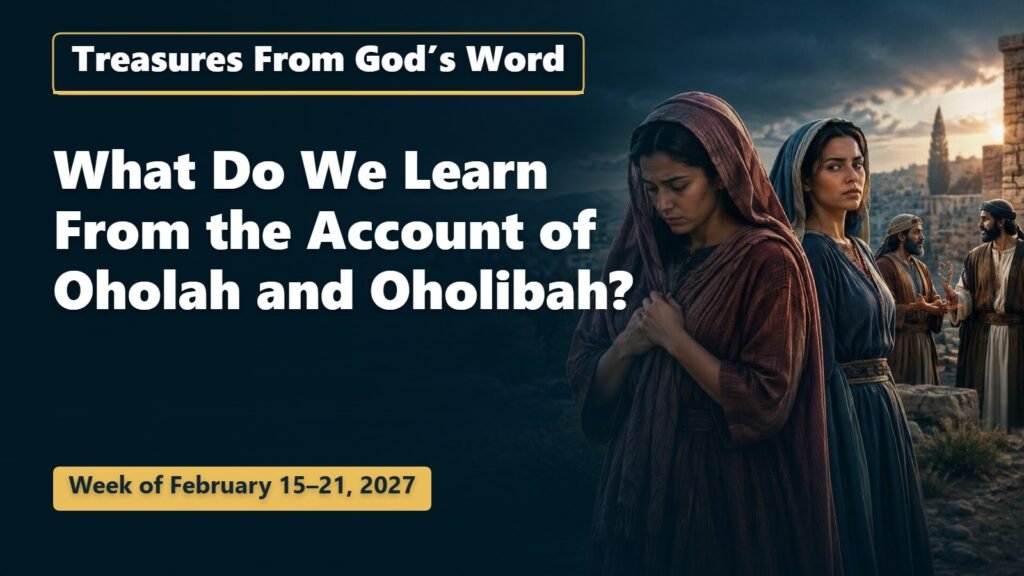
Theme: What Do We Learn From the Account of Oholah and Oholibah?
Faithfulness is one of the most precious gifts we can offer someone who loves us. And betrayal hurts precisely because there is a relationship that should have been protected. That thought helps us understand the account of Oholah and Oholibah. Although it contains strong expressions, it helps us get to know Jehovah’s feelings better and think about how we can show him that we value his love.
Jehovah used the account of two sisters to show how serious his people’s unfaithfulness was. He was not simply describing isolated mistakes, but the betrayal of those who had a special relationship with him. The sisters represent two cities and the kingdoms of which they were capitals. Let us see how Jehovah identifies them and what he says about their conduct. Let us read Ezekiel chapter 23, verses 4, 5, and 11.
Ezekiel 23:4-5,11 — Their names were Oholah, the older one, and her sister Oholibah. They became mine and gave birth to sons and daughters. As for their names, Oholah is Samaria, and Oholibah is Jerusalem. “Oholah began to prostitute herself while she belonged to me. She lusted after her passionate lovers, her neighbors the Assyrians. “When her sister Oholibah saw it, her lust became even more depraved, and her prostitution was worse than that of her sister.
Oholah represents Samaria, the capital of the ten-tribe kingdom of Israel. Oholibah represents Jerusalem, the capital of the kingdom of Judah. But there is an even more important detail than their names: Both belonged to Jehovah. The illustration presents them as his wives who later betrayed him. Therefore, their conduct was not simply a preference for other customs. It was serious unfaithfulness to the God with whom they were bound.
Verse 5 shows that Oholah directed her desires toward the Assyrians while she still belonged to Jehovah. That is the painful contrast: She had a relationship that she should have cared for, but she sought in others what drew her away from her God. Jehovah called that conduct prostitution. In this way, he made clear that worship cannot be separated from loyalty. It was not enough to belong to his people if the heart was turning away from him.
And what did Oholibah do? According to verse 11, she saw her sister’s conduct, but she did not benefit from that warning. She followed in her footsteps and became worse than she was. This invites us to ask ourselves how we respond to Jehovah’s warnings. When we see the consequences of turning away from him, do we take them seriously? Learning from the bad example of others can help us protect our friendship with Jehovah before causing him pain.
We do not read this account to feel superior to those Israelites, but to understand how much Jehovah values faithfulness. He is not indifferent to the decisions of his servants. His relationship with them is very precious to him. Now, once we understand what these sisters represent, an important question arises: Should we go a step further and say that they also represent certain religious organizations of our day?
In the past, our publications explained that the two sisters were prophetic models of the two main divisions of Christendom: the Catholic and Protestant religions. However, after much prayer and deeper study, it was recognized that this explanation did not fit fundamental details of the account. Recall verse 4: The sisters had belonged to Jehovah. Could the same be said of Christendom? That question is decisive to understanding the matter.
Christendom was never Jehovah’s wife nor was it in a covenant with him. It did not even exist when Jesus served as Mediator of the new covenant with spiritual Israel. Nor did it become part of that spiritual nation of anointed Christians. It arose in the fourth century, long after the death of the apostles, as an apostate and corrupt organization. Thus, an essential element is missing for establishing that prophetic correspondence.
There is another important difference. Jehovah gave the unfaithful cities of Samaria and Jerusalem the hope of forgiveness. Although in chapter 23 that hope is less clear than in chapter 16, in both cases he promised to bring an end to the prostitution of his people. The Bible does not offer Christendom a similar hope. The same end awaits it as awaits the rest of Babylon the Great, the world empire of false religion.
So we do not identify Oholah and Oholibah with Christendom. This clarification helps us distinguish between what the account represents and the lessons we can draw from it. We do not need to turn every detail into a prediction about our day in order to benefit from the Bible. And here we arrive at a lesson of tremendous value: The account reveals how Jehovah feels when someone brings reproach on his name and lowers his standards.
The conduct described in verses 5 and 11 allows us to see that unfaithfulness is not a matter of indifference to Jehovah. It pains him when those who should honor him act against him. Therefore, although the sisters are not prophetic models of Christendom, the account does help us understand how he feels about those who claim to represent him but tell lies about him or do not respect his standards of pure worship.
The religions of Christendom claim to represent the God of the Bible and to have Jesus Christ as their leader. However, they contradict those claims by presenting Jesus as part of a trinity and by failing to remain separate from the world. Their idolatry and participation in politics dishonor Jehovah. The lesson is not simply that bearing a religious name is insufficient, but that worship must agree with what God teaches.
But we do not want to limit ourselves to observing the mistakes of others. True Christians take these warnings seriously and apply them personally. We would never want to hurt Jehovah as Judah and Jerusalem did. Therefore, we avoid idolatry in all its forms, including greed and materialism. Something material does not have to become a religious image in order to occupy in our heart a place that should belong to Jehovah.
For example, when thinking about making a purchase or devoting more time to making money, we can examine our motives. Is it a matter of caring for a need, or is a desire to have more and more growing within us? What effect will that decision have on our worship? We do not judge the circumstances of others. Each one of us can honestly review our own priorities and make adjustments that show how much we value our friendship with Jehovah.
In addition, we want to cultivate gratitude. Thanks to his mercy, Jehovah has restored pure worship in these last days, and he will not allow it to become contaminated again. His lasting covenant with spiritual Israel will not be broken because of unfaithfulness. That guarantee does not invite us to let down our guard, but to value our privilege. Belonging to a clean people is a gift that we care for when we reject what Jehovah rejects and respect his standards.
Let us think, then, about this reflection: If Jehovah felt so hurt when the Israelites were unfaithful to him, how will he feel when we decide to remain faithful to him? This question gives a very personal meaning to our decisions. When we reject a practice he disapproves of or correct a wrong priority, we are not simply obeying a standard. We are showing love for someone who loves us and whose feelings truly matter to us each day.
The account of Oholah and Oholibah reminds us that our faithfulness matters deeply to Jehovah. We do not need to look for prophetic correspondences that the Bible does not establish in order to learn from it. We want to know his feelings, respect his standards, and care for our relationship with him. May we always value the privilege of belonging to his clean people and, by our decisions, give him reasons to be happy.
More posts for this week




Enjoy every Premium feature
More convenient meeting preparation with full access to the site’s tools.
- Ad-free browsing
- My Recorder and live transcription
- Assignment Review
- Full Academy access
- Audio posts and reading magnifier
- Saved and synced comments
- Support the project and help keep it running
Monthly plan
€3 per monthRenews monthly. Cancel at any time.
Choose monthlyAnnual plan
€30 per yearOne payment for 12 months. No automatic renewal.
Choose annual


