










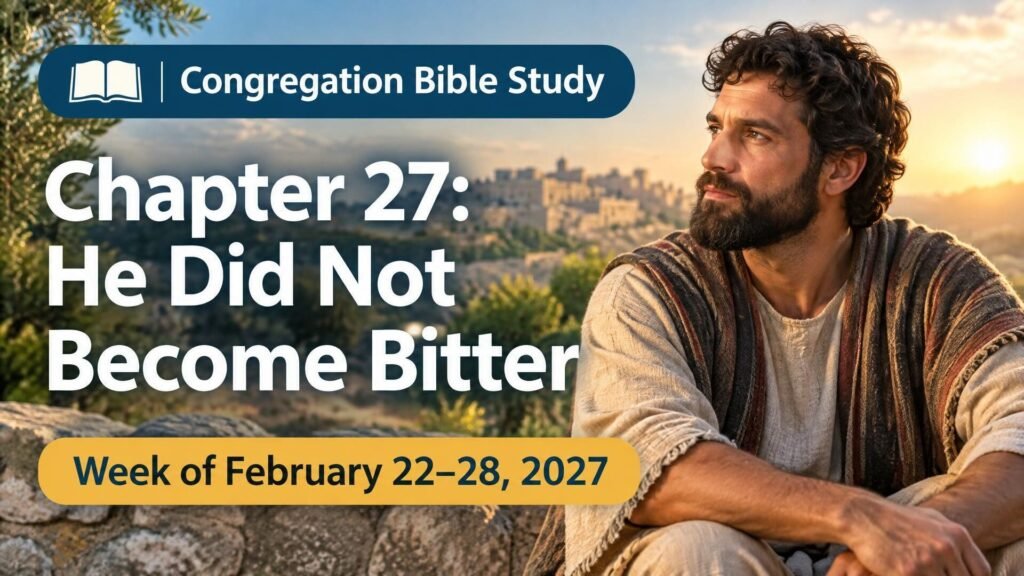
Chapter 27: He Did Not Become Bitter
In what ways did Mephibosheth show courage?
Comment 1: Mephibosheth showed courage when he went to David despite being afraid. He knew that his grandfather Saul had persecuted the king, and the chapter explains that he may have thought David wanted to kill him. Even so, he obeyed and went to see him. This helps us understand that being courageous does not mean feeling no fear. Sometimes it means taking the right step even while we are still afraid, without allowing fear to make our decisions.
Comment 2: He also needed courage to appear before David after Ziba slandered him. The king was offended with him, but Mephibosheth did not allow that situation to prevent him from explaining the truth. He did so humbly, mentioning his physical limitation and explaining his servant’s deception. His example shows that seeking peace does not mean always remaining silent. We can clarify an unjust accusation respectfully, without attacking the other person or retaliating.
Comment 3: Perhaps his greatest display of courage was refusing to be dominated by resentment. David decided that he should share his land with the very man who had betrayed him. Mephibosheth had reasons to feel hurt, but he gave greater importance to the king’s returning in peace than to recovering his inheritance. He did not allow an injustice to affect his relationship with God. This self-control shows that courage is expressed not only by confronting an enemy but also by resisting bitterness.
1. Before going to David, Mephibosheth lived “in the house of Machir.” What other detail indicates that Machir was loyal and hospitable? (2 Sam. 9:3, 4; it “Machir” No. 2).
2 Samuel 17:27-29 — As soon as David came to Mahanaim, Shobi the son of Nahash from Rabbah of the Ammonites, Machir the son of Ammiel from Lo-debar, and Barzillai the Gileadite from Rogelim brought beds, basins, clay pots, wheat, barley, fl our, roasted grain, broad beans, lentils, parched grain, honey, butter, sheep, and cheese. They brought all of this out for David and the people with him to eat, for they said: “The people are hungry and tired and thirsty in the wilderness.”
Comment 1: Later, during Absalom’s rebellion, Machir was among those who brought food and provisions to David and his companions. So his hospitality was not limited to receiving Mephibosheth in his home. He also helped the king when he was fleeing and needed support. It is significant that his loyalty was shown precisely at a difficult time. He did not merely express sympathy for David but cooperated in caring for his real needs and those of his companions.
Comment 2: Machir and the other men gave very practical help. They brought food, but also beds and various containers. They realized that those people were tired, hungry, and thirsty. This teaches me that hospitality begins with noticing what someone needs, not merely offering what is convenient for us. We can imitate that attitude by observing carefully and thinking about what specific help would ease a brother’s situation.
Comment 3: There is a beautiful detail when we compare the two occasions on which Machir appears. First, he welcomed Jonathan’s son, who had a serious physical limitation. Later, he helped David and a group of people who were going through a crisis. The circumstances were different, but in both cases there were needs to care for. His example encourages us not to reserve our generosity for only one person or situation but to be ready to help when new opportunities arise.
Comment 4: Machir did not act alone when he brought provisions to David. The account mentions him together with other men who also helped. This reminds us that we do not have to meet all of someone’s needs by ourselves in order to be hospitable. We can combine our efforts with those of others. What matters is that our concern results in some useful help.
2. Why did Mephibosheth compare himself to “a dead dog”? (2 Sam. 9:8; it “Dog” par. 5). A
2 Samuel 9:8 — At that he prostrated himself and said: “What is your servant, that you have turned your attention to a dead dog like me?”
Comment 1: By using that comparison, Mephibosheth expressed that he considered himself very insignificant before David. Insight explains that the expression represented the lowest possible condition. He was not demanding special treatment because he was Saul’s grandson. On the contrary, he was surprised that the king would take notice of him and want to treat him so kindly. His response reflects the humility and gratitude he felt on receiving generosity that, according to the chapter, he considered undeserved.
Comment 2: The chapter’s illustration helps us understand the force of the comparison. To the Israelites, dogs were unclean animals that fed on refuse. Thus, Mephibosheth was not using the affectionate image that many people today have of a pet. He was describing himself as someone of very little importance. Understanding that background helps us appreciate how astonished he was at David’s kindness and prevents us from interpreting his words according to present-day customs.
Comment 3: It is also useful to distinguish between how Mephibosheth viewed himself and how David treated him. Although he felt insignificant, the king returned his grandfather’s lands to him and gave him a permanent place at his table. His feelings did not determine the value of the treatment he received. For someone who feels worthless, this contrast can be encouraging: feeling insignificant does not mean that one cannot be loved, respected, and treated with dignity.
3. Why did the idea of taking the throne not fit Mephibosheth at all? (w02 2/15 p. 14 par. 11, footnote). B
2 Samuel 16:1-4 — When David had passed a little beyond the summit, Ziba, the attendant of Mephibosheth, was there to meet him with a couple of saddled donkeys, and on them were 200 loaves of bread, 100 cakes of raisins, 100 cakes of summer fruit, and a large jar of wine. Then the king said to Ziba: “Why have you brought these things?” Ziba replied: “The donkeys are for the household of the king to ride, the bread and the summer fruit are for the young men to eat, and the wine is for those who get exhausted in the wilderness to drink.” The king now said: “And where is the son of your master?” At this Ziba said to the king: “He is staying in Jerusalem, for he said, ‘Today the house of Israel will give back the royal rule of my father to me.’” The king then said to Ziba: “Look! Everything that belongs to Mephibosheth is yours.” Ziba replied: “I bow down before you. May I find favor in your eyes, my lord the king.”
Comment 1: The accusation that Mephibosheth wanted the kingdom came from Ziba, not from a verified statement by Mephibosheth. The material explains that it was slander. Moreover, his conduct while David was absent showed the opposite: he was mourning over what had happened to the king. He had not remained in Jerusalem to take advantage of the rebellion; his servant had deceived him. Therefore, we should not confuse what Ziba claimed with what Mephibosheth actually wanted.
Comment 2: Mephibosheth’s reaction when David returned does not fit someone who coveted his throne. He gave greater importance to the king’s returning in peace than to recovering all his land. He was willing to give up his inheritance, whereas Ziba had benefited from a lie. This contrast helps us see Mephibosheth’s true priorities. What mattered to him was the welfare of the king who represented God’s rulership, not gaining a position for himself.
Comment 3: The chapter also mentions the possibility that Jonathan had explained to his son whom Jehovah had chosen as king. We cannot state that as a fact, but we do know from the account that Mephibosheth respected David. Furthermore, when he received his kindness, he responded with humility and gratitude, not by demanding rights because he belonged to Saul’s family. All of this is consistent with a loyal and peaceable man, not with the picture of a throne claimant presented by Ziba.
4. How did Jehovah bless Mephibosheth after what happened in this account? (it “Mephibosheth” No. 2 par. 3).
2 Samuel 21:7-8 — However, the king showed compassion for Mephibosheth, the son of Jonathan the son of Saul, because of the oath made before Jehovah between David and Jonathan, the son of Saul. So the king took Armoni and Mephibosheth, the two sons of Rizpah the daughter of Aiah whom she bore to Saul, and the five sons of Michal the daughter of Saul whom she bore to Adriel the son of Barzillai the Meholathite.
Comment 1: Mephibosheth remained alive when the Gibeonites requested that descendants of Saul be put to death because of what Saul had done against them. David showed compassion for Jonathan’s son and spared him because of the oath he had made with his father before Jehovah. That was a very concrete blessing. The text also mentions another man named Mephibosheth, who was the son of Saul and Rizpah; we should not confuse him with Jonathan’s son, the one discussed in the chapter.
Comment 2: The information also highlights that Saul’s family continued through Micah, Mephibosheth’s son. Thus, when we look at his complete history, we see more than losses and injustices. We also see that he had a son and that his family continued. This helps us not to reduce his life to the harm caused by Ziba. That experience was painful, but it was not the only important thing that happened to him or the only thing the Scriptures preserved about him.
Comment 3: I find it striking that the promise between David and Jonathan continued to benefit Mephibosheth long afterward. At first it was connected with the kindness David showed him, and later it was the reason David spared his life. Although David made the mistake of believing Ziba, that mistake was not his final treatment of Mephibosheth. This highlights the importance of keeping our commitments and continuing to show loyal love as time passes.
Many suffer from depression or go through situations that other brothers may not fully understand. What encouraging thoughts can they learn from Mephibosheth’s story?
Comment 1: Those who suffer from depression or face situations that others may not fully understand can be encouraged by remembering that Mephibosheth’s limitations did not prevent him from showing very valuable qualities. He could not accompany David as he would have liked, but that did not mean that he lacked loyalty. Sometimes what a person is able to do does not reflect everything he wants to do or all that he is enduring. This account helps us not to measure a brother’s value only by what we see, and it can comfort those who feel that others do not understand their limitations.
Comment 2: Mephibosheth suffered deeply because of what was happening to David. The account does not present someone who never felt pain, but someone who maintained his loyalty amid suffering. Therefore, we should not use his example to make a depressed person feel guilty, as if simply deciding to be happy were enough. The encouraging lesson is that suffering does not equal disloyalty. One can go through a very painful situation and still sincerely love Jehovah.
Comment 3: It is also encouraging to think that Mephibosheth received help. Machir welcomed him, and later David provided for him. He did not have to face his entire life without support. His story can help us gratefully accept the kindness others offer, without thinking that needing help makes us less valuable. And if we are beside someone who is suffering, we can imitate Machir’s hospitality. We may not fully understand what the person feels, but we can show interest and offer practical help.
David took Mephibosheth’s lands after hearing only one side of the matter. What does this teach us about the importance of not being hasty and of having all the facts? C
Comment 1: David was going through a very painful situation: his son and a trusted adviser had betrayed him. This helps us understand why Ziba’s accusation may have seemed credible to him, but it did not make it true. For me, the lesson is that our recent experiences can influence how we interpret what we hear. If someone has disappointed us, we must be careful not to suspect another person without evidence. Before deciding, we need to listen and verify the facts, especially if our decision could harm someone.
Deuteronomy 19:18-19 — The judges will thoroughly investigate, and if the man who testified is a false witness and has brought a false charge against his brother, you should do to him just as he had schemed to do to his brother, and you must remove what is bad from your midst.
Comment 2: The Law required judges to investigate an accusation thoroughly. This shows that, for Jehovah, it was not enough for one version to seem convincing. The facts had to be established, and the harm caused by false testimony had to be taken very seriously. Although we are not judges in Israel, we can apply the principle: do not accept an accusation as true simply because someone states it confidently. Listening to the person affected and examining the facts is a way to treat that person justly.
Comment 3: The illustration of the young man who arrives just as the meeting begins shows how easy it is to misinterpret a scene. Someone who sees only his arrival does not know that he helped an older sister, was engaging in the ministry, and had car trouble. The explanation completely changes the initial impression. This teaches me to distinguish between what I have seen and what I am assuming. A kind question and a calm conversation can prevent an unjust judgment about a brother’s priorities.
In what ways can you imitate Mephibosheth’s courageous example?
Comment 1: I can imitate him when I need to clear up a misunderstanding. I may be afraid to speak because the other person already seems upset with me, but Mephibosheth appeared before David and respectfully explained what had happened. His example encourages me not to respond with attacks or let fear prevent me from having a conversation. I can prepare carefully what I will say, focus on the facts, and seek a peaceful explanation without turning the conversation into a struggle to prove who is right.
Comment 2: Another way is to examine what takes up the most space in my thoughts when I feel wronged. Mephibosheth did not make his lands the most important thing; he valued the fact that David had returned in peace. This does not mean that the injustice was acceptable or that it did not hurt. But it does teach me to ask whether I am allowing a loss or an offense to displace more important things, such as my peace and my relationship with Jehovah. It takes courage not to keep feeding resentment.
Comment 3: I can imitate him by remembering that another person’s mistake does not have to determine my relationship with Jehovah. David treated Mephibosheth unjustly, but he did not stop being loyal to God. If a brother disappoints me, I want to distinguish between his conduct and Jehovah’s qualities. This will help me deal with the problem without extending my disappointment to the entire congregation. Mephibosheth’s example encourages me to protect what matters most, even when I cannot make everything turn out as I hoped.
What does this account teach me about Jehovah?
1 Samuel 20:14-17 — And will you not show me the loyal love of Jehovah while I am alive and even when I die? Never withdraw your loyal love from my household, even when Jehovah wipes out all the enemies of David from the face of the earth.” So Jonathan made a covenant with the house of David, saying, “Jehovah will require it and call David’s enemies to account.” So Jonathan had David swear again by his love for him, for he loved him as he loved himself.
Comment 1: It teaches me the importance of loyal love. Jonathan wanted David to continue showing that love to his family, even after his death. Later, David looked for someone from Saul’s household to whom he could show that kindness, and Mephibosheth received help. It is beautiful to see that loyal love is not limited to a momentary feeling. It moves us to remember our commitments and act in behalf of others even after years have passed and circumstances have changed.
Comment 2: I also learn that Jehovah places great importance on justice. The law cited in the chapter required accusations to be investigated and false testimony to be dealt with. Therefore, what Mephibosheth suffered did not reflect the just way Jehovah wanted such matters to be handled. This distinction is essential: David’s mistake does not change God’s standards. If we want to reflect his qualities, we must listen carefully and protect others from the harm caused by unverified accusations.
Comment 3: I find it noteworthy that David wanted to show God’s loyal love to someone from Saul’s household. The person who received that kindness was a man with physical limitations who considered himself insignificant. This helps me appreciate that showing Jehovah’s qualities includes treating with dignity those who may feel unimportant. It is not enough to admire loyal love in theory. We can reflect it by approaching someone who needs support and making that person feel, through our actions, that we truly care.
How does this account relate to Jehovah’s purpose and the Bible’s main theme?
Comment 1: The chapter points out that David represented God’s righteous rulership. Therefore, Mephibosheth’s loyalty was not simply affection for someone who had helped him. He cared about the king who occupied that position. This connects the account with Jehovah’s rulership, a central theme of the Bible. Mephibosheth showed that he valued that rulership more than his own material interests, since the king’s returning in peace mattered more to him than keeping all his land.
Comment 2: The account allows us to distinguish between God’s righteous rulership and the mistakes of the humans who represented it. David made a wrong decision, whereas Jehovah’s Law required accusations to be thoroughly investigated. Mephibosheth did not allow that difference to destroy his relationship with God. For us, the lesson is to value Jehovah’s rulership for its righteous principles and not attribute imperfect humans’ failures to it. This distinction helps us maintain our trust when we suffer disappointment.
Comment 3: The chapter’s final question invites us to think about talking with Mephibosheth when he is resurrected. This connects his story with the hope of the resurrection. When we read about his losses and the injustices he suffered, it is encouraging not to think only about the painful parts of his life. We can also look toward the future that this hope holds out.
What would I like to ask Mephibosheth when he is resurrected?
Comment 1: I would like to ask him what helped him not to hold resentment after David decided that he should share the land with Ziba. The account tells us what he answered, but not all the thoughts that led him to respond that way. It would be nice to hear from him how he managed to give priority to peace and loyalty. In the meantime, that question invites me to examine what I am doing so that an offense does not become the center of my life.
Comment 2: I would ask him what memories he had of his father, Jonathan, and whether he remembered any teaching from him about Jehovah. The chapter says that Jonathan may have explained to him whom God had chosen as king, but it does not present this as certain. I would like to hear those details from Mephibosheth himself. Thinking about that conversation also reminds me how valuable the moments can be when parents take time to talk to their young children about Jehovah.
Comment 3: I would ask him what Machir’s hospitality meant to him during that stage of his life. Sometimes we focus on the injustice he suffered and overlook the help he received. I would like to hear what he remembers about that household and those who cared for him. This question makes me think that an act of kindness can have great value for someone who is facing difficulties.
More posts for this week



Enjoy every Premium feature
More convenient meeting preparation with full access to the site’s tools.
- Ad-free browsing
- My Recorder and live transcription
- Assignment Review
- Full Academy access
- Audio posts and reading magnifier
- Saved and synced comments
- Support the project and help keep it running
Monthly plan
€3 per monthRenews monthly. Cancel at any time.
Choose monthlyAnnual plan
€30 per yearOne payment for 12 months. No automatic renewal.
Choose annual


