










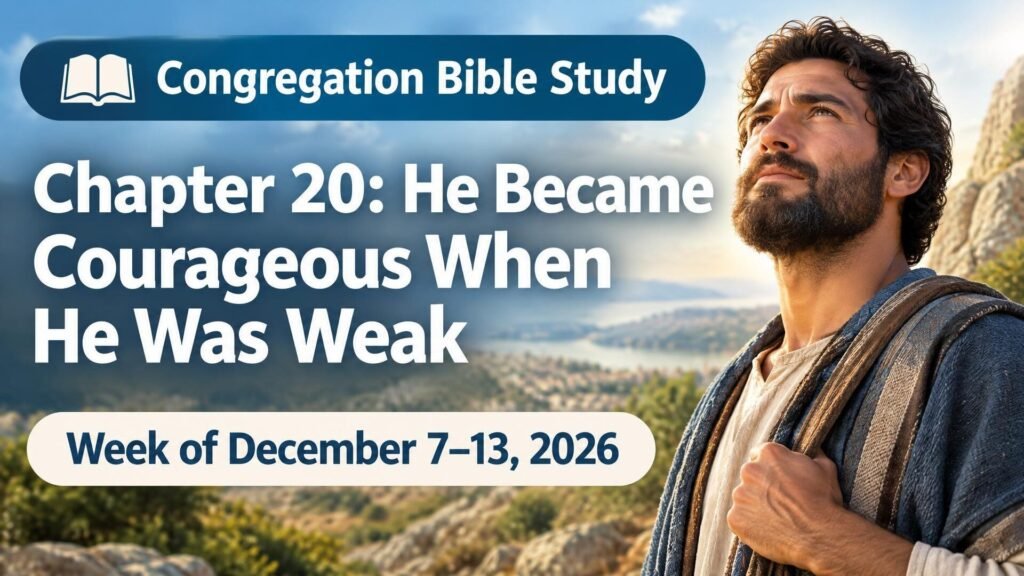
Chapter 20: He Became Courageous When He Was Weak
In what ways did Samson show courage?
Comment 1: Samson showed courage by confronting the Philistines who oppressed Israel. Unlike other judges, he did not lead an army; Jehovah used him to fight many enemies by himself. For example, when his own people handed him over bound, he broke the ropes and defeated 1,000 Philistines with a donkey’s jawbone. His courage cannot be explained simply by his physical strength. What made those victories possible was the power he received from Jehovah.
Comment 2: He was also courageous when his enemies set an ambush for him in Gaza. They wanted to kill him at daybreak, but he got up at midnight, pulled out the city gates with their posts and bar, and carried them to a mountain near Hebron. This was not merely a matter of escaping from a dangerous situation. That feat once again showed that the Philistines could not stop him as long as he had Jehovah’s backing. His security depended on that backing, not on the number of enemies.
Comment 3: What especially stands out to me is the courage he showed at the end. He had lost his sight and his freedom, and he knew that his own mistake had contributed to that situation. Even so, he did not give up seeking Jehovah. Repentant, he asked for strength and took advantage of his last opportunity to fight God’s enemies. His example reminds us that courage is also shown after a fall—by acknowledging what happened and taking whatever steps we still can to do what is right.
1. How could Samson touch dead bodies and still remain a Nazirite? (w05 1/15 30, 31)
Judges 13:5 — Look! You will conceive and give birth to a son, and no razor should touch his head, because the child will be a Nazirite of God from birth, and he will take the lead in saving Israel out of the hand of the Philistines.”
Comment 1: Judges 13:5 shows the fundamental difference: Jehovah chose Samson to be a Nazirite from birth. Samson did not voluntarily make a vow for a certain period. His service as a Nazirite would last his entire life and was connected with a specific assignment: to take the lead in saving Israel from the Philistines. So we should not assume that all the restrictions applying to a voluntary Nazirite applied to him in the same way. The prohibition against touching dead bodies did not apply to him.
Comment 2: An important difference involved what happened if a voluntary Nazirite became defiled by a dead body. According to Numbers 6, he had to purify himself and start his Naziriteship period over; the previous days no longer counted. But Samson had been a Nazirite from birth. He could not restart a service that covered his entire life from birth. As the reference explains, this helps us understand that the requirements for his Naziriteship differed from those for voluntary Naziriteship.
Comment 3: The comparison with Samuel and John the Baptist also clarifies the matter. In Samson’s case, it was specified that his hair should not be cut. Hannah promised that Samuel’s hair would not be cut either, and regarding John it was stated that he would drink no wine or other alcoholic beverages. However, none of these three lifelong Nazirites was forbidden to approach a dead person. Thus, we should focus on the instructions given for each one without adding requirements that are not mentioned.
Comment 4: The assignment Jehovah gave Samson also helps us answer the question. He was one of the judges God used to deliver Israel from its plunderers. When fighting the Philistines, he came into contact with dead bodies, such as when he killed 30 men and took their clothing. The account does not present that contact as a violation of his Naziriteship. Rather, it shows that he was carrying out the work for which Jehovah had chosen him.
Comment 5: Another proof is that Jehovah continued giving him His spirit to perform those feats. Judges 14:19 expressly connects Samson’s action against 30 Philistines with the power he received from God. Therefore, we are not merely assuming that Jehovah approved his conduct. The account identifies the source of his strength. This confirms that contact with dead bodies during those actions did not disqualify him as a Nazirite or prevent Jehovah from using him to fulfill the assignment entrusted to him.
Comment 6: In addition, Hebrews 11 includes Samson among the men of faith. That later evaluation agrees with what the accounts of his victories show: he had Jehovah’s favor while carrying out his assignment. This teaches us not to judge his case by automatically applying to him the conditions of another type of Naziriteship.
2. What indicates that Samson needed God’s holy spirit to carry the gates and their posts from Gaza to Hebron? (w04 10/15 15 pars. 7, 8)
Judges 16:3 — However, Samson kept lying there until midnight. Then he got up at midnight and grabbed the doors of the city gate and the two side posts and pulled them out along with the bar. He put them on his shoulders and carried them up to the top of the mountain that faces Hebron.
Comment 1: The account shows that Samson did not carry only some door panels. He also pulled out the two side posts and the bar and put everything on his shoulders. Gaza was a fortified city, so those pieces must have been large and heavy. Their exact weight is not given, so we do not need to calculate it. What is clear is that pulling out and carrying that entire structure required extraordinary strength, which Samson received from Jehovah.
Comment 2: The distance makes the feat even more impressive. The chapter indicates that Samson carried the gates about 60 kilometers. He did not merely lift them, move them a few steps, and drop them. He carried them to the top of a mountain near Hebron. Although the reference clarifies that we do not know the mountain’s exact location, the journey described helps us appreciate the magnitude of what he did. Normal physical ability cannot explain such a feat.
Comment 3: Besides the distance, we must consider the change in elevation. Gaza is near sea level, whereas Hebron is about 900 meters above sea level. So Samson did not simply travel along a level road with a heavy load; he had to climb. Imagining that ascent helps us read the account more attentively. The geographic details reinforce the same conclusion: that strength was not a quality Samson possessed independently of God but extraordinary help from Jehovah.
Comment 4: We do not reach this conclusion merely because the gates were heavy or the journey was long. In other feats of Samson, the Bible expressly says that Jehovah’s spirit empowered him. That happened when he tore the lion in two and when he broke his bonds upon meeting the Philistines. Those accounts explain the source of his extraordinary strength. Reading what happened in Gaza in that context, we understand that he depended on the holy spirit, not simply on his muscles.
Comment 5: The application for us is not that we should expect muscular strength like Samson’s. The reference explains that the holy spirit can strengthen us inwardly and help us understand spiritual matters. Ephesians 3:16 specifically highlights that inner strength. Thus, when an assignment or trial seems beyond our strength, we can ask Jehovah for help. The account gives us confidence in the power of his spirit, even though today that help is not manifested through extraordinary physical feats.
3. What indicates that Delilah may have been an Israelite? (w05 3/15 28 par. 3)
Comment 1: The clue lies in the way the Philistine rulers tried to obtain Delilah’s cooperation. They did not appeal to loyalty to the Philistine people but to her greed, offering her a large amount of silver. The reference explains that this seems to indicate that she may have been an Israelite. If she had been a Philistine, they could have appealed to her national loyalty. Even so, this is an indication, not definite proof of her origin.
Exodus 21:32 — If the bull gored a slave man or a slave girl, he will give the price of 30 shekels to that one’s master, and the bull will be stoned to death.
Comment 2: Exodus 21:32 mentions compensation of 30 shekels for a slave killed by a bull. That amount helps put Delilah’s bribe in perspective: if the 5,500 pieces of silver were shekels, it was an enormous sum. The comparison does not prove that she was an Israelite, but it does highlight the means the rulers chose to persuade her. They sought to buy her cooperation with money rather than ask her to act out of loyalty to the Philistine people.
Comment 3: It is wise to distinguish what is possible from what is certain. Delilah may have been an Israelite, based on the type of proposal made to her. What is certain is that she accepted the bribe and betrayed Samson. The chapter focuses attention on her disloyalty, not on establishing her nationality. Therefore, when answering, it is best to retain the reference’s caution and say that she may have been an Israelite. We do not need to turn a possibility into a fact to understand the seriousness of what she did.
4. Why did Samson want to take revenge for just one of his eyes? (Judg. 16:28; it “Samson” par. 10)
Judges 16:28 — Samson now called out to Jehovah: “Sovereign Lord Jehovah, remember me, please, and strengthen me, please, just this once, O God, and let me take revenge on the Philistines for one of my two eyes.”
Comment 1: One possible explanation is that Samson recognized his share of responsibility for what happened. He had revealed the secret connected with his Naziriteship, and that serious mistake contributed to his being captured and blinded. The reference indicates that this could explain why he asked to take revenge for only one of his eyes. The prayer does not directly explain that detail, so we cannot state it with certainty. But this possibility fits with what the chapter says about his repentance.
Comment 2: The other possibility presented by Insight is that Samson understood that, as Jehovah’s representative, he could not be avenged completely. This detail places his request in a broader context than the personal harm he had suffered. The Philistines were attributing his capture to Dagon and celebrating the victory of their god. Therefore, when explaining the question, it is appropriate to mention both possibilities offered by the reference without choosing one as though we knew with certainty what Samson had in mind.
Comment 3: Although we do not know for certain why he mentioned one eye, his prayer clearly shows his dependence on Jehovah. Samson did not take it for granted that he could bring down the temple simply because his hair had grown back. He begged God to restore his strength. To me, that is an important detail: he recognized who could help him. When studying an expression whose reason is not fully explained, we can remain cautious while learning from what the account clearly shows.
Delilah kept pressuring Samson to reveal confidential information, and he gave in. What does this teach elders and their wives?
Comment 1: The elders are reminded that someone’s insistence, even someone close to them, does not change the confidential nature of information. Samson eventually revealed his secret because Delilah kept pressuring him until he became weary. An elder needs to maintain discretion even in a relaxed setting, such as a conversation at home. He can treat his wife with affection and trust without telling her matters he must keep confidential. Protecting that information is a way of caring for those who have approached the elders for help.
Comment 2: A wife can strongly support her husband by respecting that there are congregation matters he should not tell her. She does not need to know the details in order to show appreciation for the time and effort he devotes to caring for the brothers. Rather than insist, she can help him maintain confidentiality. In this way, discretion is not viewed as a lack of trust within the marriage. Both can view it as part of the respect and love they have for the brothers.
Comment 3: The account also shows the danger of letting down our guard because of weariness. Samson did not give in immediately, but continued pressure eventually overcame his resistance. This teaches us that it is not enough to be discreet once; we must continue to be discreet when the conversation is repeated or when we are exhausted. The elder can kindly explain that he cannot discuss the matter, and his wife can accept that limit without continuing to ask questions. Such cooperation protects both confidentiality and marital peace.
Samson made a serious mistake, but afterward Jehovah used him in an amazing way. If we make a mistake, how can Samson’s example help us not to give up?
Comment 1: Samson’s example teaches me that a serious mistake does not have to become the end of our service to Jehovah. He was very repentant and again sought God’s help. He could not undo what had happened, but he could still take an opportunity to do what was right. If we fail, neither should we conclude that it is no longer worthwhile to keep trying. What matters is to acknowledge the mistake, truly repent, and act properly with the opportunities still ahead.
Comment 2: It helps me distinguish between suffering the consequences of a mistake and thinking that Jehovah can no longer help us. Samson was still blind and imprisoned when he prayed; his repentance had not erased those consequences. Nevertheless, Jehovah heard his request and again gave him strength. This does not mean that all our problems will disappear if we repent. It means that even while facing the consequences of what we have done, we can seek Jehovah’s help and work to restore a good relationship with him.
Comment 3: I am also encouraged that centuries later Paul included Samson among the men of faith. The Bible does not hide his serious mistake, but neither does it present that mistake as the only thing that defined his life. Jehovah took his faith into account. This helps us avoid becoming trapped in thoughts about our failures alone. Without minimizing them, we can remember that repentance and faith are valuable to Jehovah. The answer is not to give up but to keep striving to do what pleases him.
In what ways can you imitate Samson’s courageous example?
Comment 1: I can imitate him by recognizing that I need Jehovah’s strength instead of relying only on my own ability. Samson performed his feats through the holy spirit. I do not expect extraordinary physical strength, but I can ask for help to remain faithful when I am afraid or feel overwhelmed. For example, before facing a difficult situation, I can pray and remember what Jehovah expects of me. Being courageous does not mean thinking that I can handle everything; it means relying on the One who can strengthen me.
Comment 2: I can imitate his courage by not letting the fear of others decide how I will act. Samson’s own people handed him over to the Philistines because they were afraid of them, but he continued carrying out his assignment with Jehovah’s help. We do not imitate his acts of war. What we imitate is his trust in God. When obeying Jehovah is difficult or we do not have the support we expected, we can continue doing what is right without depending on everyone around us to be courageous.
Comment 3: Another way is to have the courage to acknowledge a mistake and correct our course. At times, admitting that we have failed may be harder than facing an external difficulty. Samson could not change his past, but he sought Jehovah and took advantage of the opportunity still available to him. I can do the same: stop justifying a failure and focus on what I must do now. This kind of courage may not attract as much attention as a physical feat, but it is very important for continuing to serve Jehovah.
What does this account teach me about Jehovah?
Comment 1: It teaches me that Jehovah does not need great human resources to accomplish what he purposes. Other judges led armies, but he used Samson to defeat many Philistines by himself. The difference was not the number of combatants but God’s power. This helps me not to measure my prospects of receiving help only by what I see. My strength is limited, but Jehovah can give me the strength I need to do his will.
Comment 2: The account teaches me that we cannot take Jehovah’s backing for granted. For years, Samson had performed impressive feats. However, when he revealed his secret and his hair was cut, he lost his strength because Jehovah had left him. His previous victories did not make him immune to the consequences of a bad decision. For me, the lesson is to care for my relationship with Jehovah every day. What I did in the past does not replace the need to keep obeying him now.
Comment 3: I also see Jehovah’s mercy. He did not overlook Samson’s mistake, but he responded to his plea when he was repentant. I am moved that the man who had ended up so weak and humiliated could again become useful in Jehovah’s hands. This helps me view Jehovah as someone to approach when I have failed, not someone from whom I should withdraw. His mercy does not make sin less serious, but it gives us reason to repent and return to him.
How does this account relate to Jehovah’s purpose and the Bible’s main theme?
Comment 1: The account highlights the difference between Jehovah and false gods. The Philistines attributed Samson’s capture to Dagon and organized a celebration in his honor. But it was Jehovah who restored Samson’s strength, and that temple eventually collapsed. So this was not merely a confrontation between Samson and his enemies. The issue also involved whom the power would be attributed to. This relates to the sanctification of Jehovah’s name and the recognition that he is the true God.
Comment 2: We also see that Jehovah was carrying out his purpose to deliver his people from oppression. Before Samson was born, Jehovah had indicated that he would take the lead in saving Israel from the Philistines. Thus, his victories were not displays of strength without an objective. They were part of the assignment God had given him. The account helps us focus not only on the feats but also on what Jehovah was accomplishing through them: acting in behalf of his people against their oppressors.
Comment 3: Samson’s final prayer highlights Jehovah’s sovereignty. Although Samson had been very powerful, he recognized that he needed to turn to God for strength. And although the Philistines were celebrating their supposed victory, they could not prevent Jehovah from acting. This contrast relates to the Bible’s main theme: Jehovah’s right to rule and the sanctification of his name. The account does not direct our confidence toward a human hero but toward the God to whom that man owed his strength.
What would I like to ask Samson when he is resurrected?
Comment 1: I would like to ask him how he experienced the moment when Jehovah gave him strength after his own people handed him over bound. The account tells what happened, but it does not explain all his thoughts. I would like to know what he learned on that occasion about relying on Jehovah when others are afraid. We cannot imagine his answer as though we already knew it, but speaking with him would allow us to hear firsthand how he experienced God’s help in such a difficult situation.
Comment 2: I would ask him what he learned during his 20 years as a judge of Israel. The chapter highlights several extraordinary feats, but his service covered many years. I would like to know more about what it was like to fulfill the assignment Jehovah had given him and what experiences helped strengthen his faith. It would be interesting to hear more than details of a victory. We could learn from his own explanation of what it meant to depend on Jehovah throughout that period of his life.
Comment 3: I would like to ask him what helped him turn to Jehovah again after his serious mistake. The chapter says that he was very repentant and asked for strength again, but it does not relate everything he thought about during his time in prison. Hearing his experience could help us appreciate Jehovah’s mercy even more. Above all, I would be interested in knowing what advice he would give, after all he experienced, to someone who feels ashamed because of a mistake and needs courage to move forward.
Enjoy every Premium feature
More convenient meeting preparation with full access to the site’s tools.
- Ad-free browsing
- My Recorder and live transcription
- Assignment Review
- Full Academy access
- Audio posts and reading magnifier
- Saved and synced comments
Monthly plan
€3 per monthRenews monthly. Cancel at any time.
Choose monthlyAnnual plan
€30 per yearOne payment for 12 months. No automatic renewal.
Choose annual


