










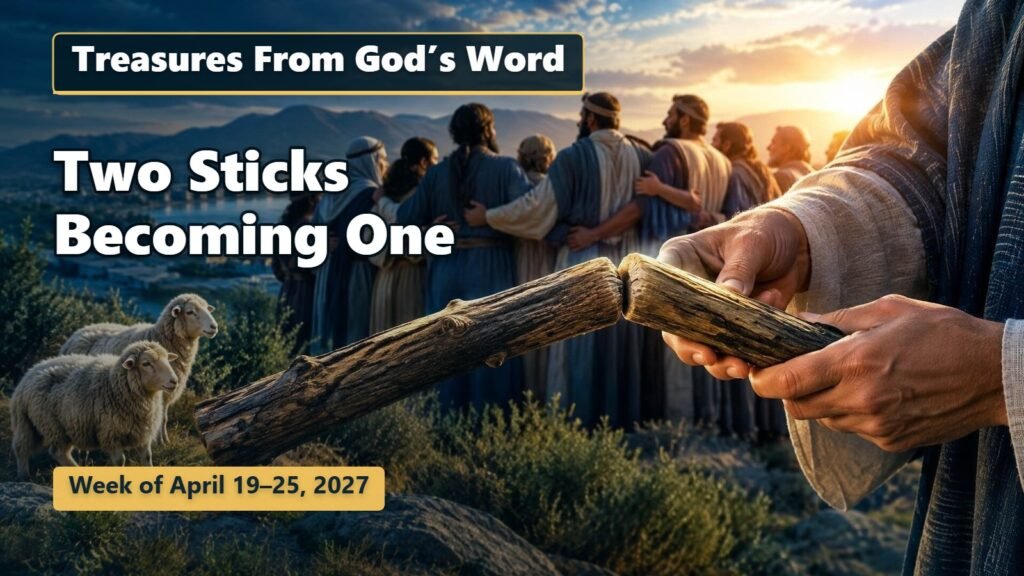
Theme: Two Sticks Becoming One
Joining two objects together can be simple. Joining people who have been separated for a long time is something very different. It is not enough to bring them together in the same place; they need to share a purpose and learn to work together. Jehovah used two sticks to show that he could accomplish precisely that with his people. That picture helps us appreciate the unity we enjoy and to ask ourselves how we can strengthen it.
To understand the meaning of that picture, let us first consider what each stick represented. They were not simply two objects with different names. They represented two kingdoms that had been part of God’s people but that were divided. Jehovah asked Ezekiel to do something very easy to observe and easy to remember. Let us read how he instructed him at Ezekiel 37:15-17.
Ezekiel 37:15-17 — The word of Jehovah again came to me, saying: “And you, son of man, take a stick and write on it, ‘For Judah and for the people of Israel who are with him.’ Then take another stick and write on it, ‘For Joseph, the stick of Ephraim, and all the house of Israel who are with him.’ Then bring them close to each other so that they become just one stick in your hand.
The stick representing Judah corresponded to the two-tribe kingdom of Judah and Benjamin. Its kings were descendants of David. In addition, this kingdom was closely connected with the priesthood, since the priests of the tribe of Levi served at the temple in Jerusalem. So when thinking about that stick, we should keep in mind both the kings of David’s family and the service of the priests.
The other stick represented the kingdom of Israel, made up of ten tribes. Why was it associated with Ephraim? Because Jeroboam, the first king of that kingdom, belonged to that tribe, and in time Ephraim became the most influential tribe in Israel. Unlike the kingdom of Judah, that kingdom included neither kings from David’s family nor priests from the tribe of Levi.
Now we understand the force of the picture more clearly. Ezekiel was to bring the sticks together in his hand. The separation would not last forever. Jehovah was announcing that those who had belonged to two kingdoms would come to be united. But bringing two sticks together was one thing; gathering a scattered people was quite another. Who could accomplish it? The explanation that Jehovah gave next answers that question.
The promised unity would not depend merely on the exiles’ willingness or ability. Jehovah himself would make it possible. Let us pay attention to who performs the action and in whose hand the sticks would be united. Let us read Ezekiel 37:19.
Ezekiel 37:19 — tell them, ‘This is what the Sovereign Lord Jehovah says: “I will take the stick of Joseph, which is in the hand of Ephraim, and the tribes of Israel who are with him, and I will join them to the stick of Judah; and I will make them one stick, and they will become one in my hand.”’
In the picture, the sticks were in Ezekiel’s hand. In the explanation, Jehovah indicated that they would be united in his own hand. That detail directs attention to the true one responsible for the reunification. From a human standpoint, freeing the exiled Jews and bringing them together again seemed completely impossible. However, Jehovah was not expressing a wish. He was announcing what he would do, and he fulfilled his word.
The captivity in Babylon ended in 537 B.C.E. Later, Jews from both kingdoms came to Jerusalem to help restore pure worship. Among those who settled there were descendants of Judah, Benjamin, Ephraim, and Manasseh. Therefore, it was not merely the return of an isolated group. Members of both former kingdoms met again, this time to participate together in the worship of Jehovah.
Moreover, Jehovah gathered Israelites who were in various nations, not just in Babylon. In the explanation of the prophecy, he no longer presented them as two separate groups, Judah and Ephraim, but as one people, the sons of Israel. Their individual backgrounds did not have to remain a barrier. What mattered was that they all belonged to Jehovah and could work together in restoring pure worship.
Jehovah also provided them with help to remain united. He gave them spiritual shepherds, such as Zerubbabel, Jeshua, Ezra, and Nehemiah, as well as prophets who encouraged them to obey him. He also protected them from enemy schemes. He did not merely gather them; he gave them what they needed to work together. This way of caring for his people prepares us to understand the unity that Jehovah has made possible in our day.
The prophecy also helps us understand the relationship between the anointed and the other sheep. Before considering how they work together, let us listen to what Jesus said about his sheep and the unity that would exist among them. Let us read John 10:16.
John 10:16 — “And I have other sheep, which are not of this fold; those too I must bring in, and they will listen to my voice, and they will become one flock, one shepherd.
Jesus did not describe two groups that would continue along independent paths. Although he spoke of other sheep that did not belong to the same fold, he explained that all of them would listen to his voice and be under his care. This supports the central idea of the prophecy: Jehovah unites his servants. The anointed, who have the hope of living in heaven, are like the stick representing Judah, the tribe from which the kings were chosen.
For their part, those who hope to live on earth are like the stick of Ephraim. Jehovah has united both groups so that they may serve under their one King, Christ Jesus. Their different hopes do not make them separate communities. Each year they attend the Memorial as members of the same flock, under the care of the same Shepherd. They share in the worship of Jehovah and work in unity.
That unity deserves more than our admiration. It deserves our care. So let us ask ourselves: What can I do to make my congregation more united? We can start with something as ordinary as our conversations before and after the meetings. If we always talk with the same people, we could make it a goal to approach someone with whom we have less contact as well. Listening to that person with interest can help us get to know him or her better and strengthen our friendship.
We can also strengthen unity by preaching with brothers of different ages or circumstances. Rather than focusing only on how different we are, we can value what we share: the desire to serve Jehovah and follow Jesus’ direction. And if a difference of opinion arises over a personal matter, we can ask ourselves whether it really deserves to create distance. Caring for unity means not allowing our preferences to become more important than our brothers.
Let us think of one specific action we can take this week: approach a brother, invite him to go preaching, or listen to him more attentively. We do not have to wait for someone else to take the first step. If Jehovah has done so much to unite his people, each of us has good reason to contribute so that this unity can be seen in the congregation.
The two sticks convey a simple yet powerful lesson: Jehovah can unite his people and give them what they need to remain united. He did so with the Israelites, and we see it today among the anointed and the other sheep. Let us value that unity and care for it by our words, our decisions, and the way we treat each brother.
More posts for this week




Enjoy every Premium feature
More convenient meeting preparation with full access to the site’s tools.
- Ad-free browsing
- My Recorder and live transcription
- Assignment Review
- Full Academy access
- Audio posts and reading magnifier
- Premium comments
- Saved and synced comments
- Support the project and help keep it running
Monthly plan
€3 per monthRenews monthly. Cancel at any time.
Choose monthlyAnnual plan
€30 per yearOne payment for 12 months. No automatic renewal.
Choose annual


